PATHWAYS OF HAIR BREAKAGE 243 critical to breakage. So during combing, when a snag is encountered, and a single hair is impacted or pulled/stressed against another object, the smaller that object (hair over hair versus hair over thin or thick comb tooth), the more readily the hair will break. CONCLUSIONS By examining photographs of snags and the resultant hair-on-hair arrangements and interactions, three pathways for hair breakage were described. Compression loads during combing were estimated by combing hair tresses with a comb fitted with a miniature compression cell and by comparing impact loading of a hair fiber over another hair versus over a comb tooth. The results of these experiments show that compression and abrasion are important to breakage during combing and that impact loading of hairs over other hairs during snagging is a likely route for hair breakage. This preliminary conclusion, based on a few impact loading experiments, will be followed up in a subsequent publication focusing more on the impact loading of hair fibers, to try to more fully assess its relevance to hair breakage during combing. REFERENCES (1) Y. K. Karnath and H.-D. Weigmann, Fractography of human hair,]. Appl. Polym. Sci., 27, 3809-3833 (1982). (2) Y. K, Karnath, S. B. Hornby, and H.-D. Weigmann, Mechanical and fractographic behavior of Ne groid hair,]. Soc. Cosmet. Chem., 35, 21-43 (1984). (3) A. C. Brown and J. A. Swift, Hair breakage: The scanning electron microscope as a diagnostic tool,]. Soc. Cosmet. Chem., 26, 289-299 (1975). (4) J. A. Swift, The mechanics of fracture of human hair, Int.]. CoS1net. Sci., 21, 227-239 (1999). (5) C.R. Robbins, Chemical and Physical Behavior of Human Hair, 4th ed. (Springer-Verlag, New York, 2002), pp. 256, 390. (6) W. Hamburger, H. M. Morgan, and M. M. Platt, Some aspects of the mechanical behavior of hair, Proc. Sci. Sect. TGA, 14, 10-16 (1950). (7a) N. P. Khumalo et al., What is normal black African hair? A light and scanning electron-microscopic study,]. Am. Acad. Dermatol., 43, 814 (2000). (76) M. L. Garcia and J. Diaz, Combability measurements on human hair,]. Soc. Cosmet. Chem., 27, 379-398 (1976). (8) G. V. Scott, Colgate Palmolive Internal Report, June 25, 1974. (9) M. L. Tate, Y. K. Karnath, S. B. Ruetsch, and H.-D. Weigmann, Quantification and prevention of hair damage,]. Soc. Cosmet. Chem., 44, 347-373 (1993). (10) P. Alexander et al, Wool: Its Chemistry and Physics, 2nd ed. (Franklin Publishing Company, New Jersey, 1963), pp. 61-65. (11) C.R. Robbins, Chemical and Physical Behavior of Human Hair, 4th ed. (Springer-Verlag, New York, 2002), pp. 168-171. (12) C. R. Robbins, Ibid, pp. 398-399 (2002).

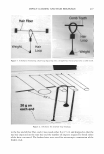
]. Cosmet. Sci.) 54, 245-257 (May/June 2006) Hair breakage during combing. II. Impact loading and hair breakage CLARENCE ROBBINS, 12425 Lake Ridge Circle) Clermont) FL 34711. Accepted for publication January 4, 2006. Synopsis During combing of hair, short fiber fragmentation (less than 2. 5 cm) and longer segment breaks occur by different pathways. Longer fiber breaks most likely occur principally by impact loading. Impact loading causes hair breakage at lower loads than tensile loading, with essentially no increase in strain versus normal tensile testing, which produces large strain increases. Strain rates in impact loading are more similar to combing rates than rates of extension in tensile loading, and the looped and crossed hair formations in snags fit impact-load breakage better than simple extension of straight/non-crossed hairs in tensile testing. Extension or impacting hair fibers with flaws or damaged hair sections such as damaged wrapped ends produces short fiber fragmentation, while longer segment breaks may be produced in fibers with natural flaws such as fiber twists, cracks, or badly abraded or chemically weakened hair or even knots. INTRODUCTION The objective of this work was to provide a better understanding of how human hair fibers break during combing or brushing, with the hope of ultimately leading to approaches for assessing the strength of hair fibers under conditions that are relevant to actual hair breakage. In the first paper in this series (1), hair snags were examined to determine the important hair-on-hair versus hair-on-comb arrangements and interac tions that might be involved in breakage. In addition, the inadequacies of tensile testing for explaining hair breakage on live heads were presented, and one impact-loading experiment was reported, suggesting that impact loading may be more relevant to breakage then simple tensile loading, a conclusion consistent with the observation by Brown and Swift about 30 years ago (2) that hair breakage on the head "is more complex than simple tensile fracture of single hairs." The focus of this paper is to explore additional variables via impact-loading experiments with hair fibers and to examine the ends of hairs broken by combing and impact loading to try to determine those condi tions most relevant to breakage during the combing of hair. EXPERIMENTAL The hair used in all of these experiments was purchased as 12-inch dark-brown virgin 245
Purchased for the exclusive use of nofirst nolast (unknown)
From: SCC Media Library & Resource Center (library.scconline.org)