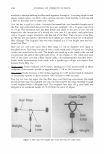
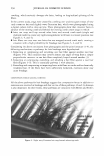
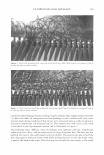
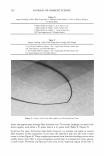
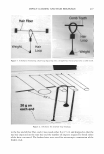
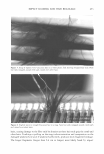
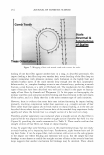
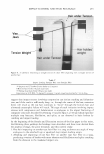
256 JOURNAL OF COSMETIC SCIENCE 3. Extension or impacting hair fibers (a) with flaws or damaged hair sections, resulting in short-fiber fragmentation on damaged ends, (b) with natural flaws such as fiber twists (2) or cracks, or (c) in chemically weakened hair or even knots. The first two pathways above apply to the breakage of longer fiber fragments and the third pathway pertains to short-fiber fragmentation and fragmentation of hairs that contain natural flaws, knots (see below), or have been badly damaged by other routes. BREAKAGE BY KNOTS Hair fibers were looped into a knot near the middle of 14-inch hairs and impact loaded with a 31- or 21-gram load using a 15-cm drop. All fibers broke on the first impact, compared to control hairs with no knots, which did not break on the first impact. The breakage of knots often occurred leaving one end of the break with a hook or curl near one of the broken ends, and this hook could be seen with the naked eye, but the fractured end usually contained a smooth fracture when observed microscopically. This result suggests that severe bending (under these conditions) as in a knot tends to promote smooth fractures. The relevance of knots to hair breakage is described in a paper by Khumalo et al. (6) in which these scientists found only 0.15% of Caucasian and Asian hair with knots, but found 13% of African hair with knots, suggesting that knots are not important to the breakage of Asian or Caucasian hair, which is not highly curled or coiled. However, it is more relevant to African hair or highly coiled hair such as highly coiled permanent waved hair. CONCLUSIONS During the combing of hair, short-fiber fragmentation (less than 2.5 cm) and longer segment breaks occur by different mechanisms. Longer fiber breaks generally occur by impact loading of one hair against another hair in a snag. Impact loading causes hair breakage at lower loads than normal tensile testing, with essentially no increase in strain versus tensile loading, which produces large strain increases. Strain rates in impact loading are more similar to combing rates than rates of extension in tensile loading, and the looped and crossed hair formations in snags fit impact-load breakage better than simple extension of straight/non-crossed hairs in tensile testing. Therefore, the conclu sion is that hair fibers break during combing by pathways that are more complex and completely different from tensile-test conditions, similar to the conclusion offered by Brown and Swift more than 30 years ago (2). Furthermore, hairs on live heads break more frequently from conditions more similar to impact loading involving hair-on-hair interactions than by tensile loading. Extension or impacting hair fibers with flaws or damaged hair sections such as damaged wrapped ends produces short-fiber fragmenta tion, while longer segment breaks of damaged hair may be produced in fibers with natural flaws such as fiber twists or cracks or in badly abraded or chemically weakened hair or even knots. REFERENCES (1) C. Robbins, Hair breakage during combing: I. Pathways of breakage,]. Cosmet. Sci., 57, 233-243 (2006).

IMPACT LOADING AND HAIR BREAKAGE 257 (2) A. C. Brown and J. A. Swift, Hair breakage: The scanning electron microscope as a diagnostic tool, ]. Soc. Cosmet. Chem., 26, 289-299 (1975). (3) Y. K. Karnath and H.-D. Weigmann, Fractography of human hair,]. Appl. Polym. Sci., 27, 3809-3833 (1982). (4) Y. K. Karnath, S. B. Hornby, and H.-D. Weigmann, Mechanical and fractographic behavior of Ne groid hair,]. Soc. Cosmet. Chem., 35, 21-43 (1984). (5) J. Alan Swift, The mechanics of fracture of human hair, Int.]. Connet. Sci., 21, 227-239 (1999). (6) N. P. Khumalo et al., What is normal black African hair? A light and scanning electron-microscopic study,]. Am. Acad. Dermatol., 43, 814 (2000). (7) D. C. Fleming, Modeling Delamination Growth in Composites Using MSC. Dytran, Florida Institute of Technology, Department of Mechanical and Aerospace Engineering (dfleming@fit.edu). (8) K. Q. Qiu et al., Salient shear bands and second phase addition interactions of bulk metallic glass matrix composites, Metallurgical and Materials Transactions A 34, A, 1147-1154 (2003).
Purchased for the exclusive use of nofirst nolast (unknown)
From: SCC Media Library & Resource Center (library.scconline.org)