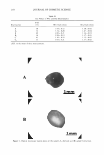
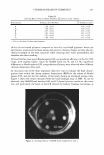
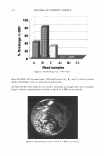
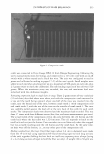
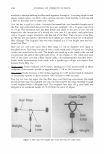
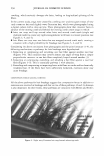
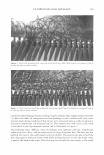
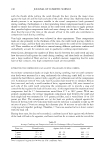
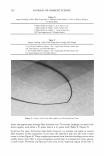
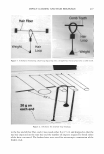
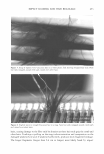
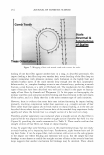
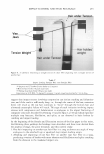
248 JOURNAL OF COSMETIC SCIENCE EQUALIZED-LOOP EXPERIMENTS Single hair loops were formed from a 14-inch hair fiber with the ends taped together 5 cm apart, forming an arch. The hair was folded back onto itself at each end and bound by tape to prevent slippage, using several 4 x 4-cm-long sections of tape to hold the fiber securely. These hair loops were taped to the 15-cm single-strand plastic-coated copper wire at the center of the tape, and the wire was formed into a hook at the free end to attach weights ranging from 10 to 50 grams (total weight 11 to 51 grams). These hair loops were individually impacted over a comb tooth or another hair similar to the attached loop setup (Figure 3 ). MICROSCOPE EXPERIMENTS Broken segments of hair fibers from all of the above experiments were collected and either put into small bottles (shorter fragments), which were labeled, or the longer segments were collected and the fibers labeled. The ends of the hairs were placed on a microscope slide with a cover slip and one to two drops of Cargille Immersion oil, Type A, were allowed to flow under the cover slip to cover the hair prior to examination under a Trinocular Phase Accu-Scope fitted with a Nikon D-100 digital camera. RESULTS AND DISCUSSION In Part I of this series (1) and from the prior literature (2-5) and this paper, the following mechanisms or pathways for hair breakage were hypothesized: 1. Impacting or compressing and extending one hair fiber against another taut hair. This condition may involve any angle of wrap from a simple perpendicular crossover to a hair fiber completely looped around another (2). 2. Impacting or compressing, extending, and abrading a hair fiber against a taut hair this may be pictured as pathway 1 with abrasion. 3. Extending and compressing or impacting hairs with flaws or cracks and/or chemically weakened hair. If a hair is sufficiently weakened, extension alone may cause breakage. Short-fiber fragmentation of wrapped hair ends is likely the most common subset of this type of breakage, with hairs that contain knots a less common subset (6). IMP ACT-LOADING EXPERIMENTS Most of the impact-loading experiments reported in this paper were of two types and are described as attached loop or equalized loop in the Experimental section. In the attached loop experiments, one end of a hair fiber is held firmly and the free end is impacted over a straight section of another hair fiber that is held either between two vises or strung taut over comb teeth (Figure 2). The top hair fiber has a weight attached to its free end, and the weight is raised and dropped so that the top hair impacts on the taut hair (bottom hair) and the number of impacts required to break at a fixed load are noted. In a slightly different version of this experiment, called the equalized-loop experiment, a single hair loop or arch with weights attached is impacted over a comb tooth or another hair similar to the attached loop setup (see Figure 3 and the Experimental section for details). The first paper in this series (1) showed that hair fibers break more easily by impact

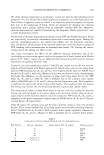
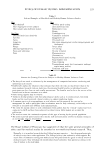
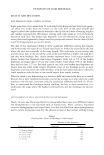
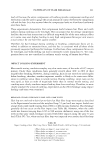
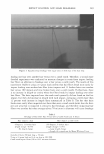
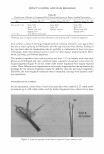
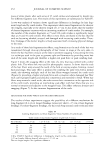
IMPACT LOADING AND HAIR BREAKAGE 249 Figure 3. Equalized-loop breakage with equal stress on both legs of the hair loop. loading one hair over another hair versus over a comb tooth. Therefore, a second more detailed experiment was conducted to measure changes in strain from impact loading hair fibers in addition to breakage over a hair versus a comb tooth. The results of this experiment (Table I) using a 33-gram load confirm that hair fibers break more easily by impact loading over another hair fiber (nine impacts and 11 broken hairs over another hair versus 109 impacts and nine broken hairs over a comb tooth). Furthermore, there is no increase in length (or strain) when the fibers break by impact loading over other hair fibers. The hairs impacted over the comb tooth generally did not break on the first impact, but they did increase in length with each impact, averaging a little more than 12 percent total increase in length (data summarized in Table I). The fact that hairs break more easily when impacted over hairs than over a comb tooth shows that the force per unit area that is impacted is critical to hair breakage, and therefore impacting hair fibers over another hair that averages about 70 microns in diameter will cause breakage Table I Breakage of Hair Over Hair Versus Over a Comb Tooth and % Strain Hair impacts a hair 9 Impacts, 11 broken hairs Length change -0.64% -No length change Initially all hairs 200 mm long ± 20 mm. Hair impacts a comb tooth 109 Impacts, 9 broken hairs Length change + 12.4% -Large length change -Length dis significant by Mann-Whitney U-test Using a 33-gram load and 3-4-cm drop at 40% RH. Comb tooth tapered from 940 to 1245 microns thickness.
Purchased for the exclusive use of nofirst nolast (unknown)
From: SCC Media Library & Resource Center (library.scconline.org)