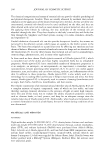
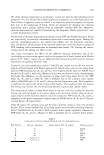
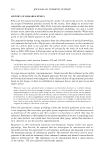
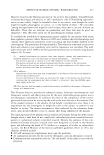
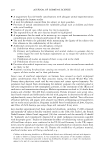
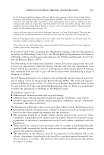
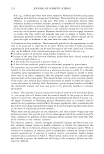
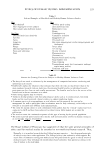
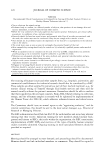
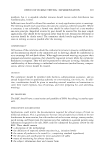
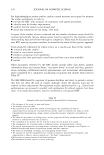
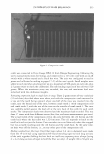
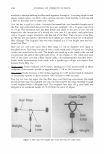
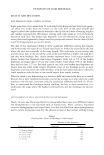
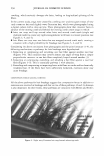
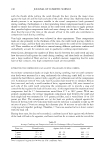
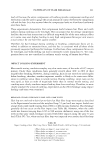
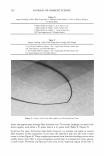
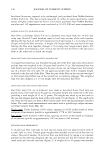
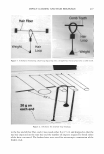
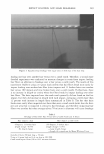
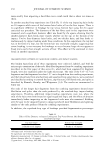
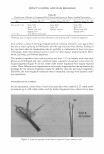
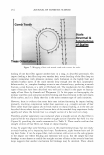
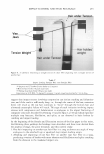
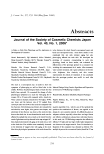
254 JOURNAL OF COSMETIC SCIENCE Comb Tooth · · ··· · ······ ···· -....... Scale eversal & Inter ockinq of Scales Fi g ure 7. Wrapping of hair ends around comb teeth reverses the scales. loading of one hair fiber against another hair in a snag, as described previously. On impact loading a hair fiber loop over another hair, severe bending of the fiber loop on impact (sometimes with abrasion) initiates crack formation in the highly bent and extended surfa�e layers. If the crack extends deep enough into the hair, catastrophic failure results, i.e., complete breakage occurs in one of several ways, producing a smooth fracture, a step fracture, or a split or fibrillated end. The mechanisms for the different types of fractures have been described very well and in detail in the paper on fractog raphy of hair fibers by Karnath and W eigmann (3 ). In this paper on fractography, the primary route for crack initiation involves bending and thus extension in the outer layers of the surface, and it is likely that this is the most common type of crack initiation. However, there is evidence that some hairs may initiate fracturing by impact loading primarily involving compression rather than extension, e.g., straight sections of hair fibers rather than loops appear also to break readily on impact loading, as in the one case described above where the top and bottom hairs of the attached-loop experiment broke equally and where the bottom hair is a straight section of a hair and not a loop. Therefore, another experiment was conducted where a straight section of a hair fiber in a special holder was impacted onto another straight section of another hair held in a vise (Figure 8), providing the results summarized in Table V. These results confirm that straight sections of hair fibers can break on impact loading. It may be argued that some bending occurs in this experimental setup, but not nearly as much bending as by impacting hair loops. Furthermore, eight bottom hairs and 16 top hairs broke. It can be argued that crack initiation still occurs on the side opposite to the impact site where bending and extension will occur, but the simple fact that breakage occurs almost as readily for straight sections of hairs as for severely bent hair loops suggests that another mechanism for breakage may be involved. These details

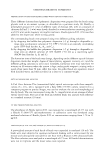
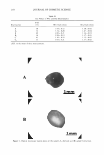
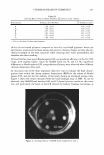
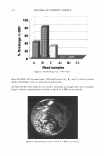
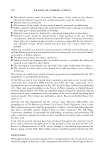
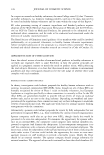
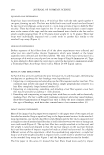
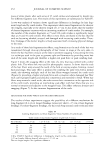
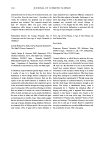
IMPACT LOADING AND HAIR BREAKAGE 255 : rfair under Tension Vise ....•····· · .... •·- Jaws ·············· ·· Tension Weighr ··············· i Hair under Jension ········ ..Hair holder/ weight Figure 8. A schematic illustrating a straight section of a hair fiber impacting over a straight section of another hair. Table V Impact Loading Straight Hair onto Straight Hair 26 Impacts and 27 breaks (2 hairs broke on 1 impact). 8 Bottom hairs broke ( l 0-gram taut load). 19 Falling (top) hairs broke (30-gm taut load). Experiment at 41 % RH, 72 degrees F, using an 11-gram impacting load and a 7-8-cm drop. suggest that impact stresses involving compression can initiate cracking and delamina tion, and if the crack is sufficiently deep, i.e., through the center of the hair, extension forces will result as the top hair continues to "move" through the bottom hair and ultimately catastrophic failure will result. This type of crack initiation involving impact stresses with compression and delamination is analogous to the impact fracturing of composite structures described by Fleming (7) and by Qiu et al. (8) and should produce multiple step fractures, fibrillation, and splits, as are observed in hairs broken by combing and impact loading. At the beginning of the Results and Discussion section of the first paper in this series, the following three pathways for breakage were described, and these were derived from the analysis of snags, the prior literature, and this current study: 1. One hair impacting on another taut hair fiber in a snag at almost any angle of wrap analogous to the attached-loop or equalized-loop impact-loading setups. 2. Abrading and impacting of one hair fiber on another taut hair fiber in a snag, producing a variety of breaks with more abrasion and fibrillation and splits resulting from the abrasion to the weakened impact site.
Purchased for the exclusive use of nofirst nolast (unknown)
From: SCC Media Library & Resource Center (library.scconline.org)