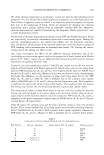
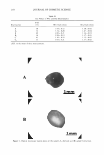
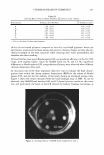
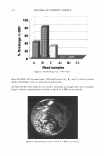
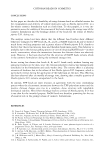
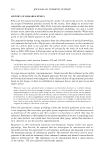
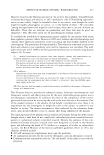
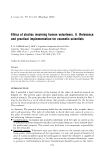
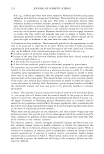
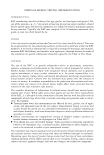
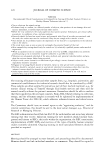
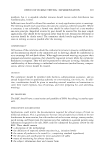
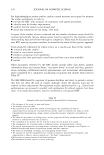
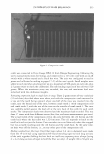
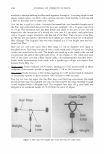
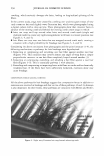
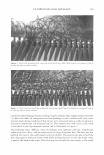
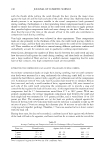
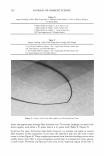
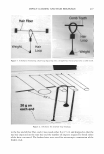
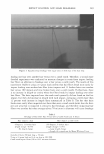
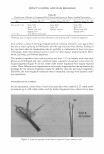
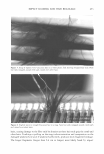
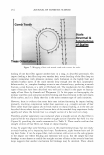
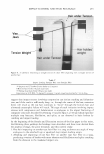
PATHWAYS OF HAIR BREAKAGE 239 Figure 4. Very curly Caucasian hair snag underneath advancing comb. Note looped and crossover hairs at or near the hair-to-comb interface. Figure 5. Very curly Caucasian hair underneath advancing comb. Note the looped and crossover hairs at or near the hair-to-comb interface. conclusion that breakage during combing is more complex than simple tensile extension (3). Since the effect of compression on hair breakage is not a widely held view, com pression loads during combing of hair tresses were measured using a comb containing a miniature compression cell mounted onto it. The compression comb used in this work is described in the Experimental section and is illustrated in Figure 1. The following three different ways of combing were explored with the compression comb using two-, four-, and six-gram tresses of virgin Caucasian hair: The first way was holding the tress in the comb loosely with the thumb. The second way was to hold the hair snug against the back of the comb while pulling the hair so that the major stress is against the back of the comb. The third way was to hold the tress snugly in the comb

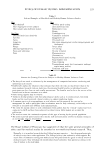
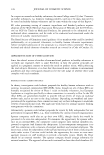
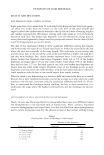
240 JOURNAL OF COSMETIC SCIENCE with the thumb while pulling the comb through the hair, placing the major stress against the load cell and the back and side of the comb. These data (Table II) show that thumb pressure is an important variable in the actual compression loads generated during combing. Furthermore, it is best (providing lowest compression loads) to use the thumb to ensure that all hairs remain in the comb teeth rather than to apply pressure that provides higher compression loads and more damage to the hair. These data also show that the size of the tress or the amount of hair in the comb also contributes to compression loads during combing. Very high compression loads were achieved in these experiments. These compression loads are due primarily to the thickness of the tress, the comb teeth spacing, which in this case is large, and how hard one presses the hair against the comb or the compression cell. These variables are all difficult to control among different qualitative combers and undoubtedly account for variations seen in qualitative combing experimentation. These factors determine the number of fibers that fit between the comb teeth and also how the tress is held against the comb during combing, and these loads are distributed over a large number of fibers and not in a uniform manner, suggesting that for some hair-on-hair contacts, very high compression loads are encountered. ESTIMATING THE COMPRESSION LOAD AGAINST SINGLE HAIRS DURING COMBING To estimate compression loads on single hairs during combing, hair-on-comb compres sion loads were measured in a snag underneath the advancing comb held in a vise to control the hair fibers in contact with a specific part (of known size) of the compression cell. A miniature trees of very curly hair (Caucasian hair steam-set to simulate African hair) was used, and only a small number of hairs, approximately 100, were inserted on each side of the comb tooth containing the compression cell to provide a snag and control the hair against the load cell button only. In this experiment the maximum total compression load for 17 determinations varied from 271 to 1867 grams. With two primary assumptions, the average maximum compression load between the comb and each single hair was estimated at 39.5 grams per fiber, and it varied from 16 to 110 grams per fiber. The assumptions are: (a) the hairs are perfectly aligned against the button of the load cell (1524 microns wide) and (6) each hair is assumed to take up 90 microns of space (70-micron average hair diameter plus 10 microns on each side for hair crimping and imperfect packing). Therefore, 17 hairs are assumed to be in direct contact with the load cell. During these runs, for data to be recorded, a uniform layer of hairs against only the button of the load cell had to be apparent, and hairs could not be in contact with the rest of the Table II Average Combing and Compression Loads for Undamaged Wavy Caucasian Hair Tress size Thumb loosely Against back of comb 2-gram 22 ± 11 80 ± 50 4-gram 56 ± 20 290 ± 82 6-gram 205 ± 82 889 ± 316 Date is expressed in gram load within the 95% confidence limit. Against cell 449 ± 111 602 ± 196 994±231
Purchased for the exclusive use of nofirst nolast (unknown)
From: SCC Media Library & Resource Center (library.scconline.org)