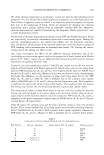
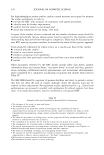
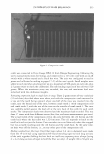
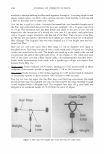
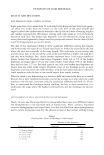
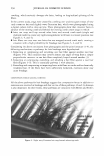
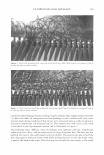
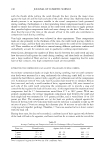
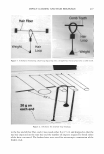
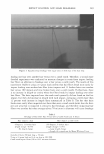
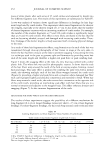
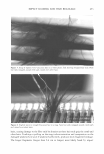
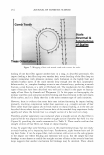
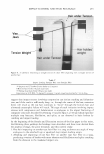
IMPACT LOADING AND HAIR BREAKAGE 249 Figure 3. Equalized-loop breakage with equal stress on both legs of the hair loop. loading one hair over another hair versus over a comb tooth. Therefore, a second more detailed experiment was conducted to measure changes in strain from impact loading hair fibers in addition to breakage over a hair versus a comb tooth. The results of this experiment (Table I) using a 33-gram load confirm that hair fibers break more easily by impact loading over another hair fiber (nine impacts and 11 broken hairs over another hair versus 109 impacts and nine broken hairs over a comb tooth). Furthermore, there is no increase in length (or strain) when the fibers break by impact loading over other hair fibers. The hairs impacted over the comb tooth generally did not break on the first impact, but they did increase in length with each impact, averaging a little more than 12 percent total increase in length (data summarized in Table I). The fact that hairs break more easily when impacted over hairs than over a comb tooth shows that the force per unit area that is impacted is critical to hair breakage, and therefore impacting hair fibers over another hair that averages about 70 microns in diameter will cause breakage Table I Breakage of Hair Over Hair Versus Over a Comb Tooth and % Strain Hair impacts a hair 9 Impacts, 11 broken hairs Length change -0.64% -No length change Initially all hairs 200 mm long ± 20 mm. Hair impacts a comb tooth 109 Impacts, 9 broken hairs Length change + 12.4% -Large length change -Length dis significant by Mann-Whitney U-test Using a 33-gram load and 3-4-cm drop at 40% RH. Comb tooth tapered from 940 to 1245 microns thickness.

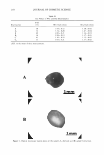
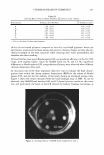
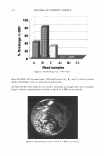
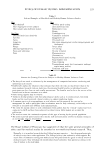
250 JOURNAL OF COSMETIC SCIENCE more readily than impacting a hair fiber over a comb tooth that is about ten times as thick. In another attached-loop experiment (see Table II), 11 of the top impacting hairs broke on 16 impacts while seven of the bottom hairs broke, all on the first impact. There is no significant difference in breakage by top versus bottom hair using the chi square statistical test procedure. The diameters of the hair fibers used in this experiment were measured, and a significant diameter effect was found by chi square, showing that the smaller-diameter hairs break more readily whether on the top or the bottom of the impact. Twelve finer-diameter hairs broke, and two thicker hairs, and four broke si multaneously by impact loading under these conditions. In this experiment, the top hair was in the form of a loop, but the bottom hair was essentially straight, suggesting that severe bending is not necessary for breakage to occur because loops do not appear to break more easily than straight sections of hair. This effect will be examined in more detail in another experiment. FRAGMENTATION PATTERNS OF HAIRS FROM COMBING AND IMPACT LOADING The broken hairs from all of these experiments were collected, labeled, and held for microscopic examination of the ends. Hair fiber fragments from the combing experiment described in the first paper of this series (1), which had been separated by fragment length, were also examined under the light microscope. The ends of the 6.35-12.7-cm fragments and the fragments less than 1.27 cm in length from the combing experiment, and the broken hairs from attached-loop and equalized-loop experiments, were examined and classified according to smooth fractures, step fractures, fibrillated ends, and splits as described by Karnath, Hornby, and W eigmann (3 ,4). The results are summarized in Table III. The ends of the longer hair fragments from the combing experiment showed more fibrillation and splits than the ends produced by the attached-loop impact-loading experiments. Therefore, additional impact-loading experiments were run, where the ends of the hairs were both bound or equal (equalized loop), and the effects of abrasion immediately before impacting on the fragmented ends were also examined. Rubbing over the spot (to be impacted) prior to impact produced more fibrillation and splitting similar to the ends produced from the combing experiments. In addition, the equalized-loop type of breakage provided fragmentation percentages Table II Effect of Fiber Diameter on Impact Loading and Top-Versus-Bottom Hair Breakage (attached-loop setup) Top hair (loop) Bottom hair (straight) 11 Breaks of 16 impacts 7 Breaks of 16 impacts 16 Impacts and 18 broken hairs (above). No significant top-vs-bottom effect by chi square. Diameters measured and 12 thinner-vs-thicker broke, 2 thicker broke, and 2 broke simultaneously (sig nificant diameter effect by chi square). 33-gram load, 3-4-cm drop, 40% RH, fibers 200 ± 20 mm.
Purchased for the exclusive use of nofirst nolast (unknown)
From: SCC Media Library & Resource Center (library.scconline.org)