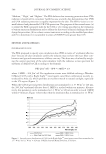
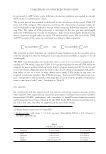
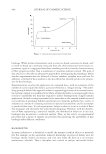
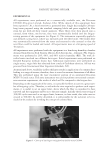
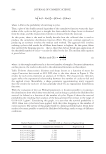
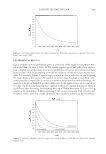
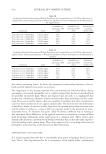
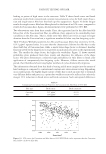
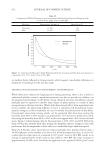
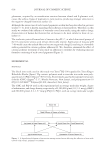
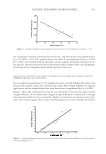
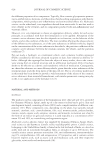
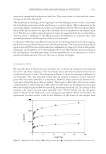
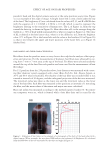
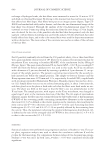
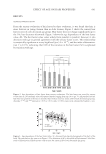
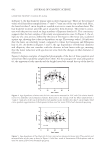
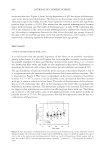
JOURNAL OF COSMETIC SCIENCE 600 breakage. While technical parameters such as stress-to-break, extension-to-break, and/ or work-to-break are commonly extracted from the afore-mentioned stress-strain ex- periments, again it is suggested that these variables provide a scientifi c characterization of fi ber properties rather than a simulation of consumer-relevant stimuli. The goal of this article is to describe an alternative approach for investigating hair breakage, which involves experiments that are believed to better simulate everyday wear and tear. In addition, a method of data analysis is also described that literally predicts the propen- sity for hair breakage. Experimentation involves the application of a repeated force, with an evaluation of the number of cycles required for failure, a process referred to as “fatigue testing.” The under- lying principle behind this approach relates to repeated application of an external stimu- lus, leaving a sample in a weakened state where, ultimately, failure occurs upon application of a force considerably less than that required to induce breakage from a single stimulus application. As such, testing is presumed to be more akin to the external stimuli received over a lifetime of grooming. Similar experiments are commonly performed in a variety of industries as a means of evaluating resistance to repeated external force and in an attempt to predict failure rates. In such experiments, failure is taken to occur as a result of fl aws that propagate and ultimately fail with repeated fatiguing. Therefore, with the distribu- tion of fl aws representing a statistical variable, the likelihood of failure (or in our case, breakage) also necessitates a statistical analysis. Thus, in this article, an experimental procedure and a means of analysis are presented for predicting the probability of hair breakage under different conditions. BACKGROUND In many industries it is benefi cial to model the manner in which objects or materials fail. For example, in the automobile industry, knowledge of projected failure rates for bearings, shocks, brakes, electronics, and even tires forms the basis of a car’s routine maintenance schedule. Thus a discipline has evolved to analyze and model failure Figure 1. Typical stress-strain curve for dry hair.

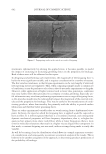
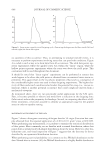
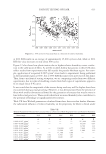
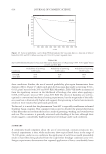
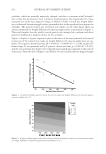
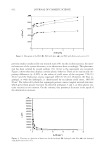
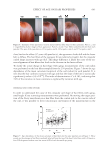
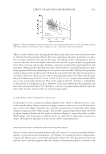
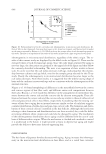
FATIGUE TESTING OF HAIR 601 events. Such work is often termed reliability statistics or survival probability. In this work, the objective has been to model the propensity for hair breakage under repeated fatigu- ing forces—a process that is proposed to better mimic the stimuli received during conventional grooming. Applications of fatigue testing are known in the textile indus- try and in the evaluation of other fi brous materials (1), although the approach has re- ceived only minor attention in the hair science literature. Previously, members of our Institute described microscopic analysis of fracture patterns obtained after performing such tests on a homemade device (2). Meanwhile, a parallel can be drawn between re- peated application of an extensional force and the repeated application of a frictional force, as is used in fl exabraison experiments (3). It is also possible to think of repeated combing experiments (4–6) as a version of a fatigue experiment. The work described here relates to experiments performed on a commercially available unit, the Dia-stron CYC800 (Dia-stron Limited, Andover, UK). This equipment has been described previ- ously (7,8), in articles where the primary focus was to describe new commercial instru- mentation. The purpose of this paper is to provide guidance in designing and performing such experiments, in addition to describing and illustrating the novel na- ture of the data analysis. In similar applications of fatigue testing involving other fi brous materials, it is taken that breakage occurs as a result of propagating fl aws that ultimately result in failure of the fi - ber. Such fl aws are generally thought to be at the surface—that is, in a homogeneous fi - brous material, the surface represents a greater area than the bulk, and consequently there is a higher likelihood of these fl aws being present at the surface. As such, failure is taken to be virtually independent of fi ber thickness and, instead, the fi ber length is considered more important. That is, there is a higher likelihood for such fl aws to exist in a long fi ber compared to a shorter one. Some issues arise in thinking about hair in the same manner. First, unlike many synthetic fi bers, hair does not have a homogeneous structure. It is well recognized that the surface of hair consists of a hard, resistant cuticle layer that protects the inner portions but has no signifi cant contribution to the tensile strength (9). Instead, the inner cortex structure is responsible for the bulk of the strength. Therefore, propagat- ing surface cracks would not be expected to result in fi ber breakage and, consequently, failure must be considered a result of bulk fl aws. Microscopic analysis of fi bers that have been subjected to this repeated stimulus do frequently show the presence of propagating surface cracks (for example, see Figure 2), but these are not thought to be points that ultimately result in breakage. Hair also differs from many synthetic fi bers in that there is considerable variability in dimensions. Synthetic fi bers are often manufactured to high dimensional tolerance, which does not occur in natural fi bers. Therefore, use of a common fatiguing force on fi bers of varying dimension will result in a range in the applied stress (force per unit area). Fur- thermore, with differences in applied stress comes an infl uence on the number of cycles to break. That is, a fi ber is likely to fail earlier when exposed to repeated application of a higher stress. This occurrence is well recognized in fatigue testing, as will be discussed at some length. Ideally, there is the desire to apply a repeating force (or, more specifi cally, a repeating stress) that is representative of actual grooming conditions. However, this information is not readily available. As such, while these experiments appear to better simulate real-life conditions, it is not yet possible to replicate them. Nevertheless, it is possible to use the approach to compare the likelihood of breakage in hair of varying quality, or after specifi c
Purchased for the exclusive use of nofirst nolast (unknown)
From: SCC Media Library & Resource Center (library.scconline.org)