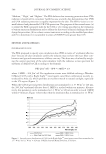
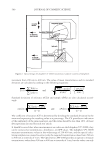
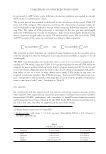
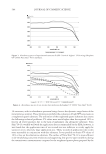
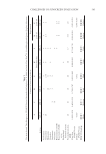
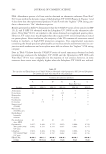
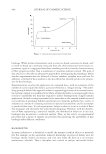
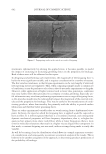
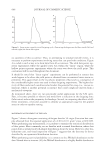
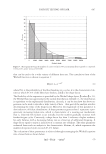
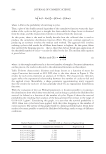
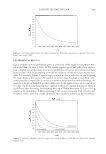
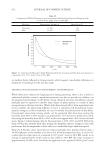
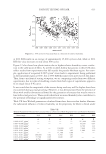
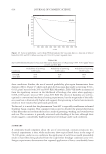
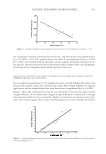
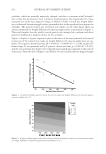
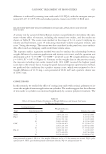
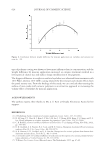
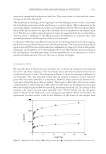
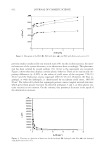
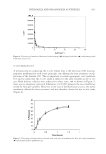
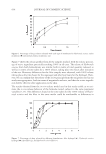
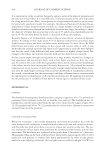
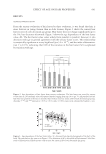
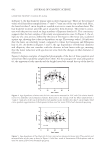
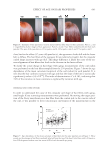
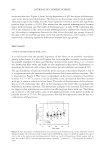
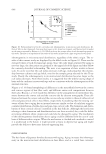
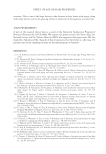
JOURNAL OF COSMETIC SCIENCE 606 no awareness of this occurrence. Thus, in attempting to simulate real-life events, it is necessary to perform experiments involving stress that can span both conditions. Figure 4 is coded in such a way as to show data from all occurrences. The solid data points rep- resent experiments where the applied stress was within the “linear” region, while the hollow points represent experiments where the stress was above the yield point. This convention will be used throughout this document. It should be noted that “linear region” experiments can be performed at stresses that would appear to be above the yield point as obtained from conventional stress-strain ex- periments. This again relates to the viscoelastic properties of hair and is a consequence of the considerably higher strain rate used in these fatiguing experiments. The higher elas- ticity of fi bers under such conditions also hinders the potential for creep (i.e., viscous re- laxation), which is another potential occurrence that could complicate matters from a mechanical viewpoint. As mentioned above, there are two potentially useful applications for the S-N curve. First, it becomes possible to observe and model how a reduction in the fatiguing force (lubrication) reduces the propensity for breakage. Second, in comparing the effects of dif- ferent treatments, it becomes possible to identify an appropriate range for the applied stress in order to expedite testing. MATHEMATICAL TREATMENT OF THE DATA Figure 7 shows a histogram consisting of fatigue data for 50 virgin Caucasian hair sam- ples obtained from the repeated application of a 0.010–0.011 g/um2 stress at 60% RH. When performing any measurement, it is prudent to examine the statistical distribution of data points. Most commonly, we are familiar with a normal distribution, where data points form a symmetrical bell-shaped distribution about the mean. However, other dis- tributions exist, and visual inspection of Figure 7 suggests that the data may be better described by an exponential distribution function. When performing survival probability it is common to fi t a Weibull distribution to the data. Named after its inventor (10), the Weibull distribution is a highly fl exible distribution Figure 6. Stress-strain curves for initial fatiguing cycle, illustrating the shapes seen for fi bers inside (left) and outside (right) the linear-like region.

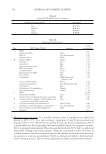
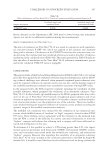
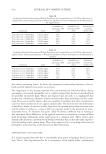
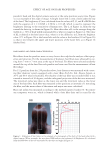
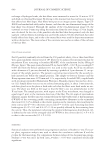
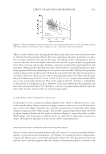
FATIGUE TESTING OF HAIR 607 that can be used to fi t a wide variety of different data sets. The cumulative form of the Weibull function is shown in equation 1: F(x) e (x/DE 1 (1) where F(x) is the probability of the fi ber breaking in x cycles, α is the characteristic life- time at which 63.5% of the fi bers have broken, and β is the shape factor. The fl exibility of the expression is provided by the Weibull shape factor, β: when β = 3.6, the Weibull function approximates the normal distribution when β = 1, the distribution is equivalent to the exponential distribution. As such, it can be seen how the above ex- pression can be used to describe a wide variety of data—thus part of the analysis involves determining the value of the shape factor. Moreover, the magnitude of this parameter is also indicative of failure distribution. A shape parameter greater than 1 represents a pro- gressively increasing failure rate, which is characteristic of a wearing-out mechanism that is, relatively few failures occur initially, but the number gradually increases with further fatigue cycles. Conversely, a shape factor less than 1 indicates a higher tendency for early failures, with a decreasing failure rate as a function of additional fatiguing. A shape factor equal to unity is indicative of a constant rate of failure. The other parameter evaluated from such an analysis is the characteristic lifetime, α, which represents the number of repeated cycles to reach 63.2% failure. The evaluation of these parameters is achieved through rearranging the Weibull equation into a linear form as shown below: ln (1 F(x)) = (x/DE (2) Figure 7. Histogram showing the number of cycles-to-fail for 50 Caucasian hair fi bers exposed to a repeated 0.010–0.011 g/um2 stress at 60% RH.
Purchased for the exclusive use of nofirst nolast (unknown)
From: SCC Media Library & Resource Center (library.scconline.org)