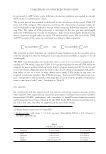
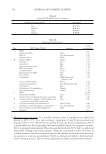
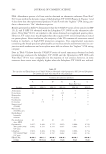
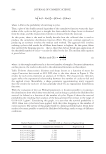
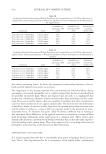
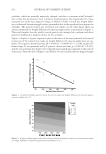
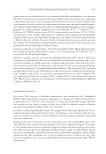
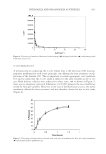
JOURNAL OF COSMETIC SCIENCE 610 that reduce grooming forces. In short, the exponential relationship between cycles-to- break and the applied stress works to our favor. The magnitude of the average repeated force encountered by individual fi bers during grooming is not readily obtainable, yet it could be argued that the forces described here are probably excessively high. This is not disputed and, for now, it is emphasized that results and calculations illustrate relative trends rather than modeling real-life condi- tions. However, as will be shown, there are a number of variables that alter circumstances such that these conditions do not appear unreasonable. The fi rst involves the dimensions of the fi bers, where calculations readily show how the squared relationship between stress and the radius of a fi ber (i.e., stress = f/πr2) can quickly result in the potential for more- reasonable forces. To illustrate this point, Table IV shows a different way of looking at this same data. Here differences in the applied stress are accounted for in terms of fi bers with decreasing dimensions under application of a common load. These results quite dramatically illustrate a problem for individuals with fi ne hair, in that this same exponen- tial relationship works against them. Thus, there appears to be a steep drop-off in survival probability with relatively small decreases in fi ber dimensions. AFRO HAIR VERSUS CAUCASIAN HAIR It is widely regarded that Afro hair is considerably more prone to breakage than Caucasian hair. This is often hypothesized to be a consequence of the highly kinky conformation Table III Probability Results Obtained from Weibull Parameters for Caucasian Hair at 60% RH as a Function of Applied Stress, Illustrating the Extent to Which the Likelihood of Survival Depends on the Magnitude of the Applied Force Conditions Stress Probability of surviving 1,000 cycles Probability of surviving 5,000 cycles Probability of surviving 10,000 cycles 52.0 g force on a 70-μm fi ber 0.0135 g/μm2 55% 4% 0% 48.1 g force on a 70-μm fi ber 0.0125 g/μm2 77% 26% 7% 44.3 g force on a 70-μm fi ber 0.0115 g/μm2 89% 62% 40% 40.4 g force on a 70-μm fi ber 0.0105 g/μm2 96% 81% 65% 36.6 g force on a 70-μm fi ber 0.0095 g/μm2 97% 91% 86% Table IV Probability Results Obtained from Weibull Parameters for Caucasian Hair at 60% RH as a Function of Applied Stress, Illustrating the Extent to Which the Likelihood of Survival Depends on the Dimensions of the Fiber Conditions Stress Probability of surviving 1,000 cycles Probability of surviving 5,000 cycles Probability of surviving 10,000 cycles 30 g force on a 63.4-μm fi ber 0.0095 g/μm2 97% 91% 86% 30 g force on a 60.3-μm fi ber 0.0105 g/μm2 96% 81% 65% 30 g force on a 57.6-μm fi ber 0.0115 g/μm2 89% 62% 40% 30 g force on a 55.3-μm fi ber 0.0125 g/μm2 77% 26% 7% 30 g force on a 53.1-μm fi ber 0.0135 g/μm2 55% 4% 0%

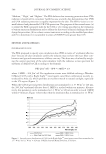
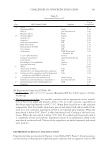
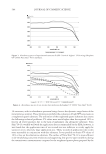
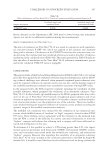
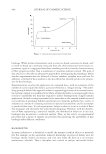
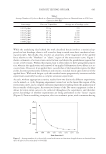
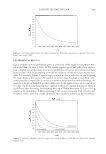
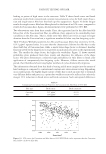
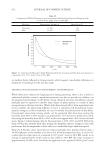
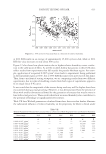
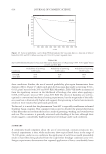
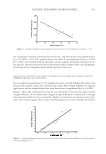
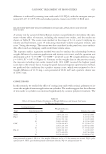
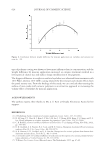
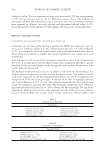
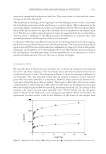
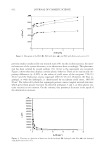
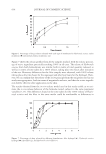
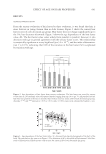
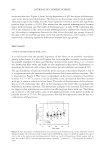
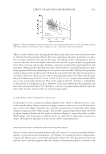
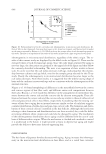
FATIGUE TESTING OF HAIR 611 leading to points of high stress in the structure. Table V shows break stress and break extension results from conventional constant-rate extension curves for both virgin Cauca- sian and single-source Afro hair that back up this supposition. Figure 10 shows fatigue results for single-source Afro hair fi bers plotted in the form of an S-N curve, compared to results for Caucasian hair. Again, all measurements were performed at 60% RH. Two observations arise from these results. First, the regression line for the Afro hair falls below that of the Caucasian hair. But, in addition, there appears to be considerably more variability in the Afro data. That is, while some Afro fi bers survive for an equal or longer duration than the Caucasian hair, a signifi cant number fail after very few fatiguing cycles. Table VI shows Weibull parameters for Afro and Caucasian fi bers that received a 0.010– 0.011 g/μm2 repeated stress. It is seen that the characteristic lifetime for Afro hair is only about half that of Caucasian hair, while a much lower shape factor is obtained. Another function served by the shape factor is to provide an indication of scatter in the experimental data. The smaller the shape factor, the higher the variability. Figure 11 shows survival probability plots produced from these results and illustrates the infl uence of the shape factor. The plots demonstrate a relatively high probability for Afro fi bers to break after application of comparatively few fatiguing cycles. However, if fi bers survive this initial period, their likelihood of surviving higher numbers of cycles dramatically improves. The information obtained from this kind of testing yields more insight into the nature of hair breakage as compared to conventional constant-rate stress-strain testing. Expanding on an earlier point, the highly fragile nature of Afro hair is such an issue that it demands very different habits and practices, a point that would not seem to be refl ected in a relatively meager 13% reduction in break stress and break extension. Such anticipated differences Table V Comparing Conventional Tensile Properties for Caucasian and Afro Hair at 60% RH Hair type Break stress Break extension Caucasian 2.07 g/μm2 45.1% Afro 1.80 g/μm2 39.3% Figure 10. S-N curves for Caucasian and Afro hair at 60% RH. Filled circles represent data for Caucasian hair hollow circles are Afro hair.
Purchased for the exclusive use of nofirst nolast (unknown)
From: SCC Media Library & Resource Center (library.scconline.org)