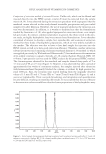
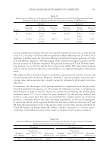
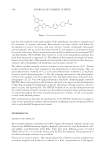
J. Cosmet. Sci., 61, 343–352 (September/October 2010) 343 Assessment of styling performance in hair gels and hair sprays by means of a new two-point stiffness test PETER HOESSEL, SOLVEIG RIEMANN, ROBERT KNEBL, JENS SCHROEDER, GERD SCHUH, and CATALINA CASTILLO*, BASF SE, 67056 Ludwigshafen, Germany. Accepted for publication June 15, 2010. Synopsis A new two-point bending stiffness method on fl at hair strands was developed and validated after application of hair styling gels and hair styling sprays. A special mold was used to align single hair fi bers after applying the formulations to the hair. The styling gels used contain different commercially available thickeners and styling polymers, e.g., car- bomer, acrylates/beheneth-25 methacrylate copolymer, Polyquaternium-86, PVP, VP/VA copolymers, and VP/methacrylamide/vinylimidazole copolymer. Evaluation of hair sprays was performed after spray applica- tion on fl at hair strands. Commercially available hair styling resins were used, e.g. acrylates/t-butylacrylamide copolymer, octylacrylamide/acrylates/butylaminoethyl methacrylate copolymer, and VP/VA copolymer (30:70). The new stiffness test method provided the best correlation with practically relevant sensory assessments on hair strands and a panel test in which styling gels were evaluated. However, we did not observe a correlation between the new stiffness method on fl at hair strands and practical assessments in hair spray application. We postulate that different polymer/hair composites are responsible for these discrepancies. Hairs on model heads for half-side testing are spot-welded after spray application, while hairs are seam-welded in the stiffness test after alignment of single hair fi bers. This alignment is necessary to achieve reproducible results. INTRODUCTION Hair gels and sprays have a high rank among styling products. Gels are favored for short hair styles and are particularly used by men, while sprays are used by women with long hair. However, styling products differ in composition, especially in the polymers used. In order to tailor properties such as fi xative power, wash-out, and elasticity, polymers are developed by a smart choice of monomer composition and process technology. A tempo- rary hold is achieved by means of a composition of hair fi ber and polymer at the hair surface. For characterization of the polymer fi lm, bending stiffness is the most important parameter. There are several methods to evaluate stiffness: sensorial tests on hair strains, half-side tests on model heads, salon tests, and panel tests. The objective test, fi rst *Trainee from March to July 2009. Address all correspondence to Peter Hoessel.
Purchased for the exclusive use of nofirst nolast (unknown)
From: SCC Media Library & Resource Center (library.scconline.org)