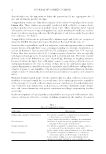
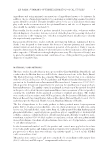
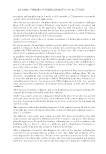
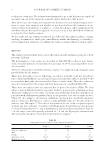
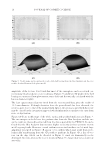
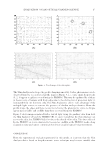
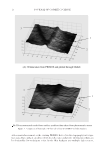
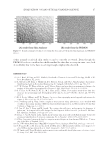
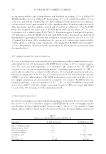
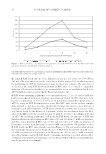
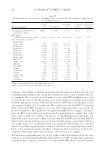
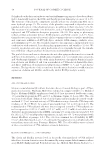
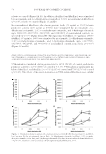
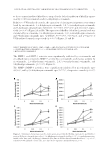
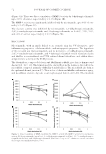
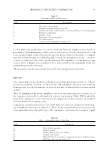
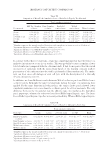
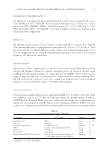
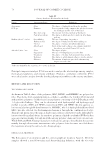
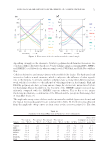
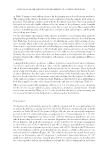
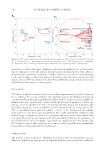
JOURNAL OF COSMETIC SCIENCE 70 Principal component analysis (PCA) was used to analyze the relationships among samples, rheological parameters, and sensory attributes. Pearson’s correlation coeffi cients (PCC) were calculated to analyze how the rheological properties infl uence the sensory attributes. RESULTS AND DISCUSSION THICKENING MECHANISM As shown in Table I, three of the polymers, HEC, HPMC, and HMHEC are polysaccha- rides. They derive from a natural polymer—cellulose—and have the benefi ts of both natural and synthetic polymers. Celluloses are linear polymers consisting of (1-4) β-D-glucan with 1-4 glycosidic linkages. They can be substituted with hydroxyethyl and hydroxypropyl methyl to produce HEC and HPMC, respectively. HEC and HPMC thicken aqueous so- lutions mainly through H-bond interaction. HMHEC, which is hydrophobically-modifi ed HEC, was also selected. Its thickening mechanism is through the combination of a hy- drogen bond interaction (the same as traditional cellulosic derivatives) and a hydrophobic interaction of long alkyl chains. As synthetic polymers, slightly crosslinked PVPs thicken aqueous solutions mainly through interlinks among polymer chains and steric interactions. While PAA and PAA Na are polyacrylates with anionic groups, they thicken the systems mainly through electrostatic interactions—the polymer chain becomes uncoiled due to the rejections among the same electric charge groups. RHEOLOGICAL PROPERTIES The fl ow curves of six emulsions and the control sample are shown in Figure 1. All of the samples showed a non-Newtonian and shear-thinning behavior, with the viscosity Table III Sensory Attributes Evaluated in the Study Factors Sensory attributes Defi nition Appearance Gloss The degree of light refl ected from the product Pick-up Firmness Force required to fully compress the product between the forefi nger and the back of the hand Ease of pick-up The amount of product picked up by fi ngers Peak after pick-up The degree to which products stands up after fi nger pick-up Rub-in (after 15 circles) Spreadability The ease of spreading the product Hydration feel The degree of hydration felt while rubbing in Oil feel The degree of oiliness felt while rubbing in Absorbencya Total circles used to disperse the samples until full absorbency is reached. Limit: 120 circles. After-feel (after 5 m) Gloss The degree of gloss Slipperiness The ease of sliding fi ngers across the skin Greasiness The degree of feeling of greasiness/product residue Tackiness The degree to which fi ngers adhere to residue product Moisture The amount of moisture perceived when moving fi ngers across the skin a Scales are defi ned by the equation: 10 - (total circles/12).

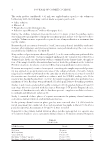
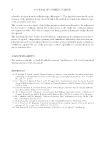
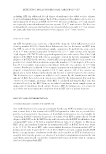
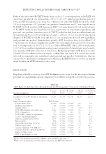
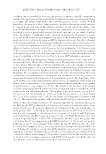
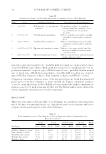
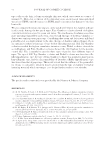
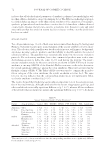
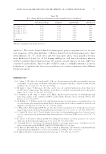
RHEOLOGICAL AND SKIN SENSORY PROPERTIES OF COSMETIC EMULSIONS 71 depending strongly on the shear rate. Synthetic polymer-based formulas were more vis- cous than cellulose derivative-based ones. Under shaking, samples containing HEC, HPMC, and HMHEC could fl ow freely, whereas samples with PVP, PAA, and PAA Na could not fl ow. Cellulose derivatives are linear polymers with modifi ed side chains. The hydrogen bond interaction leads to a weak structure, which is subject to the infl uence of other ingredi- ents in the formula. Conversely, synthetic polymers have a strong three-dimensional net- work, which is less subject to the infl uence of other ingredients in the formula. PAA and PAA Na polymers also have a strong anionic charge for electrostatic interactions for bet- ter thickening effi cacy. In addition, the viscosity of the HMHEC sample increased sig- nifi cantly compared with the HMHEC aqueous solution. This is due to its unique thickening mechanism, a combination of the H bond and the synergetic thickening effect of long alkyl chains (9). The amplitude sweep curves of these emulsions were also studied (fi gures not shown) and the typical rheological parameters are summarized in Table IV. Yield stress was obtained from the amplitude sweep curves as shear stress at the crossover point (10). The data Figure 1. Flow curves of the six emulsions and the control sample. T able IV Summary of the Typical Rheological Parameters of Seven Emulsions Sample Viscosity at 0.1 s-1 (Pa·S) Viscosity at 1 s-1 (Pa·S) Viscosity at 10 s-1 (Pa·S) Viscosity at 100 s-1 (Pa·S) G′ (Pa) G″ (Pa) Damping factor (1) Shear stress at crossover point (Pa) Control 11.6 2.6 0.6 0.2 21.3 9.2 0.4 2.7 HEC 34.9 10.5 2.9 0.7 47.4 33.3 0.7 13.1 HMHEC 36.8 8.9 2.1 0.5 47.3 29.6 0.6 8.4 HPMC 13.8 3.2 0.9 0.3 62.7 35.9 0.6 6.0 PVP 254.0 56.2 15.9 3.1 1,010.0 141.0 0.1 46.5 PAA Na 539.0 122.0 22.9 3.9 1,730.0 206.0 0.1 79.6 PAA 361.0 87.2 19.5 3.3 838.0 105.0 0.1 68.8
Purchased for the exclusive use of nofirst nolast (unknown)
From: SCC Media Library & Resource Center (library.scconline.org)