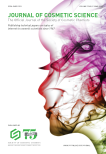
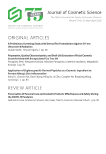
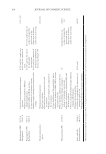
Journal of Cosmetic Science The Official Journal of the Society of Cosmetic Chemists Volume 73 No. 2 |March/April 2022 ORIGINAL ARTICLES A Preliminary Screening Study with Dermal Tea Formulations Against 311 nm Ultraviolet B Radiation Gulsah Gedik, Timuçin Uğurlu |pp. 58 Preparation, Quality Characterization, and Shelf-Life Evaluation of Facial Cosmetic Cream Enriched with Encapsulated Tea Tree Oil Panagiota Eleni, Kleopatra Kalouta, Nikolaos Panagiotou, Katerina Vassilatou, Magadalini Krokida |pp. 70 Application of Euglena gracilis-Derived Peptides as a Cosmetic Ingredient to Prevent Allergic Skin Inflammation Xuhui Li, Chunxin Xia, Danni Kong, Ming Xu, Jin Zhu, Congfen He, Bingliang Wang, Junxiang Li |pp. 84 REVIEW ARTICLE Preservation of Personal Care and Cosmetic Products: Effectiveness and Safety During the COVID-19 Pandemic Gabriela Correa, Andrezza Canavez, Vera Isaac, Marcio Lorencini, Desiree Schuck |pp. 96

58 Address all correspondence to Gulsah Gedik, gulsahgedik@gmail.com A Preliminary Screening Study with Dermal Tea Formulations Against 311 nm Ultraviolet B Radiation GULSAH GEDIK AND TIMUÇIN UĞURLU Pharmaceutical Technology, Trakya University, Faculty of Pharmacy, Edirne, Turkey (G.G.) Pharmaceutical Technology, Marmara University, Faculty of Pharmacy, Istanbul, Turkey (T.U.) Accepted for publication January 9, 2022. Synopsis One potential health benefit of Camellia sinensis extracts on the skin is protection from the detrimental effects of UV radiation. Tea polyphenols both absorb the UV and also alleviate the UV-induced damage in human skin. In this study, we aimed to test the protection of black and green tea gels against UV. The gels were prepared using a carbomer resin and freeze-dried black or green tea extracts. In formulations, total phenolic content, antioxidant activity, and free radical scavenging activity were tested. The sites were irradiated with an artificial narrow band UVB source 30 min after topical application of the formulations on separate regions of the upper back of 21 subjects, Black and green tea gels, and the commercial sunscreen protected the skin of volunteers against the UV erythema. Caffeine gel and carbopol control gels did not provide any protection. Commercial sunscreens can only protect the skin by absorbing or scattering UV radiation. However, tea extracts both absorb the UV radiation and also have the potential to repair the UV damage inside the skin due to their strong antioxidant contents. Tea extracts are safe for humans as well as for aqueous environments without toxicological concerns. INTRODUCTION The tea plant, Camellia sinensis, contains polyphenolic compounds. The majority of health benefits related to this plant are due to the effects of these polyphenols (1). Tea polyphenols, also called catechins, have been reported to regulate inflammatory responses. Studies display tea polyphenols when applied orally or topically, improve destructive skin reactions following ultraviolet (UV) exposure, including erythema and lipid peroxidation (2). Polyphenols are effective radical oxygen species (ROS) scavengers (3) and they are more potent antioxidants than ascorbic acid and α-tocopherol (4). Besides polyphenols, the tea plant also contains caffeine, l-theanine, minerals, trace amounts of vitamins, amino acids, and carbohydrates. The description of polyphenols contained in tea is determined by the level of fermentation to which it has been subjected (5). White tea consists of minimally processed young leaves and green tea minimally processed mature leaves. While oolong tea is semifermented, black tea is completely fermented. Throughout the J. Cosmet. Sci., 73, 58–69 (March/April 2022)
Purchased for the exclusive use of nofirst nolast (unknown)
From: SCC Media Library & Resource Center (library.scconline.org)