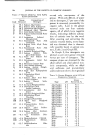
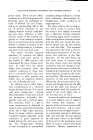
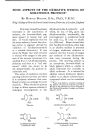
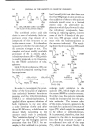
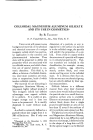
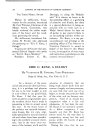
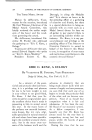
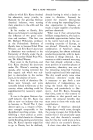
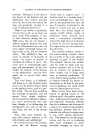
SOME ASPECTS OF THE OXIDATIVE DYEING OF KERATINOUS PROTEINS* By HAROLD BURTON, D.Sc., Ph.D., F.R.I.C. Ki.ng's College of Household and Socia] Science, University of Lond•h, England FOR SOME YEARS I have been interested in the constitution of melanin, the brownish-black pig- ment present in human hair and skin. [I would emphasize that by the name melanin, I mean the color- ing matter or pigment derived by oxidation of 5,6-dihydroxyindole or a suitable derivative.] It was shown by Raper that when tyrosine is treated with oxygen in the pres- ence of the enzyme tyrosinase, it is oxidized first to 3,4-dihydroxyphen- ylalanine and then to a "red sub- stance" which was shown to be 2,3 - dihydroindole - 5,6- quinone - 2- carboxylic acid This series of oxidations involves starting with free tyrosine and there is no evidence whatever that com- bined tyrosine can undergo the same reactions. When the abovequinone is kept in dilute aqueous solution it undergoes rearrangement to 5,6- HOt• fH. COOH NH2 Tyrosine [Ol 5,6-Dihydroxyindole- 2-carboxylic Acid 240 dihydroxyindole-2-carboxylic acid which, by loss of CO,., gives 5,6- dihydroxyindole incidentally, the rearrangement is accelerated both by acids (i.e., H ions) or alkalis (i.e., OH ions). Raper showed that this 5,6-dihydroxyindole, when kept in an alkaline medium in presence of oxygen, underwent oxidation to melanin and that 2 atoms of oxygen per molecule of the dihydroxyin- dole were consumed during the process. The resulting melanin is an amorphous, brownish-black to black pigment which is soluble in alkali hydroxide but insoluble in alkali carbonate. It is redUCed by alkaline sodium dithionate (hydro- sulfite) to an almost colorless leuco- compound which can be reoxidi.zed * Paper read before a scientific meeting of the Society of Cosmetic Chemists of Great Britain in the Chemistry Lecture Theater of the Chelsea Polytechnic, London, on Friday, March 3, 1950. NH• 3,4-Dihydroxyphenylalanine [o1 / 0%/% O•L//•N•CH.COOH.•H,• 2,3-Dihydroind'ole-5,6-quinone- 2-carboxylic Acid

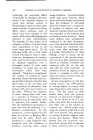
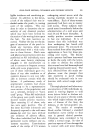
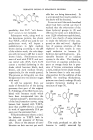
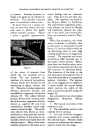
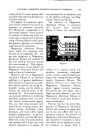
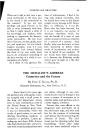
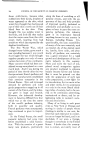
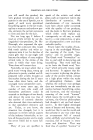
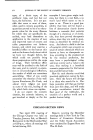
OXIDATIVE DYEING OF KERATINOUS PROTEINS 241 (e.g., by alkaline potassium ferri- cyanide or hydrogen peroxide) to the melanin. Incidentally, this prop- erty of being soluble in alkali hydrox- ide (NaOH, KOH) only, precludes the possibility--apart from the ex- pensive nature of the pigment--of using it as a coloring matter for hair or any other part of the body! In 1948, I suggested (Chem. &Ind., p. 313) a structure for melanin based on the above properties in con- junction with analytical evidence. No mention was made of the actual mechanism whereby 5,6-dihydroxy- indole is converted into the pig- ment, but I suggest that oxidation occurs by introduction of a hy- droxyl group at position 3 with formation of 3-hydroxyindole-S,6- quinone which could then undergo "polymerization." Subsequent oxidation would give the 5,6-quinone which now contains sulfur attached directly to the ben- zene ring. 3,4- Dihydroxyphenylalanine is known to occur in the vegetable kingdom (for example, in the pods of broad beans), but there appears to be no evidence that it can be iso- lated from the animal body. I consider that the presumed non- occurrence of this amino acid in animal protein is incorrect, and would point out that hydrolysis of a protein containing combined 3,4- dihydroxyphenylalanine in the pres- ence of oxygen might well lead to the formation of an indole (see above) which would undergo subsequent decomposition (as occurs with tryp- tophan). Assuming that the com- bined tyrosine in a protein can be HO H H [o1 [o1 Nn N• ø•%• Unpublished work that I have carried out on natural melanins in- dicates that these pigments often contain a small but definite amount (about 1%) of firmly combined sul- fur. I suggest that if the above hy- droxyindolequinone undergoes poly- merization in the presence of free SH groupsbeven the few normally pres- ent in proteins--then the following addition reaction may well occur: NH oxidized to combined 3,4-dihydroxy- phenylalanine, it appears likely that the latter may undergo further oxidation in one or both of two ways, viz., (i) direct hydroxylation at position 6 of the benzene nucleus, (ii) oxidative elimination of the side-chain to give 1,2,4-trihydroxy- benzene (hydroxyquinol). In either case the orientation of the three hydroxyl groups in both oxidation products is the same. SR sjlø addition H0 H [0] + HSR • HO N• O//"'d'x"•'NU
Purchased for the exclusive use of nofirst nolast (unknown)
From: SCC Media Library & Resource Center (library.scconline.org)