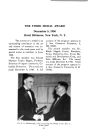
264 JOURNAL OF THE SOCIETY OF COSMETIC CHEMISTS solid political foundation. He was a founder of the Essential Oil Associa- tion of the United States, and then he proceeded to establish the Scien- tific Section of that Association, of which he has been chairman since it was founded some sixteen-years ago. It was Dr. Kunz personally who first proposed to the Essential' Oil Association the adoption of industry-wide standards for perfume materials, a proposal which was greeted with great skepticism, but which he persistently urged and today the Essential Oil Association has already adopted standards for numerous essential oils and aro- matic chemicals which are followed not only by producers and users in the United States, but throughout the world. Among his many achievements, Dr. Kunz can proudly recall his almost one-man campaign to con- vince the U.S. Pharmacopoeia Re- vision Committee of the desir- ability of accepting racemic men- thol in the U.S.P., thus contributing to making America independent of foreign sources for its menthol, and aiding to avert a critical shortage of this substance during the recent World War. In the field of interna- tional affairs, he made an original contribution in a critique of the multilateral system of trade agree- ments, and, to come to a subject closer to the group gathered here, his critique of the American patent system, coupled with concrete •nd constructive proposals, stands out as another original contribution of a versatile intellect. If one were to name the out- standing achievements of the past decade in the domain of cosmetic chemistry, I dare say that there must come to the minds of many the development of antiseptic and germicidal soaps and cosmetics, ca- pable of being used for everyday pur- poses. The deodorant qualities of these materials, arising out of their bactericidal power, have widened their appeal to the public, and the germicidal qualities have materially increased the functional value of numerous cosmetics and soaps and widened the horizons of the entire cosmetic industry. The study of antisepsis, and the search for non- toxic germicides which would re- tain their bacteria-killing power in the presence of soap, was foremost for many years in the mind of Dr. Kunz, and the historically signifi- cant use patent involving the utilization of G-11 (hexachloro- phene) or related substances in soap bears the name of Dr. Kunz as one of the co-inventors. It was fitting, indeed, that in a career devoted so fully to the per- fection of pleasantly odorous mate- rials, the crowning glory should have been the perfection of odor- inhibiting materials. And thus, one of the most ancient and most exquisite of the purposes of cos- metics--to make more fragrant the human body--was made possible by the work of Dr. Kunz in two different but complementary direc- tions. This is, as I have said, a lifetime of work that can tell its own story.

COSMETICS AND What can I add to this save a per- sonal testimonial to the man, just as his record is the testimonial to the scientist? It was my rare privilege and good fortune to be ab•le to work intimately with him, so that I might absorb a little of his knowledge and wisdom, while seeking to appreciate his humani- tarian personality. He was more than visionary, teacher, guide, men- tor, and employer he was friend, inspirer, example and, if I may unashamedly look inward behind the cloak of my own mind, there was in my evaluation something of the hero-worship of a child in con- templation of a father. As I think of this glorious life- THE FUTURE 265 time of achievement, I find it fit- ting and, indeed, inevitable, that we should have come to this dinner tonight to pay homage to Dr. Kunz. But, on reflection, it is not Dr. Kunz who has been honored, but it is our industry, our section of American chemistry, which has had the benefit of a man of such caliber among its foremost scientists for a quarter of a century. And, finally, mine was the honor to have been permitted to deliver these words of introduction and evalua- tion in behalf of our medalist. If my words have been inadequate, it is because the flickering candle cannot pour its light on a life that is a blazing sun. THE MEDALIST'S ADDRESS Cosmetics and the Future By ERic C. KUNZ, PH.D. Givaudan-Delawanna, Int., New York •7, N.Y. SOME THIRTY-FIVE years ago, the perfume and toilet goods count- ers occupied only a small corner in the drug and department stores, even in such cosmopolitan cities of the United States as New York. It was not considered good taste, it was not fashionable, within the circles of good society, to use such alluring beautifying mediums as cosmetics or perfume. Ladies pa- rading up and down Fifth Avenue who had enhanced their attractive- ness with cosmetics and perfume were not ladies, although it was com- monly known that in Europe it was more a matter of economics as to whether ladies used perfume and, to a lesser degree, cosmetics. Creams that were offered in the drugstores were practically all of the cold-cream type, and were used less for the purpose of enhancing one's beauty than for preventing the infection of hands. The cold- cream was for cleansing rather than beautifying. Some older ladies even saw some medicinal value in
Purchased for the exclusive use of nofirst nolast (unknown)
From: SCC Media Library & Resource Center (library.scconline.org)