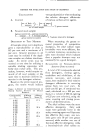
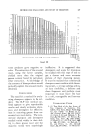
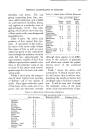
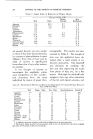
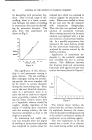
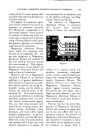
SWELLING STUDIES OF SINGLE HUMAN HAIR FIBERS 249 it was noted that as ammonium thioglycolate swelled a previously untreated fiber, a change took place in the refractive index of the fiber where the solution had pene- trated. This makes possible the measurement of the rate of pene- tration of the reducing solution into the fiber. In this type of ex- periment both the diameter of the whole fiber and the boundaries of the penetrating solution had to be observed and recorded for each time interval. From this data the per- centage of penetration can be calcu- lated. From a parallel rate of reaction experiment, the millimoles of sulf- hydryl groups per gram of hair formed during corresponding reac- tion periods were obtained. The percentage of penetration and the millimoles of sulfhydryl groups formed for corresponding reaction periods are shown graphically (Fig. 6). These data show that the pene- tration of the waving lotion into the hair fiber is followed very rap- •oo 8o 7o % •o P•mlm•m4o •o Io o o QI 02 Q:5 0• O• 07 Q• 0.9 ID mM SH i•er •mm of hair idly by the reaction of the reducing agent with the disulfide bonds of the hair to form sulfhydryl groups. The main conclusion to be drawn from inspection of this data is that the concentration of cystine is very close to constant throughout the cross section of the fiber. If all of the cystine in the hair (assuming that there is a 16 per cent cvstine content) were immediately and completely reducible to sulf- hydryl or SH, the curve would be a straight line to the co-ordinate 1.33, 100. However, we have found that 1.1 millimoles of SH per gram of hair is about the limit of reactivity. According to these data, we reach 100 per cent penetration after about 90 per cent of the available cystine is reacted. After a short time the last 10 per cent of reduc- ible cystine reacts. The bow in the curve and the fact that the reaction is completed after the solution has penetrated completely to the center of the fiber shows that there is a slight, but real, hindrance--steric or otherwise--to the reaction. These three comparatively simple experiments have been described to illustrate the types of problems that can be studied and to show that the apparatus performs in the wav that we desired. Those of you who are interested in keratinous fiber studies can no doubt see many more problems and experiments of interest. I hope that this presenta- tion will help to stimulate the ex- ploration of this field.

COLLOIDAL MAGNESIUM ALUMINUM SILICA'IE' AND ITS USE IN COSMETICS* By B. R. T. Fanderbilt C•., Inc., New York, N.Y. Tins PAPER will present some background material on the physical and chemical structure of a unique inorganic colloid which has particu- lar application in the cosmetic and pharmaceutical industries. Then data will be presented to define th4 properties which are associated with its c611oidal nature, and which there- fore are of special interest to cos- metic chemistry. This field is, in effect, a division of colloidal chemis- try, since most cosmetics are emul- sions or suspensions, both of which involve colloidal systems. The material we are discussing is Magnesium Aluminum Silicate, a processed, highly refined product.t This inorganic colloid has definite advantages over organic colloids. It is uniform. It is stable on pro- longed storage and it does not have to be preserved. It is readily dispersed in water without soak- ing. A colloid is commonly defined as a particle whose size ranges from 1 to 500 millimicrons. But if only one * Presented at the December 5, 1950 Meeting. New York City. t VEEGUM, reg. trade mark, R. T. Vanderbilt Co., Inc. dimension of a particle, or any ir- regularity in the surface of a particle is in the colloidal range, the particle will exhibit the properties of a col- loid. Even a hole or a space within the structure of a particle will impart to it colloidal properties (1). Vari- ous materials are included in this classification, for example: viruses, genes, vitamins, egg albumin, starch, carbon black, and even smoke and fog occur in the colloidal state. It is obvious then that col- loids are not any one chemical group, but are strictly defined by their spa- tial measurements. Colloids behave in a different manner from what their chemical nature alone would indicate because the particle size is so small that tre- mendous surface area is available. Electron microscope examination of carbon black shows that a single pound would blanket an area of not less than 12 acres if the surfaces of all its particles were spread out flat. The physical structure of the prod- uct Magnesium Aluminum Silicat% determined by x-ray diffraction and electron microscope, is believed to be in the shape of a long thin rod (2). In the optical range it can be likened 250
Purchased for the exclusive use of nofirst nolast (unknown)
From: SCC Media Library & Resource Center (library.scconline.org)