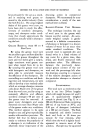
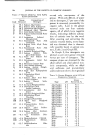
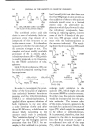
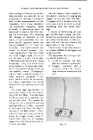
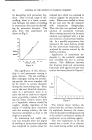
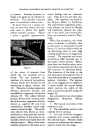
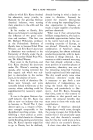
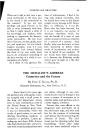
METHOD FOR EVALUATION AND STUDY OF SHAMPOOS 221 be purchased for the use as a stand- ard in studying wool grease re- moval in the textile industry (from the A.A.T.C.C.). By using weighed skeins of this greasy wool yarn, we have been able to study the effec- tiveness of synthetic detergents, soaps, and shampoos under condi- tions that closely approximate the conditions actually used in shampoo- ing the hair. GREAS•. R•.MOVAL rROM 98 TO 0 P•.R C•.NT By using the greasy wool yarn we are able to get a uniform distribu- tion of the grease throughout the yarn and test skeins give a surpris- ingly consistent total grease con- tent when tested from lot to lot. By scouring this greasy wool yarn with detergents and shampoos, we were able to accurately measure the efficiency of the shampoos. By controlling our conditions and limit- ing time and temperature, we were able to develop a test method under which an average shampoo removes only about 50 per cent of the grease from the wool yarn, and by using an extremely effective and efficient synthetic detergent 98 per cent of the grease may be removed. A great many detergents and soaps removed not more than 90 per cent of the grease under any conditions. This method appears to be quite simple to use and gives reproducible results with excellent precision. We further feel that its failure accu- rately to estimate the popularity of a shampoo is an indication of the relatively minor importance of the cleansing action in commercial shampoos. We recommend for your c6nsideration a study of the test method here outlined. B^RN•.TT-POWERS TEST METHOd) The technique involves the use of wool yarn in the grease with known wool-fat content. An accu- rately weighed sample is gently scoured in a definite concentration of shampoo or detergent in a known volume of water for an exact time under standard conditions. The scoured wool is squeezed dry and rinsed twice in a fixed volume of tap water for a given time, then dried, and finally extracted with petroleum ether. The difference between the previously deter- mined grease content of the raw wool and the percentage left after the shampoo scouring is a measure of the relative detergent action of the particular shampoo or chemical compound. EXPERIMENTAL The wool yarn as received on the cone is cut into 20-foot lengths which will weigh between 4.5 and 5 gm. A quantitatively weighed sample is placed (see Fig. 1) in a 500-ml. Erlenmeyer flask containing 200 mi. of tap water at 38øC. and 0.50 gm. of detergent (calculated on a 100 per cent basis). The flask is stoppered and slowly inverted back and forth at 50 times per minute foi' four minutes,•:•after which time the wool is tightly hand- squeezed to remove most of the solution. (Sample may be squeezed

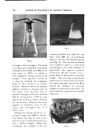
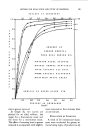
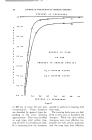
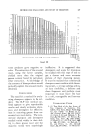
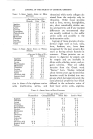
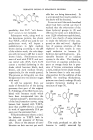
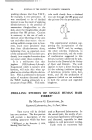
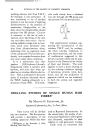
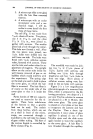
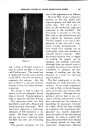
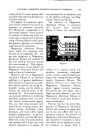
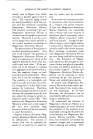
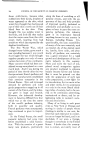
222 JOURNAL OF THE SOCIETY OF COSMETIC CHEMISTS Fig. I through a hand wringer.) The flask is drained and rinsed free of residual detergent, then filled with 100 mi. of tap water at 38øC., to which is then added the damp-scoured wool sample. This operati•m serves as a rinse by shaking the stoppered flask fi)r two minutes in a similar fashion. Remove the wool, squeeze tightly as befi•re to remove most of the water, rinse the flask free of residual detergent, fill with another 100 mi. of tap water at 38 ø C., and repeat the second rinsing by shaking for one minute. liemove the wool, squeeze to eliminate most of the water, and thor(mghly dr)' in a 45øC. oven. l)uring the drying operation, ac- curately weigh two 400-ml. extrac- tion flasks (see Fig. 2) and a sec- ond wool yarn sample previously cut into a 20-foot length. Place the completely dry sample in the ex- Fig. 2 traction thimble and reflux fi•r one hour with 200 mi. of petroleum ether to remove the residual grease (see Fig. 3). The second unscoured wool sample is used as a control by extracting in the same manner to determine the grease content. Ewtporate off the solvent over a steam bath in the hood to constant weight. This last step is of extreme importance to insure that all solvent has been removed--hence the flask should be checked to constant weight by repeated evaporation. It was found that one hour was nsually adequate. Fig. 3
Purchased for the exclusive use of nofirst nolast (unknown)
From: SCC Media Library & Resource Center (library.scconline.org)