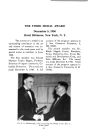
COSMETICS AND What can I add to this save a per- sonal testimonial to the man, just as his record is the testimonial to the scientist? It was my rare privilege and good fortune to be ab•le to work intimately with him, so that I might absorb a little of his knowledge and wisdom, while seeking to appreciate his humani- tarian personality. He was more than visionary, teacher, guide, men- tor, and employer he was friend, inspirer, example and, if I may unashamedly look inward behind the cloak of my own mind, there was in my evaluation something of the hero-worship of a child in con- templation of a father. As I think of this glorious life- THE FUTURE 265 time of achievement, I find it fit- ting and, indeed, inevitable, that we should have come to this dinner tonight to pay homage to Dr. Kunz. But, on reflection, it is not Dr. Kunz who has been honored, but it is our industry, our section of American chemistry, which has had the benefit of a man of such caliber among its foremost scientists for a quarter of a century. And, finally, mine was the honor to have been permitted to deliver these words of introduction and evalua- tion in behalf of our medalist. If my words have been inadequate, it is because the flickering candle cannot pour its light on a life that is a blazing sun. THE MEDALIST'S ADDRESS Cosmetics and the Future By ERic C. KUNZ, PH.D. Givaudan-Delawanna, Int., New York •7, N.Y. SOME THIRTY-FIVE years ago, the perfume and toilet goods count- ers occupied only a small corner in the drug and department stores, even in such cosmopolitan cities of the United States as New York. It was not considered good taste, it was not fashionable, within the circles of good society, to use such alluring beautifying mediums as cosmetics or perfume. Ladies pa- rading up and down Fifth Avenue who had enhanced their attractive- ness with cosmetics and perfume were not ladies, although it was com- monly known that in Europe it was more a matter of economics as to whether ladies used perfume and, to a lesser degree, cosmetics. Creams that were offered in the drugstores were practically all of the cold-cream type, and were used less for the purpose of enhancing one's beauty than for preventing the infection of hands. The cold- cream was for cleansing rather than beautifying. Some older ladies even saw some medicinal value in

266 JOURNAL OF THE SOCIETY those cold-creams, because when rubbed into their hands, droplets of water appeared on the skin, which water they thought they had pressed out of their skin or even out of their blood lines in the skin. They thought this was surplus water in the body, and little did they realize that the water came from the cold- cream itself, resulting from bad emulsions which decomposed by the slightest interference. The first World War, which changed many habits, gave youth a new standing because it was youth that fought the war which brought together peoples not only of many nations but even of two continents. Many customs which had been con- sidered wrong were placed on a new moral level. And it was during the period of time shortly after the war that prominent French perfume and cosmetic manufacturers established their associate companies in the United States. New and increased demand for perfumes and toilet goods preparations surged up in all corners of the Union, and the indus- try grew in leaps and bounds. However, the industrial develop- ment in America differed from that which was at the time the center of the world's perfume industry, both in quantity and quality. French perfumes were unsurpassed they continued to grow in import- ance. In the United States, the small cosmetic industry had some time before established a solid founda- tion. With the creation of a great many new products, particularly OF COSMETIC CHEMISTS along the lines of vanishing or all- purpose creams, and with the ap- pearance of face and body powders of improved quality, perfumed so artistically and profusely as to re- place at least in part the more ex- pensive perfumes, this industry grew in its importance beyond anything known in any country in Europe, including France. Un- questionably, the easy accessibility of many of the raw materials, such as mineral oils of the desired qual- ity, lanolin, fatty acids, and prac- tically all perfume raw materials, was a great stimulant for a rapid growth and development of the cos- metic industry in this country. More and more the wail of mis- placed moral antagonism against any product marketed to enhance beauty became fainter and fainter. But it must be pointed out that with the appearance of eaoh new toilet preparation, a new fight for its introduction, for its use in wider and wider circles, for its acceptance not only in the more liberal think- ing circles of society, had to be car- ried on by continuous advertising, institutional or direct, and by en- lightening talks in women's socie- ties and associations. Many of us living in such great cities as New York or Chicago and moving in circles of people whose thinking is similar to our own, be- lieve that such resistance to cosmet- ics can no longer be found, and is an abolished, if not even a foreign, thought to everybody in the United States. I doubt that this assump- tion is correct, and surely most of
Purchased for the exclusive use of nofirst nolast (unknown)
From: SCC Media Library & Resource Center (library.scconline.org)