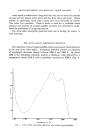
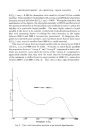
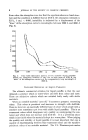
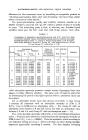
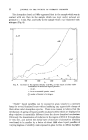
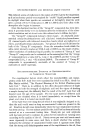
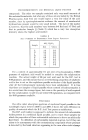
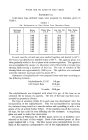
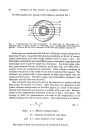
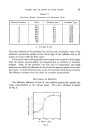
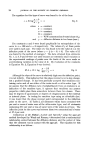
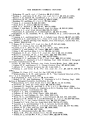
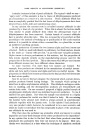
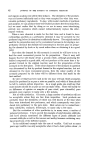
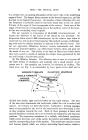
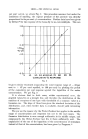
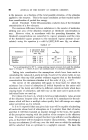
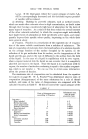
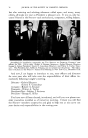
WATER AND OIL RATIO OF COLD CREAM 23 TABLE 2 PER CENT WATER, DIFFUSION AND EMULSION TYPE Ointment Number Water Diffusion (mm.) Emulsion Type __ 1 82-9 a O/W 2 74-6 9.0 O/W 3 66.3 8.8 O/W 4 $8.0 8.5 o/w '5 49-8 8.2 O/W 6 41.4 7.3 O/W 7 33.1 3.8 W/O 8 24.9 3.2 W/O 9 16-5 2.5 W/O 10 8.3 2.5 W/O a. Too thin to test. The outer diameter of the cylinder was used because, invariably, some of the ointment covered the surface of the whole edge of the cylinder wall at all points of contact with the filter paper. It was found that if determinations were made over a period of time longer than two hours, reproducibility was impaired due to variatiov. in moisture content. Some of the moisture was lost due to evaporation and some moisture was added by diffusion of water from the aqueous phase of the oint- ment base. If determinations were made after periods of less than two hours, the diffusion distances were too short for accurate measurement. DISCUSSION OF RESULTS The diffusion distances (Table 2) were plotted graphically against the water concentration in the various bases. The curve obtained is shown in Fig. 2. •v v I i i I I Fig. 2.

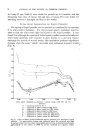
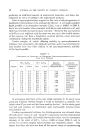
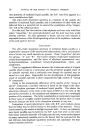
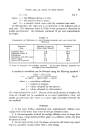
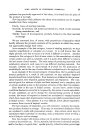
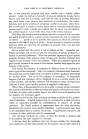
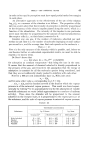
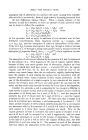
24 JOURNAL OF THE SOCIETY OF COSMETIC CHEMISTS The equation for this type of curve was found to be of the form y--b c+Klog-- -- x Eq. 2. a-y where c = constant, b = constant, a = constant, K = constant, x = W/W concentration of water in base (%), and y = diffusion distance in two hours (mm.). The constants a and b were found graphically by extrapolation of the curve to x = 100 and x = 0 respectively. The values of y at these points were used in each case. The value of c was found to be the value of x at the inflection point of the curve (where y = } (a -- b) + b). The value of K was found by the method of averages. 8 The data obtained from ointments No. 1, 2, 3, 9 and 10 were not used because an extremely small variation in the experimental readings of points near the limits of the curve made an overwhelming variation in the value of K. By evaluation of the constants in Equation No. 2, Equation 3 was derived: y -- 2.5 37.4+12.1 log 8-8--y--X' Eq. 3. Although the slope ot the curve is relatively high near the inflection point, i t is not infinity. This indicates that the phase reversal is not a step change, but a gradient change. It has been generally accepted that emulsions con- taining water and oil are either of the water-in-oil or oil-in-water type. If we assume that the diffusion rate of sulphathiazole from an emulsion is an indication of the emulsion type, it appears that emulsions can possess properties which place them somewhere between these two classes. There may be degrees of aqueousness or degrees of oleagenousness of the external or internal phase. In testing for emulsion type using an oil-soluble dye,' it was found that the phase reversal point corresponded to the inflection point on the curve. In Table 2, all ointments whose bases contained 41.4 per cent or more of water were of the oil-in-water type, and all ointments containing 33.1 per cent or less of water were of the water-in-oil type. The inflection point on the curve was between these two concentrations of water at 37.4 per cent. Comparison of the Method.--Lockie and Sprowls,'" using the agar gel method developed by Waud and Ramsay, 4 determined that a mathematical relationship existed between the diffusion distance and the period of time that the ointment was in contact with the agar gel. The equation for this relationship is as follows:
Purchased for the exclusive use of nofirst nolast (unknown)
From: SCC Media Library & Resource Center (library.scconline.org)