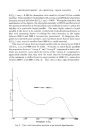
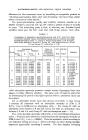
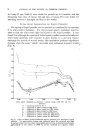
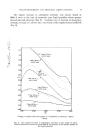
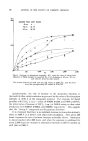
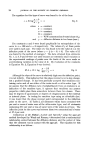
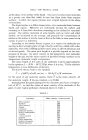
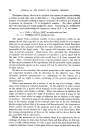
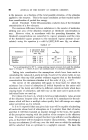
4 JOURNAL OF THE SOCIETY OF COSMETIC CHEMISTS The band at 2710 zk is typical of a benzenoid molecule, and it can, in fact, be shown that the spectral intensity distribution in the region between 2400 A and 2800 .• is the result of the superimposition of the spectra of two groups of compounds, "A" and "B," one of benzenoid character and the other with a falling absorption curve on progressing to longer wavelengths. Wide variations are encountered of the content of "Group A" compounds in liquid paraffin which satisfies the B.P. Acid Test. The intensity of the band at 2710/k may reach a value o f E (1%, 1 cm.) = 0.3202 or it may be as low as E(1%, 1 cm.)= 0.0005. For the former a B.P. Acid number of 1.5 Red, 4-5 Yellow was determined, and for the latter 0.9 Red, 2.7 Yellow. In view of these particular figures it is worthy of note that there is no correlation between absorption intensity and B.P. Acid number. To give one or two examples, the spectra were measured of materials for which the absorption intensity at 2710 A. had the values E(1%, 1 cm.) = 0.00049, 0.0053, and 0.0494, whereas the corresponding B.P. Acid numbers were Red Yellow 0.9 2.7 2.3 6.2 0.8 1.7 respectively. By a combination of ultra-violet and infra-red spectrophotometry it has been possible to identify the "Group A" compounds as alkylated symmetrical octahydrophenanthrenes. Their concentration in liquid paraffin can be derived from the ultra-violet spectrum. There is about • per cent of alkylated symmetrical octahydrophenanthrenes in a liquid paraffin which at 2710 A has E (1%, 1 cm.) ----- 0.05. Since the naphthene-paraffin molecules are quite innocu- ous this means that the lower the absorption intensity of liquid paraffin is in the spectral region between 2400/k and 2800 A the better is its quality. As an approximate guide for a good liquid paraffin the absorption intensity at 2710 A must be E(1%, 1 cm.)•0.100. The instability of liquid paraffin is caused by the "Group B" compounds. It is possible to remove from liquid paraffin large proportions of its conten. t of "Group B" compounds. When this is done, the ratio between "Group A" and "Group B" compounds increases and the liquid paraffin assumes greater stability. Since the "Group A" compounds essentially determine the value of the absorption intensity at the peak of the band at 2710 A. and the super- imposition of their spectrum on that of the "Group B" compounds governs the absorption intensity and wavelength position of the minimum in the region of 2490 J•, a stability criterion can be based on the value of the ratio of the absorption intensities at the maximum and the minimum in conjunction with a consideration of the E(1%, 1 cm.) value of the maximum. It can thus be shown that when the peak of the absorption band does not lie higher than

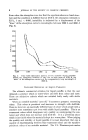
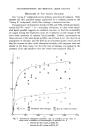
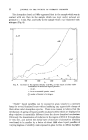
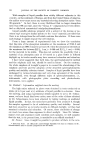
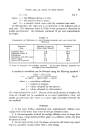
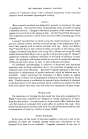
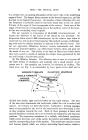
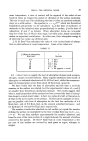
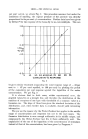
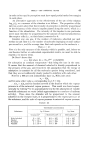
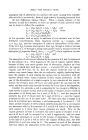
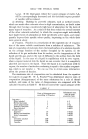
SPECTROPHOTOMETRY AND MEDICINAL LIQUID PARAFFIN 5 E(1%, 1 cm.)= 0.100 the absorption ratio must be at least 2-0 for a stable material. This numerical relationship holds as long as at 2710 ,& the absorption intensity does not fall below E(1%, 1 cm.)= 0.010. We require, therefore, the combination of two figures, the absorption intensity at 2710 A and the ratio of the absortion intensities at the maximum and minimum in order to assess the stability of a particular liquid paraffin. The more highly refined a liquid paraffin is the lower is its content of alkylated octahydrophenanthrenes, so that with increasing degree of refining the band structure in the region between 2400 A and 2800 A becomes less pronounced. It disappears alto- gether for extremely pure products, and experience shows that in these cases E(1%, 1 cm.) must be smaller than 0.006 for a stable material. This does not mean that any liquid paraffin with an absorption at 2710 .i of E(1 ø/o. 1 cm.)-• 0.006 must be stable. Normally, in stable liquid paraffins the proportion between "Group A" and "Group B" compounds is ten to one. There are, however, cases where the excess of the "Group A" compounds is appreciably smaller than this, with the result that the wavelength position of the minimum is shifted from its usual position at 2490 i to some•vhere between 2500 )• and 2600 A (Fig. 2). This, then, is also a sign of instability. 022 018 014 010 2.400 SAMPLE p 248- GROUP C i i 2,500 •,600' •,700 WAVELENGTH IN 2,800 2,900 Fig. 2. Ultra-violet absorption spectrum of an unstable liquid paraffin.
Purchased for the exclusive use of nofirst nolast (unknown)
From: SCC Media Library & Resource Center (library.scconline.org)