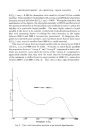
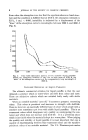
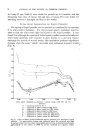
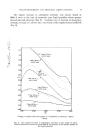
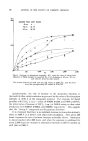
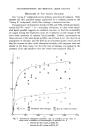
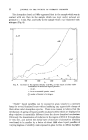
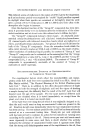
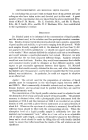
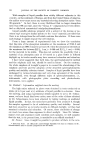
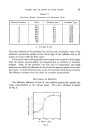
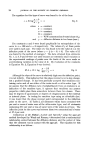
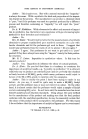
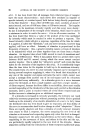
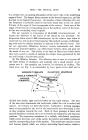
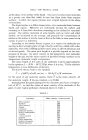
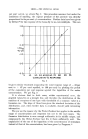
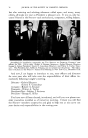
64 JOURNAL OF THE SOCIETY OF COSMETIC CHEMISTS BxiO- 5 4x 3xl! MOLAR C...ON C'N 0x 4XlO 2 5 IO 2.0 30 405060 70 80 go CUMULATIVE ø/o RESPONSE Fig. 3 Ferguson draws attention to the relation between the partition coefficient of a substance between two phases and its partial free molar energies in the two phases, and points out that in toxicity studies, etc., in a homologous series the linear relation between the logarithm of the various types of distribution coefficients and the number of carbon atoms indicates that the constant addition of partial molar free energy at each step is the controlling factor. For vapours •'e have :-- f•/7o q- R• 1øge P/Ps where Fo,F are the partial free molar energies of a reference state and the state under con- sideration, and •b/•b s is a near enough estimation of the activity of the vapour. Ferguson finds that the ratio •b/• s is between 0.01 and 0 07 for a wide variety of vapours toxic to mice, and has also a small range, although different, of values for toxicity for insects. We have seen that the ratio log •/•bs is the most suitable measure of the applied stimulus in relation to the response of the olfactory organs to increases in vapour concentrations. Therefore, it would appear that stimuli which result from the distribution of two vapours each between two phases.

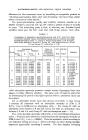
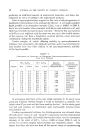
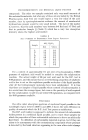
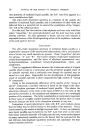
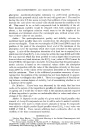
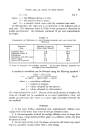
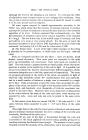
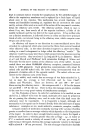
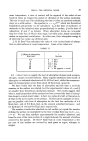
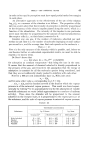
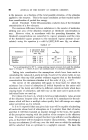
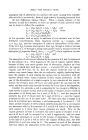
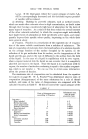
SMELL--THE PHYSICAL SENSE 65 in order to be equal in perception must have equal partial molar free energies in each phase. An alternative approach to the effectiveness of the use of the relation løge P/Ps as a measure of the stimulus is as follows. The properties of the nervous system show that the intensity of perception is directly proportional to the frequency of the electric impulse passed along the nerve, which is a function of the stimulation. The intensity of the impulse in one particular nerve must therefore be proportional to the amount of material adsorbed on the receptor cells (i.e., on their hairs) connected to it. Consider any one gas, if the number of molecules adsorbed per unit surface in unit time is a, the number of molecules impinging on unit surface per second is n, and the average time that each spends on the surface is r. Then tr --=- nr. Now a is the only •neasure of the stimulus which is possible, and, before we can theorise further or understand experimental results, we must be able to express a in known terms. De Boer TM shows that a: Kp where K •- Nro eO/•er 'X/(2•'MRT) for adsorption at constant temperature--this being the case in the nose. It means that the amount of chemical adsorbed is directly proportional to the pressure of the gas, and it involves the assumption that the energy of adsorption is constant for all the molecular species being considered, and that they are not sufficiently closely packed to interfere with each other. Now for a 100 per cent uniinolecular layer (% Mols./unit area) •o = gps and for some other value ,, corresponding to p, * = Kp. ß '. a/ao: PIPs and the fraction covered is the fraction which the vapour pressure is of the saturated vapour pressure. This result was found experi- mentally by Cutting • to be approximately true for the adsorption of volatile insoluble substances on water (which approximates to a surface of uniform activity). Thus, since the stimulus will be proportonal to the amount adsorbed on the receptor hairs, it is proportional to the vapour pressure of the substance, and the ratio of vapour pressure to saturated vapour pressure TABLE III Substance Ethyl alcohol Phenol Pyridine Vanillin Threshold Concentration by Volume Grains/era a Molecules/cm a =n __ 5 X 10 a 6'5 X 10 • 1-2 X 10 -ø 7.7 X 10 • 4 X 10 -• 3.0 X 10 • 2 X 10 -la 7.9 X 10 s by Area __ Molecules/cm 1-6 x 10 t• 1.8 X 10 TM 4-5 • 10" 8.5 x 10 •
Purchased for the exclusive use of nofirst nolast (unknown)
From: SCC Media Library & Resource Center (library.scconline.org)