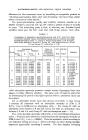
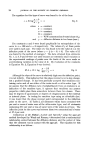
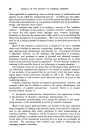
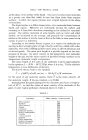
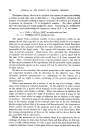
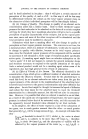
66 JOURNAL OF THE SOCIETY OF COSMETIC CHEMISTS is the measure, as a fraction of the total possible stimulus, of the stimulus applied to the receptor. This is the same conclusion as that reached earlier from consideration of partial free energy. (h) (it) Threshold. Table III summarises available data of the threshold concentration of a few odorants. The enormous difference between substances in the number of molecules striking unit area of the olfactory receptors at threshold concentration is seen. However when, in accordance with the preceding discussion, the threshold concentrations are converted to vapour pressures and the ratio of the threshold vapour pressure to the saturated vapour pressure is cal- culated-using the equation p = nlO-•2x/(MT)/3.52 mm. Hg, we obtain: TABLE IV p calculated from Substance n in above table, P, mm. Hg* mm. Hg Ethyl alcohol 5.37 X 10 -4 88 6.1 X 10 -6 Phenol 8.65 X 10 -•ø 6.7 X 10 -x 1.3 X 10 -9 Pyridine 1.98 X 10 -• 29 6.8 X 10 -x8 Vanillin 5.19 X 10 -•5 I 2 X 10 -a 2.6 X 10 -•' * p, is extrapolated to 32 ø C., using existing vapour pressure data and the relation log p ---- K log T q- C where K and C are constants and T is absolute temperature. Taking into consideration the assumptions which have been made in calculating the values of Ps and p in Cols. 3 and 4 of the above table, we can do no more than say that present evidence suggests that at the threshold concentration the minimum stimulus is of the order of pips = 10 '•2. The extent of the adsorption will apply to those hairs for which the substance has a heat of adsorption Q (which depends on the amino acid structure of the hairs) and will be to different extents on hairs which have varying heats of adsorption, and will vary as the more active spots on the individual hairs are used up. For values of p close to p•, which in turn has a high absolute value, several of the olfactory receptor areas will be covered by a monolayer for the sub- stance which will have a multiple odour quality that will emerge as a single odour perception as p is reduced. It is to be expected that any given hair type will be capable of adsorbing all molecules whose heat of adsorption on it is greater than that of water, and that it will then transmit an impulse message to the brain, the quality of the perception varying with the position of the receptor in the olfactory area. It is also reasonable to expect that hair type will alter over the olfactory area, so that there will be changes in receptor characteristics. This being so, for any one substance Q will vary over the total area on which the molecule will be adsorbed from an optimum to a negligible amount. We have the

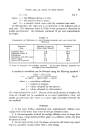
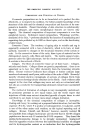
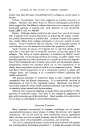
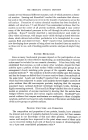
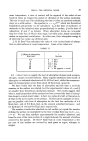
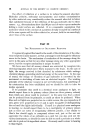
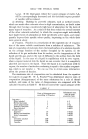
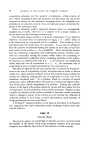
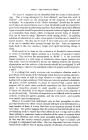
SMELL--THE PHYSICAL SENSE analogous case of adsorption on a surface with spots varying from consider- able activity to no activity, those of high activity becoming saturated first. (h) (iii) Differences between Odours. When a simple mixture of two odorants (a and b) is smelled, we have an amount of each adsorbed which can be shown to follow the equations: •---- (•o)• baP•,/(1 q-' b•p• q- bbpb) and ab = (ao) • b•p•/(1 + b•p•) q- b•pb) where b,,: N•'a/(ao),,•/(2rrM,,RT ) b• = N,b/(•o)•/(2•rM•RT ) At low pressures, such as apply to mixtures of two odorants near to their threshold concentrations, these equations become a,: (ao)•b•p•, and %---- (ao) • bbp b, and the adsorption of either is independent of the other. If the term b•p• becomes much greater than b•p• through a relative increase in pressure of a, or through b• being much greater than b• because its heat of adsorption Q• is greater than Q• (for ,•: (,o)•eO/Rr), these equations become a• •- (ao) • bap•/(1 q- b•p•) and = bbp/(1 + The adsorption of a is now not affected by the presence of b, but b is depressed by the presence of a. (This happens in the case of organic yapours which, because of their very much greater heat of adsorption, displace air from surfaces to which they both have access. , is around 10-* secs. for organic yapours and 10 TM secs. for air, thus the organic molecules stay on the surface very much longer than the air molecules, rapidly displacing them, since the number of each striking the surface has no connection with the number already there, being a function of their vapour pressures.) In the case of the stimulation of a single receptor by two odorants at low concen- tration, the receptor hairs will have a Q value greater for one than for the other, and this could easily increase its value for b over that of its competitor. Consider two odorants a and b, competing for two receptors differing to some extent in nature so that most active spots of receptor A have a heat of adsorption of 15 Kcals./mol. for a and of 10 for b and the receptor B similarly has Q of 15 Kcals./mol. for b and of 10 for a and the vapour pressures of each are of the same order. We have seen that a change in Q from 10 to 15 Kcal./mol. increases ,, and consequently b, by about 5 x 10 4 times, so that receptor A will be almost entirely stimulated by a, its response not interfered with by the presence of b, and B will behave in like manner with respect to b when their vapour pressures are small. Now, as the vapour pressure of both is increased, the active spots of receptor A for a and of B for b •vill be occupied by a and b respectively, and the more generalised structures of A and B will become of importance. For these, in the case of A, Q for a will be below the original 15 Kcal./mol., but little altered for b, and vice versa for B. The presence of each of the odorants will now reduce the adsorption of the other on their respective receptors,
Purchased for the exclusive use of nofirst nolast (unknown)
From: SCC Media Library & Resource Center (library.scconline.org)