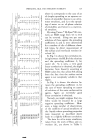
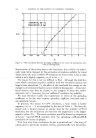
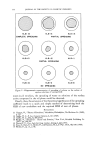
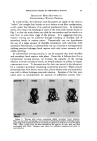
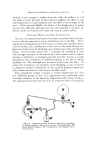
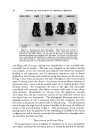
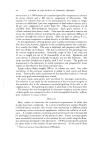
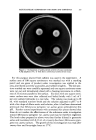
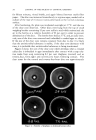
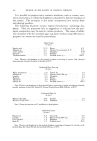
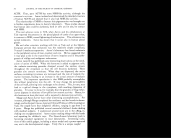
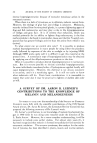
MOI ECULAR FORCES IN PERMANENT WAVING 335 SECONDARY BOND RUPTURE IN CONVENTIONAL WAVING PROCESS As noted earlier, the literature and the patent art speak of the need to "soften" the straight hair keratin so as to induce a new fiber configuration, a curl, under the influence of an external mechanical force. In molecular terms, this means the breaking of some of the inter-chain bonds shown in Fig. 1 so that the main chains can slide by one another and be rebuilt in a new form at some later stage of the process. It is suggested that per- manent waving can be achieved through breaking of disulfide and of secondary bonds in various ratios. Theoretically one can hypothesize the use of a large amount of disulfide breakdown with relatively little secondary bond attack, or alternatively one can visualize a waving process utilizing massive hydrogen bond rupture with only minor amounts of di- sulfide splitting. In conventional waving practice, it can be assumed that both disulfide and secondary bond rupture take place. From this it follows that if in a conventional waving process, we increase the capacity of the waving solution to break secondary bonds, we should enhance its ability to impart a permanent wave. To demonstrate this, hair was waved in the laboratory by a standard procedure simulating commercial practice--fifteen-minute processing time with lotion, water rinse, thirty-minute wait and neutraliza- tion with a dilute hydrogen peroxide solution. Samples of the hair were taken prior to neutralization for analysis of sulfhydryl content (12)-- NI•3 .J Figure 2. Waving with lotions containing added secondary bond br•ake•ss. Hair was waved by simulating a conventional commercial procedure involving 15-min. processing with thioglycolate lotion containing no additive or 2 M urea or 0.15 M added NHa. After a water rinse, the hair remained on the rods for 30 min. and was then neutralized with Ho_Oo•. Samples were taken for sulfhydryl analyses just prior to neutralization.

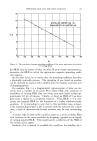
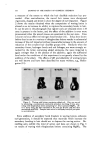
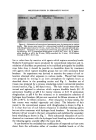
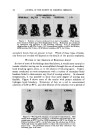
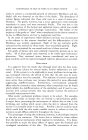
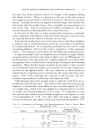
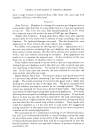
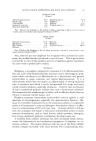
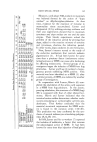
336 JOURNAL OF THE SOCIETY OF COSMETIC CHEMISTS a measure of the extent to which the hair disulfide reduction has pro- ceeded. After neutralization, the waved hair tresses were shampooed vigorously, shaped and dried to show the degree of curl imparted. Figure 2 shows the results obtained when the composition of waving lotion is altered so as to increase its ability to rupture the secondary bonds in hair. It can be seen in the photograph that tighter curls are obtained when 2 M urea is present in the lotion, and the effect of the additive is even more pronounced when the waved tresses are examined in the wet state. Urea is known to be an effective hydrogen bond breaker (13). It has been shown before that its use in a variety of thioglycolate lotions results in substantial increase of the curl imparted without measurable increase in the amount of reduction of the covalent hair disulfide groups (14). Similarly when the secondary forces, hydrogen bonds and salt linkages, are more strongly at- tacked by the lotion containing added ammonia, the wave imparted is again stronger than in the absence of the additive again the sulfhydryl level under the conditions of this experiment is not greatly altered by the addition of the alkali. The effects of pH and alkalinity of waving lotions are well known and have been described by many workers, e.g., Hellin- gotter (15). s, LVEL-- I o.2 I 077 i 0.20 Figure 3.. Waving with lotions containing added salt. Hair was waved by simulating a conventional commercial procedure involving 15 min. proc- essing with thioglycolate lotion containing 0, 1 M or saturated MgSO4. Af- ter a water rinse, the hair remained on the rods for 30 min. and was then neutralized with H.,O.•. Samples were taken for sulfhydryl analysis just prior to neutralization. Since addition of secondary bond breakers to waving lotions enhances curl generation, it should be expected that materials which increase the secondary bonding in hair should act to depress the waving action. De- swelling salts exhibit this kind of action and data are shown in Fig. 3 on results of waving with thioglycolate lotions containing MgSO4. The
Purchased for the exclusive use of nofirst nolast (unknown)
From: SCC Media Library & Resource Center (library.scconline.org)