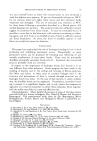
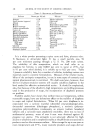
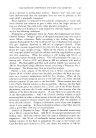
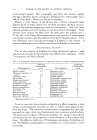
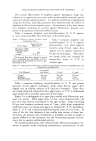
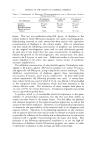
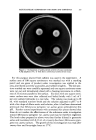
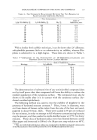
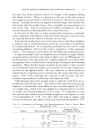
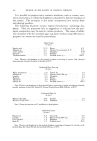
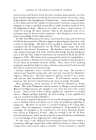
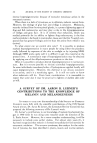
348 JOURNAL OF THE SOCIETY OF COSMETIC CHEMISTS TABLE 1--SoLuBILITY OF DIAPHENE Solvent Grams per 100 ml. Solvent Grams per 100 ml. Acetone 0.58 Methyl cellosolve 1.88 Amyl acetate (approx.) 1.0 Oleic acid 0.07 Arlacel 0.1 Olive oil 0.15 Benzol 0.03 Polyethylene glycol 400 3.0 Benzyl benzoate 0.3 Polyethylene sorbitan Carbon tetrachloride 0. 006 monolaurate 2.0 Castor oil 0.315 Propylene glycol 0.08 Dibutyl phthalate 0.4 Span 40 (at 80øC.) 3.0 Diethyl phthalate 0.5 Span 60 (at 80øC.) 3.0 Dimethylformamide 23.0 Span 80 0.1 Dimethyl phthalate 0.6 Toluol 0.03 Distilled water 0. 0015 Triethanolamine 6.0 Ethyl alcohol Tween 20 0.1 95% appr. 0.25 Tween 40 0.1 70% appr. 0.03 Tween 60 (at 80øC.) 6.7 Glycerol 0. 008 Tween 80 0.06 Glycerol triacetate 0.2 Xylol 0.03 Isopropyl alcohol O. 25 It is a white powder possessing a spicy taste and faint, pleasant odor. It fluoresces in ultraviolet light. It has a small particle size, 99 per cent minimum passing through a U.S. No. 200 mesh screen. The solubility of this composition, which we shall refer to as diaphene for brevity, is only 0.0015 per cent in water at 25øC., but in 95 per cent ethyl alcohol, it is soluble up to 0.25 per cent. Table 1 presents solubility data for a number of vehicles, including various raw materials used in cosmetic formulations. Because of the relative insolu- bility of the antiseptic composition, its use in some types of cosmetics and topical pharmaceuticals is restricted. We shall note later, however, that the hot oil phase emulsion systems will usually solubilize diaphene to the level needed for effective antimicrobial action. It should be emphasized, also, that because of the alkalinity, high temperatures and milling processes used in the production of soaps, the incorporation of diaphene presents no problem. Stability studies have shown that neither time nor temperature, within reasonable ranges, have any deleterious effect on the stability of diaphene in soaps and topical formulations. When 0.5 per cent diaphene is in- corporated into a cationic material (dimethyl stearamidopropyl-2-hy- droxyethyl ammonium dihydrogen phosphate), a nonionic (polyoxy- propylene polyoxyethylene condensate), an anionic (sodium hexadecyl sulfate) and a sarcosine type ampholytic emulsifier, there was no loss of antibacterial potency zones of over 6 mm. were obtained against M. pyogenes var. aureus. The antiseptic is not adversely affected by high acidity or alkalinity and is completely stable at the pH levels encountered in products used on the cutaneous surface. After storage for up to one year at room temperature and 37øC., many cosmetic products and soaps did not

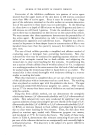
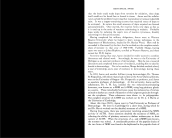
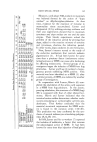
SALICYLANILIDE COMPOSITION FOR SOAPS AND COSMETICS 349 show a decrease in antibacterial activity. Special "use" tests with soap have demonstrated that the antiseptic does not lose its potency as the soap tablet is gradually consumed. Since diaphene is composed of two phenolic compounds, it reacts with ferric chloride test solution to give a violet color, but larger amounts of iron are tolerated than with many other phenolic antiseptics. The analysis of diaphene in soap using ferric chloride reagent is carried out by the following technique: Preparation of Calibralion Curve for Fisher Electrophotomeler for Ferric Chloride Mezhod. Weigh 5 grams of shredded untreated soap into each of seven 100-ml. volumetric flasks containing a few boiling chips. Into separate flasks pipette 0, 5, 10, 15, 20 and 25 ml. of diaphene stock solution (0.1 gm. diaphene dissolved in 100 ml. of isopropyl alcohol). These flasks then contain respectively 0, 0.1, 0.2, 0.3, 0.4 and 0.5 per cent dia- phene per 5-gm. sample of soap. Make up the volume to about 50 ml. with isopropyl alcohol and boil the solution until the soap dissolves or goes into fine suspension. While the solution is still boiling add 30 ml. of methanolic barium bromide solution. This will precipitate the soap as a barium salt. Cool to 25øC. and dilute to 100 ml. volumes with methyl alcohol. Mix thoroughly and filter each solution rapidly into separate dry 500 ml. filter flasks using a Buchner funnel containing a Whatman No. 1 filter paper. The flitrate may then be stored for analysis. Pipette a 2-ml. aliquot of the tiltrate into a 50-ml. volumetric flask. Pipette 20 ml. of ethyl alcohol into the flask, and place the flask and con- tents in a constant temperature bath for five minutes. When all the solutions have been prepared and are in the bath add 1 ml. ferric chloride solution (aqueous 2.5 per cent) to the first flask. Three minutes later add 1 ml. of ferric chloride solution to the second flask. Remove the first flask from the bath, pour the solution into a 23-ml. cell of the Fisher Electro- photometer, and note the A scale reading exactly four minutes after the addition of the ferric chloride solution. (A color filter is not used this time in the electrophotometer.) Add 1 ml. of ferric chloride solution to each remaining flask in order at three-minute intervals and read the color of the previously prepared solution exactly four minutes after the addition of ferric chloride solution. Prepare a calibration curve of per cent diaphene versus A scale readings. In those instruments where a color filter must be used, a green filter (550 mu.) is recommended. Atnalysis of Diaphene in Soap. Weigh 5 grams of shredded treated soap into a 100-ml. volumetric flask. Add 50 ml. of isopropyl alcohol and a few boiling chips. Boil the solution until the soap i's dissolved or goes into suspension. Add 30 ml. of methanolic barium bromide solution to the boiling contents of the flask to precipitate the soap as the barium salt. Cool the flask and contents to 25øC. and dilute the solution to 100 ml.
Purchased for the exclusive use of nofirst nolast (unknown)
From: SCC Media Library & Resource Center (library.scconline.org)