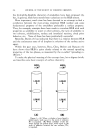
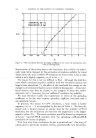
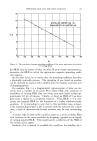
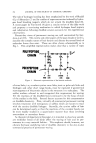
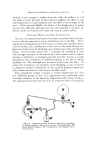
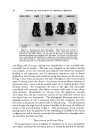
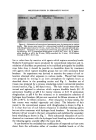
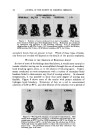
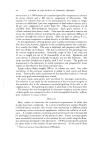
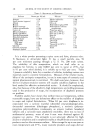
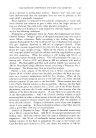
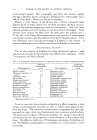
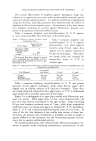
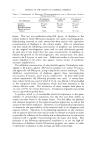
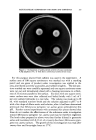
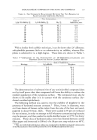
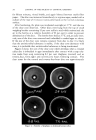
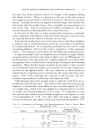
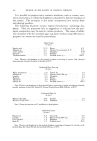
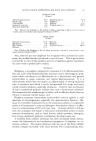
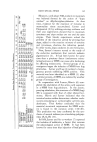
SPREADING, HLB, AND EMULSION STABILITY 329 where St corresponds to the case of an oil droplet spreading on an aqueous so- lution of emulsifier (hence to an oil-in- water emulsion), and S= to the spread- ing of water on an oil-phase solution of emulsifier, and hence to a water-in- oil emulsion. By using Tween © 80-Span © 80 mix- tures an HLB range from 4.3 to 15.0 can be covered. Using one per cent solutions of these agents the spreading coefficients S• and S= were determined for a number of oils of different chem- ical types, by direct measurement of the surface and interfacial tensions in- volved (6). In Fig. 3 is shown the correlation ex- isting between the HLB of the solutions and the spreading coefficient S• for castor oil. As is seen, a very good linear correlation is obtained, the slight deviation from linearity occurring at HLB values less than about 8.0 arising from the fact that the surface active agent is not completely soluble in that region. In Fig. 4 is shown the relation be- tween the spreading coefficient S= for the case of water spreading on castor oil solutions of the same surface active agents. Again an extremely good linear correlation is obtained. Naively, we might suppose that sta- bility would be ensured by a large negative spreading coefficient. How- ever, a large number of observations of the stability of actual emulsions of the liquids whose spreading properties were measured as described above leads to a slightly different conclusion. The data for oil-in-water emulsions, taken from the work of Ross and co- workers (6), are shown in Table 1.

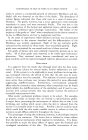
330 JOURNAL OF THE SOCIETY OF COSMETIC CHEMISTS HLB IO CASTOR OIL ON I% EMULSIFIER IN H• o/ 4 -28 -24 -20 -16 -12 -8 -4 0 4 8 Si Figure &--The correlation between spreading coefficient S• for castor oil and aqueous solu- tions of varying HLB. Examination of these data lead to the conclusion that (within the admit- tedly wide limits imposed by the estimation of emulsion stability by visual observation) the most stable O/W emulsions are found when S• has a value which is only slightly negative, i.e., 0 to ca. - 5. The reason for this is not too difficult to find. Although the primitive view which correlated emulsion stability with low interfacial tension has largely been abandoned (7), the effect of the interfacial free energy on the energetics of emulsion formation cannot wholly be disregarded. A low inter- facial tension may thus be classed in the category of what the mathe- maticians call a "necessary but not sufficient" condition for stability. We may therefore modify the requirement in terms of the spreading coefficient to be the most negative spreading coejficient consistent with a low interfacial tension. In practice, this means for O/W emulsions, a value which is barely negative, i.e., ca. - 1, as exemplified by the data of Table 1. We have ob- tained only a limited amount of similar data for the stability of W/O emulsions, but the indications are that here the requirement is the largest negative value of S2. The same conclusion would be drawn by comparison of known required HLB numbers with the spreading coefficient-HLB correlation of various oil phases. Now, how may these conclusions be put to practical use? One may, of course, given a particular emulsion system, systematically vary the ernulsi-
Purchased for the exclusive use of nofirst nolast (unknown)
From: SCC Media Library & Resource Center (library.scconline.org)