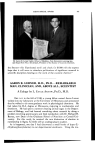
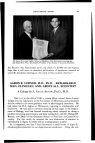
364 JOURNAL OF THE SOCIETY OF COSMETIC CHEMISTS terial in that small bottle, I had learned to prepare dopa-melanin, and had done several experiments involving the interconversions of tyrosine, dopa, dopa-melanin, and the pigments of human hair. Aaron became interested in this field, and his first studies involved pilot reactions, using tyrosine, designed to make it possible eventually to make synthetic melanins from the dipeptide of dopa. Hence, I can claim at least a small amount of credit for starting the chain reaction--that is, the beautiful series of ex- periments done by Aaron and his associates--that has given us most of our present knowledge of skin pigmentation. In 1942 I left Minnesota, but Aaron continued his work, and by the end of 1942 he had earned his Master's degree in physiological chemistry, with a minor in physiology. He had, in fact, worked so zealously that he had completed all the requirements for the Ph.D. degree except the work needed for the doctor's dissertation. He decided to enter medical school and, taking advantage both of his inexhaustible energy and the speeded up pace of the war-time medical curriculum, he received his M.D. and Ph.D. degrees in 1945. His thesis work concerned the study of cryoglobulins-- curious proteins in the blood of certain unfortunate patients that precipitate in vivo when an extremity becomes chilled. Since some of the resulting symptoms are dermatologic in nature, already unconsciously he had entered the field of experimental dermatology. Another important event occurred about this time. He married a talented and beautiful young lady who had just received her Bachelor's degree at Minnesota. She had majored in speech, wanted to be a writer, and had not been introduced to science. It will become evident soon, however, that her later indoctrination has been unusually thorough! After graduation, Aaron interned at the Marine Hospital on Staten Island. His wife, Marguerite (better known as Marge), entered nearby Barnard College because she thought it was time she took a few science courses. Some of her fellow students applied for admission to medical school. Marge, perhaps thinking she had nothing to lose, applied also and was accepted by Johns Hopkins. Now came a period of separation of six months during which time Marge was in medical school and Aaron was in what he sometimes describes as purgatory. He spent six months in a mental hospital in St. Cloud, Min- nesota. Here he organized a research laboratory. Fortunately for der- matology, he managed to be transferred to the Army Chemical Center, then known as Edgewood Arsenal. Here he worked in Dr. W. H. Sum- merson's laboratory, and it was here that his series of brilliant contributions to our knowledge of skin pigmentation really began. At that time, it was believed that mammalian tissue did not contain a tyrosinase, although animal skin could readily be shown to have a dopa- oxidase that could convert dopa to melanin. It was necessary to assume

SIXTH SPECIAL AWARD 365 that the body could make dopa from tyrosine by oxidation, since dopa itself could not be found free or bound in tissue. Aaron and his collabo- rators solved the problem by proving that mammalian tyrosinase indeed did exist. It was a copper-containing enzyme that required traces of dopa to be activated. In nature the small amounts of dopa required are formed autocatalytically. Once started, the reaction forms new dopa as fast as it is used up in the series of reactions culminating in melanin. Probably dopa works by reducing the cupric ions of inactive tyrosinase, thereby converting it to the active enzyme. Having completed his military obligations, Aaron went to Western Reserve University where he hoped to learn isotope techniques in the Department of Biochemistry, headed by Dr. Harlan Wood. How well he succeeded is illustrated by the fact that he worked out the complete metab- olism of tyrosine in that year of 1948-1949. Faithful Marge, having spent two years at Johns Hopkins, enrolled at Western Reserve, and there earned her M.D. degree. So:•etime during that year, Aaron decided he really wanted to combine laboratory and clinical work. Accordingly, he went to the University of Michigan as an assistant professor of dermatology. Here he ran a research laboratory and completed three years of residency, enabling him to take his boards in dermatology. Not to be outdone, Marge finished medical school, a year of internship, and a year of residency in dermatology during these years. In 1952, Aaron and another brilliant young dermatologist, Dr. Thomas B. Fitzpatrick, with whom Aaron had worked at the Army Chemical Center, went to the University of Oregon--Dr. Fitzpatrick as professor, and Aaron as associate professor, of dermatology. At this university, Aaron and his collaborator, Dr. T. H. Lee, isolated the two melanocyte-stimulating hormones, now known as a-MSH and g-MSH, using hog pituitary glands as a source. These remarkable hormones cause the melanocytes of various animals to darken as a result of dispersion of their pigment granules through- out the cytoplasm. These substances were shown to be polypeptides. The complete structure of g-MSH was worked out by Dr. J. I. Harris at the University of Cambridge. About this time (1955), Aaron went to Yale University as Professor of Dermatology. He went to Cambridge for a short time, during which he and Dr. Harris worked out the detailed structure of a-MSH. During these years, there was controversy revolving around the MSH- activity of ACTH. Some scientists doubted the existence of MSH, at- tributing the ability of pituitary extracts to darken melanocytes to their content of ACTH. When the structures of a- and /•-MSH were known, the mystery was solved. A considerable portion of the peptide chains of the two forms of MSH was found to be duplicated in the peptide chain of
Purchased for the exclusive use of nofirst nolast (unknown)
From: SCC Media Library & Resource Center (library.scconline.org)