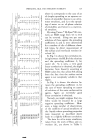
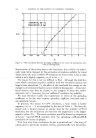
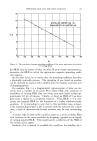
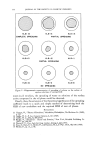
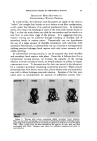
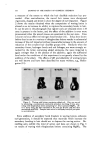
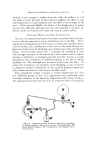
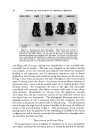
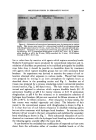
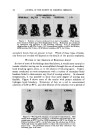
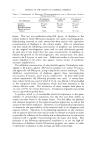
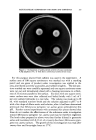
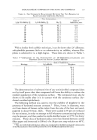
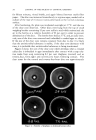
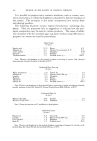
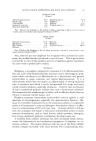
SALICYLANILIDE COMPOSITION FOR SOAPS AND COSMETICS 351 The over-all effectiveness of diaphene against pathogenic fungi con- tributes to its superiority over many other antimicrobials currently used in soaps and certain topical products. In addition, preliminary experiments using the A.O.A.C. sporicide procedure have demonstrated the ability of diaphene to kill various bacterial spores. Furthermore, it has been shown that diaphene maintains its activity against Micrococcus pyogenes var. aureus in the presence of blood and blood serum. Table 3 compares diaphene and hexachlorophene, U.S. P. against L. casei using wood fiber disc techniques with pooled saliva. TA•3•E 3--Poot. E•) SALIVA S'rUDIF•S WITH l,actobaci//us Casei Bacteria Count Active Agent Under Disc* Diaphene, 0.08% 0 Hexachlorophene, 0.0s% 100 Control T N T C *Using wood fiber discs dipped in pooled saliva containing the percentage of active agent indicated and placed on nutrient agar containing L. casei. Table 4 compares diaphene and hexachlorophene U.S. P. against gram-positive and gram-negative bacteria using 10-ram. paper discs dipped into an alkaline solution of 0.1 per cent antiseptic. These discs are rinsed, dried and cultured for twenty-four hours at 37øC. in nutrient agar. TABLE 4--COMPARISON OF DIAPHENE AND HEXACHLOROPHENE AGAINST GRAM-PosITIVE AND GRAM-NEGATIVE BACTERIA M. pyogenes Test Material var. aureus E. coli S. typhi. Control No zone No zone No zone Diaphene 21 mm. 1 mm. 2 mm. Hexachlorophene 16 min. No zone No zone Table .5 compares diaphene, hexachlorophene U.S. P. and phenyl mercuric lactate against pathogenic fungi using 10-mm. paper discs dipped into an alkaline solution of 0.1 per cent antiseptic. These discs are rinsed, dried and cultured for forty-eight hours at 37øC. in Sabouraud agar seeded with a mycelial suspension of the fungus. Figure 1 is a photograph of an agar plate seeded with Micrococcus pyo- genes var. aureus. Filter paper discs, 12 mm., were saturated with a 10 per cent soap solution and placed on the agar surface. Soap containing 0.3 per cent diaphene produced zones of 7 ram., while three competitive medicated soaps containing such agents as bithionol U.S. P., hexachloro- phene U.S. P. and trichlorocarbanilid produced zones of 3 to 4 min. In view of the fact that diaphene is less soluble than certain of these bac- teriostats, the greater zone of inhibition is probably not due to simply a greater diffusion of the antiseptic into the surrounding aqueous environ- ment, but to superior antibacterial activity. No resistance phenomena were observed with Micrococcus pyogenes var. aureus in growth media containing subinhibitory concentrations of dia-

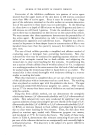
352 JOURNAL OF THE SOCIETY OF COSMETIC CHEMISTS TABLE 5--COMPARISON OF DIAPHENE, HEXACHLOKOPHENE• AND A MERCURIAL AGAINST PATHOGENIC FUNGI Trichophyton Microsporum Microsporum Test Material rnentagrophytes rubrum audouini Control No zone No zone No zone Diaphene 8 mm. 12 mm. 14 min. Hexachlorophene 2 mm. 4 mm. 4 ram. Phenyl mercuric lactate 1 mm. No zone No zone phene. This test was performed using 0.01 p.p.m. of diaphene in the culture media in which Micrococcus pyogenes var. aureus was being grown. Subculturing occurred at each twenty-four-hour period with equivalent concentrations of diaphene in the culture media. After six subcultures had been made the inhibiting concentration of diaphene was determined on the original micro/Srganism strain and on each subcultured growth. In each case it was found that the same concentration of diaphene in- hibited the growth of the micro/Srganism this concentration was deter- mined to be 0.1 p.p.m. in each case. Additional studies in this area have shown diaphene to be active also against various strains of antibiotic- resistant staphylococci. The inhibition concentration of salicylanilide against Trichophyton inter- digitale is 40 p.p.m., against Micrococcus pyogenes var. aureus 50 p.p.m., and against E. coli 1013 p.p.m., using a deep broth culture technique. The inhibition concentrations of diaphene against these micro/Srganisms are 2 p.p.m., 0.1 p.p.m., and 1 p.p.m., respectively. In these deep broth culture experiments the following procedure was used. A twenty-four- hour culture broth was used of which 0.1 $ mi. was diluted 1: 10 and added to the compound under investigation which had been dissolved in the culture dilution series. The incubation of these samples took place in an oven at 37øC. for twenty-four hours. Evaluation of growth was carried out on a growth-no growth basis. A question which is of considerable practical importance is the pene- trability of antimicrobial substances into the skin and their ability to attack microbes found in the deeper layers. For this effect the physical and chemical properties of the material used are important, as well as the nature of the vehicle employed. However, it is of fundamental importance to determine the penetrability of the material itself in an oleaginous and aqueous vehicle. Therefore, in the following experiment an oily ointment and an aqueous jelly base were used in order to attempt to exclude as much as possible the influence of the vehicle and to determine how far the active material itself is capable of penetrating into the lower skin levels. The principle in the following experimental conditions is to use the high ef- fectiveness of diaphene toward Micrococcus pyogenes var. aureus in order to determine its presence in skin sections cut with a microtome.
Purchased for the exclusive use of nofirst nolast (unknown)
From: SCC Media Library & Resource Center (library.scconline.org)