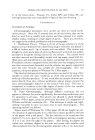
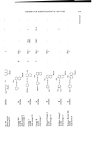
METHOD FOR IDENTIFICATION OF AZO DYES 237 having the same anion (i.e., potassium or sodium chloride) effectively con- tributes to definition of spots, which are almost as perfect as in the case of alkaline single-phase solvents. Methods and Results Two different analytical schemes were developed. Their relative use- fulness depends on the complexity of the unknown mixtures, the worker's expertness and the required speed. It is well known that experimental conditions have an observable in- fluence on the final results in paper chromatography (4, 18). Therefore, it is possible that the cited systems, excellent for the resolution of all the problems which have confronted us (including mixtures of up to eight azo colors extracted from one commercial sample alone), may fail under other laboratory conditions. For this reason, we emphasize that the reported schemes should be considered as general guides rather than as universally applicable methods of analysis. Systematic Fast Method The first analytical scheme has been developed by rational selection of solvents, keeping in mind the possibility that the work might be carried out without the aid of standard samples of the colors. It requires some practice in the handling of dyes as well as rough knowledge of their normal shades and their changes in tone at different pH's. Availability of the dye-patterns (or, at least, the most important ones) not only makes these requirements unnecessary but increases the accuracy of results considerably. The method is based on the simultaneous development of the extracts or of the unknown with four selected solvents: Solvent 1: Phenol saturated with water Solvent 2: 1% lithium chloride Solvent 3: 1.5% potassium chloride in 6.5 N hydrochloric acid Solvent 4: 2% sodium carbonate in 3 N ammonia solution Equilibrated for 10 to 12 hours with the same solvent system. Development in a closed chamber but without equilibration. Solvents 1 and 3 are group-selective revealing general characteristics of the dyes present, such as the number of sulfonate groups and the funda- mental structure itself. Solvents 2 and 4 are compound-selective, revealing specific rather than general aspects of the colors (position ofsulfonate groups, presence of certain lipophilic functions, existence of aminated auxochromes, alkali effects, etc.). Procedure. Development may require from 25 to 30 centimeters. A time of twenty to twenty-four hours is generally required for chromatogram 1, while the others can be completed within five to ten hours. That is, the time necessary for analysis will be governed by the development with solvent 1.

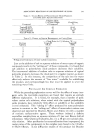
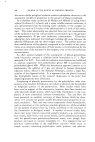
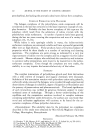
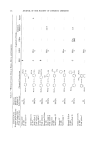
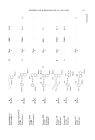
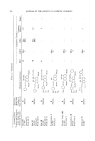
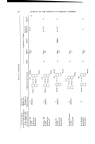
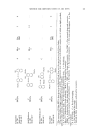
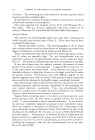
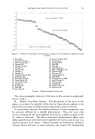
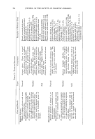
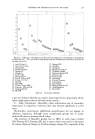
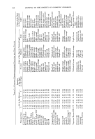
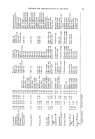
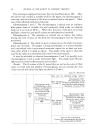
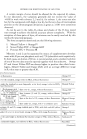
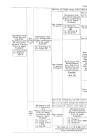
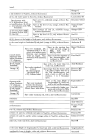
238 JOURNAL OF THE SOCIETY OF COSMETIC CHEMISTS The technique employed has been the one described above (II). After the solvent has reached a suitable level on the paper, the chromatogram is removed, and the advance of the front is marked with a soft pencil. Then one of the indicated methods is followed: Chromatograms ! and 2: The chromatogram is placed over an ordinary filter-paper sheet of suitable size and cautiously dried under an infrared lamp (or in an oven at 60øC.). When dry, the color of the spots in normal daylight is observed, and the R/values are calculated and recorded. Chromatog•am ¾: The operation is carried out as above, but before drying the color of spots on the fresh wet chromatogram must be observed and noted. Chromatogram 3: The shade of spots is observed on the fresh chromato- gram and recorded. The paper is hung immediately in a closed chamber and neutralized with concentrated ammonia vapors for at least ten min- utes, after which it is dried as above. The shade of the spots is observed and the Rf values are calculated and noted in the same manner. It may be advisable to observe chromatograms 1 and 2, or possibly even chromatograms 3 and 4, under ultraviolet light. The shade under Wood's light and any observed fluorescence are recorded. Results. The Rf values of the 35 tested dyes as well as the color of their spots on fresh acid and alkaline chromatograms and on neutral dry ones under normal and ultraviolet light are shown in Table 3. T^BI•E 4.--FLow Spot over (1) Development with 7 N HydrooS/oric Acid Without equilibration -- 30-32 cm. length neutralization with ammonia vapors. Standards: (!) ()range G (2) Victoria Violet 4BS Spot over (1) yellowish orange (pink ir Spot between (1) and (2) Spot between (2) and the starting line Development with 50% Phosphoric ztcid Without equilibration 30 cm. neutralization with ammonia Standard: Victoria Violet Development with ButanoLEthanoLConc. NH:• Equilibration with the sz solvent for about 12 hot 28-30 cm. length. Standards: (1) Anthosine B (2) Orange G Spot on the starting line: Consult the chromatogram developed Phenol Saturated with I4/'ater
Purchased for the exclusive use of nofirst nolast (unknown)
From: SCC Media Library & Resource Center (library.scconline.org)