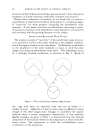
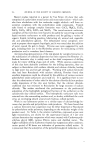
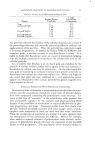
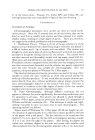
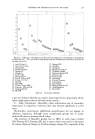
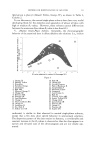
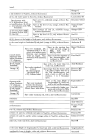
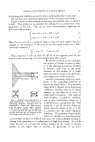
RECENT DEVELOPMENTS IN SURFACE PHYSICS 249 tion can dissolve substantial quantities of water-insoluble materials is well known. Rather early in the study of solubilization it was found that polar solutes such as the fatty alcohols, acids and esters behaved quite differently from hydrocarbons and other nonpolar solutes. In general, the polar solutes were found to be much more soluble. Most nonsolid soils, the skin secretions themselves, and other materials we wish to cleanse from skin or hair are polar, and also many polar soils of this type are solid at ordinary temperature. Extensive studies of three component systems comprising surfactant, water and a polar oil have been made in recent years, largely by Lawrence, at the University of ShefField. The results can best be discussed by referring to the triangular phase diagram, Fig. 2 (1). o L C eL! Figure 2.--Ternary phase diagram for the system: sodium dodecyl sulfate (S)-water (W)-caproic acid (A) system at 25øC. PQ repre- sents the binary soap-water liquid crystalline phase, WP isotropic solution and, above Q, solid soap exists. D is the point at which the liquid crystalline phase has redissolved and E is the point of separa- tion into two isotropic liquids. Tie line AZ represents addition of caproic acid to a dodecyl sulfate solution of concentration Z in water. (After Lawrence et al. (1).) The salient feature of this system is the large area over which a liquid crystalline phase is formed, containing all three components. This phase is liquid and flows like a liquid, at least in one direction. Flow perpendicu- lar to the oriented planes is accomplished by folding the planes cylindrically. In addition to the liquid crystalline phase there are three other liquid areas on the diagram. One of these, the L2 area is of particular interest. It probably represents a microemulsion, a phase where the dispersed particles

250 JOURNAL OF THE SOCIETY OF COSMETIC CHEMISTS are so small that the system is optically isotropic, like the familiar "soluble- oil" systems of technology. A most interesting type of ternary system occurs when the polar "oil" is a solid at ordinary temperatures. The addition of detergent and water lowers the melting point markedly more specifically as the temperature is raised, a point is reached where the soap and water can penetrate the solid. This suggests that the ternary liquid crystal phase might form spon- taneously at room temperature by mixing the components, or, more directly to the point, that an aqueous detergent solution can literally melt and liquefy a relatively large proportion of solid polar fatty matter. What actually happens when these two phases are placed together at a low tem- perature and slowly warmed is that they interact slowly. At a definite critical temperature, however, penetration of the detergent solution into the polar material starts to take place rapidly and the mass soon becomes fluid. These phenomena are most rapid and easiest to observe in fairly concen- trated aqueous detergent solutions, that is, solutions of 2 to 5 per cent de- tergent at a minimum. We are familiar in a practical qualitative way with this effect, and have many examples of the extraordinary solvency and cleaning power of concentrated detergent solutions. The penetration phenomenon, however, can be demonstrated at low detergent concentra- tions presumably because it is a rate phenomenon. An adsorbed layer of detergent forms at the interface, and this adsorbed layer can act as a con- tinuously renewable concentrated detergent solution, which can combine with the polar soil to form a liquid crystalline phase. This, then, is the newly recognized type of detersire action involving polar oily soils. It supplements the well known "roll-back" mechanism of detergency which is applicable to nonpolar soils as well. It affirmatively answers an old question in cosmetic science, as to whether it is possible to remove sebaceous secretions or other solid fatty matter from pores by straight detergent action, and it even points the way toward practical solutions of this problem. (Received January 17, 1962) REFERENCES 1. Hyde, A. J., Langbridge, D. M., and Lawrence, A. S.C., Discussion Fmrmdmy Sot., 18, 239 (1954). 2. Stevenson, D. G. 7,- TextileInst., 44, T12 (1953). 3. Schwartz, A.M., and Minor, F. W., 7. Colloid $ci., 14, 572 (1959). 4. Rader, C. A., and Schwartz, A.M., Textile Research 7., in press.
Purchased for the exclusive use of nofirst nolast (unknown)
From: SCC Media Library & Resource Center (library.scconline.org)