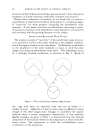
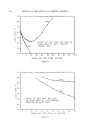
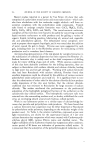
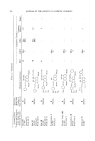
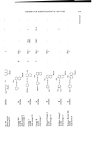
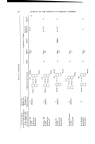
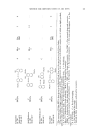
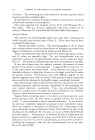
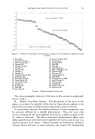
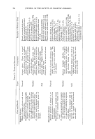
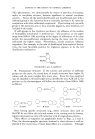
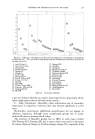
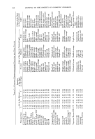
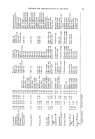
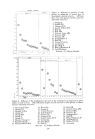
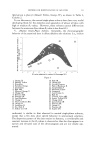
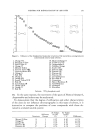
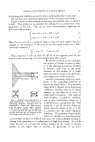
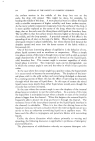
ASSOCIATION REACTIONS O13' POLYETHYLENE GLYCOLS 205 ioo o o o so EFFEGT OF SALT (NaGI AND Gc•GI 2 ) ON 40 CLOUD POINT AND VISCOSITY OF O,1% "POLYOX" RESIN WSR -3OI 30 O IO 20 GRAMS SALT PER IOO ML SOLUTION Figure 4. and his co-workers to conclude that the hydrated calcium ions were as- sociated or complexed with the polyether groupings. The salt was bound to the organic surfactant in such a way to lose its identity, and no free salt-or salt hydrates were observed. Similar observations were made in our laboratory confirming the effect of calcium ions on a typical nonionic surfactant (Tergitol © Nonionic NPX). In Fig. 2 comparison is given of the cloud points of 0.5 per cent Tergitol NPX solutions containing various concentrations of sodium chloride or calcium chloride. At high concentrations of calcium chloride, the cloud point is raised above that of NPX in pure water. These results are con- sistent with the concept that calcium ions, but not sodium ions, form as- sociation complexes with the ether oxygen atoms of the polyether structure. We have shown also that the solubilizing effect of calcium ions applies to the nonsurfactant polymers of ethylene oxide such as the Carbowax poly- ethylene glycols and the Polyox resins. Again, using the cloud point temperatures as the measure of relative solubilities, it is seen in Fig. 3 that sodium chloride causes much greater insolubilization than calcium chloride with Carbowax polyethylene glycol 6000. Similarly, the very high molecu- lar weight polymer of ethylene oxide, Polyox resins WSR-301, shows di- vergent solubility characteristics in the presence of the different salt solutions (Fig. 4). Viscosity can also be used to demonstrate the solubiliz- ing effects of calcium ions. Normally, a polymer solution exhibits a higher viscosity in a good solvent than in a poor one, due to greater solra- tion and extension of the polymer molecule. This effect is apparent from the viscosity data for a 0.1 per cent Polyox resin WRS-301 solution, also shown in Fig. 4.

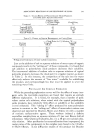
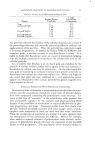
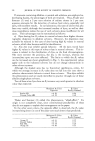
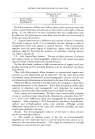
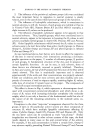
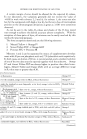
206 JOURNAL OF THE SOCIETY OF COSMETIC CHEMISTS Recent studies reported in a patent by Van Strien (2) show that salts comprised of a polyvalent metal cation and monovalent anion--which salts also form alcoholates with low molecular weight alcohols--will form as- sociation complexes with the polyethylene oxide compounds. Typical salts found to undergo complex formation were CaCi=, MgCI=, CuCI=, ZnCI•, CoCi•, A1C13, CdCI• and MnCI•. The metal-nonionic surfactant complexes of this invention were found to be useful for converting normally liquid nonionic surfactants to solid products and for gelling a variety of organic liquids including gasoline, lubricating oil, animal and vegetable oils and polyalkylene glycols. The dehydrated metal complexes were used to prepare these organic liquid gels, and it was noted that the addition of water caused the gels to break. Diverse uses were suggested for such gels, including their use in the Hydrofrac process for stimulating oil field production and in waterless hand cleaners. An interesting demonstration of the role played by complex formation in the stabilization of colloidal dispersions has been reported by Doscher (3). Sodium bentonire clay is widely used as the chief component of drilling muds for rotary drilling of gas and oil wells. While aqueous suspensions of this clay have desirable attributes for the drilling operation, they are subject to flo•culation with sodium chloride and calcium chloride, leading to high water loss and low gel strength. Working with sodium bentonire that had been flocculated with calcium chloride, Doscher found that excellent dispersions could be obtained by the addition of various nonionic polyethylene oxide surfactants and crude oil. It is significant here to note that the substitution of other salts for the calcium chloride did not produce stable dispersions of the clay and, further, that the calcium chloride- stabilized clay was resistant to flocculation by large excesses of sodium chloride. The author attributed this performance to the preferential adsorption of the hydrophilic polyglycol fractions of the surfactant on the calcium-rich clay colloid surface. The hydrophobic surfactant tails were oriented into the surrounding medium and, no doubt, solubilized the crude oil as an enveloping sheath around each hydrous colloid particle. Work in our laboratory points to a similar type of calcium-bridge be- tween clay particle and polyethylene oxide products. We have found that a calcium bentonire clay suspension may be either dispersed or flocculated by polyethylene oxide polymers, depending on the molecular weight of the product used. In Table 3, the relative turbidities, expressed as per cent light transmission, are shown for the supernatant liquors of 5 per cent calcium bentonire clay suspension which were treated with Carbowax poly- ethylene glycol 6000, various Polyox resins and distilled water. The higher turbidides of the Carbowax treated clay suspensions after a sedimen- tation period of 20 hours are indicative of protective colloid action. It is presumed that the adsorption of the polyethylene glycol molecules on the
Purchased for the exclusive use of nofirst nolast (unknown)
From: SCC Media Library & Resource Center (library.scconline.org)