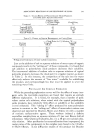
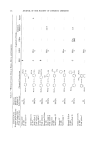
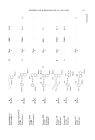
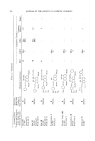
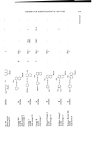
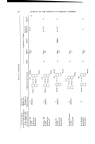
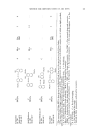
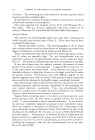
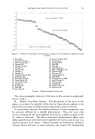
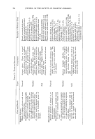
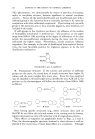
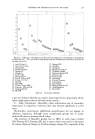
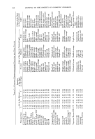
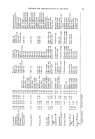
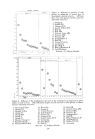
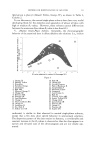
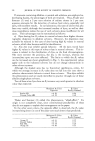
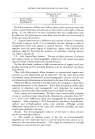
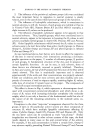
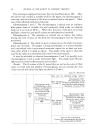
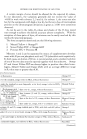
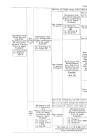
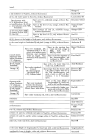
METHOD FOR IDENTIFICATION OF AZO DYES 243 colors present in any unknown will be related to that of the standard dyes on the paper. Thus, by means of careful selection of solvents, the need for the other 25 compounds as standards is avoided (this is, in fact, very con- venient since many of these dyes are not easily available). The method is long and slow, since sometimes as many as five successive elutions are required. These disadvantages are balanced by a considerable increase in accuracy since errors in the Rs values are insignificant, since subjective factors are greatly reduced, and since conditions become more reproducible. In substance, the method should not lead to errors in interpretation and is not influenced appreciably by laboratory conditions. Procedure and Results. The chromatographic technique is that de- scribed for the short method (with alkaline and acid chromatograms being observed before drying). Standard solutions and unknowns are spotted separately on the starting line, but in at least one of the points it is con- venient to place standards and unknowns together. The flow sheet is given in Table 4, comment on which we believe un- necessary. The color of the spots is considered only in the final stages since unknowns are frequently mixtures of dyes which may be super- imposed in some solvents. Auxiliary colors added in small proportions for shading purposes must always be considered and should not be confused with principal coloring matters. The positions of auxiliary dyes given in Table 3 are similar to the positions in the solvents employed in this method with minor variations: The spectrum in saline solvents is closely related to that in solvent 2, in two-phase solvents to that in solvent 1, in acid solvents to that in solvent 3 and in alkaline solvents to that in solvent 4. Interpretation of the results is always easy if the unknown contains a single color. If two or more dyes are present in unknowns, the interpre- tation is also easy after the dyes are separated in the final stages of the analysis. If several spots appear in the first chromatograms, the interpre- tation becomes more complex, but, even in this case, it is possible, in many instances, to follow the analysis for each spot without interference from the others. If this is not possible, the dyes may be isolated and recovered as follows: several drops or a band of test solution instead of a single drop are spotted along the starting line after which a new chromatogram is developed with the same solvent system. The colored zones are then cut transversely, and the dye is recovered by elution with water. From this solution, acidified with tartaric acid, the color is dyed on wool, stripped with dilute ammonia and concentrated for chromatography. The indicated analysis is followed then with each recovered fraction. Although some of the dyes discussed in this manuscript are on the U.S.A. certifiable list, the samples used in this work were of British, German and

244 JOURNAL OF THE SOCIETY OF COSMETIC CHEMISTS Spanish origin and were not certified by the U.S. Food and Drug Adminis- tration. REFERENCES (1) Separation and Identification of Food Colours Permitted by the Colouring Matters in Food Regulations 1957. The Association of Public Analysts. London (1960). (2) Anderson, J. R., and Martin, E. C., Atrial. Chim. Atcta, 8, 530 (1953). (3) Thaler, H., and Sommer, G., Z. Lebensm. Untersuch. u. Forsch., 97, 345 (1953). (4) Tilden, D. H., •t./lssoc. O•c./lgr. Chemists 35, 423 (1952). (5) Fouassin, A., •t. Pharm. Belg., 6, 3 (1951). (6) Fujii, S., Kamikura, M., and Hosogai, Y., Chem. Atbstr., 52, 12685 (1958). (7) Food Standards Committee. Ministry of Agriculture, Fisheries and Food. Report on Colouring Matters. London (1954). (8) Food Standards Committee. Ministry of Agriculture, Fisheries and Food. Supple- mentary Report on Colouring Matters. London (1955). Revision and Reclassification. London (1957). (9) Deutsche Forschungsgemeinschaft. Farbstoffkommission. Mitteilung 9. Wiesbaden, Franz Steiner Verlag (1956). (10) Deutsche Forschungsgemeinschaft. Kommission zu Bearbeitung des Lebensmittelfarb- stoffproblem. Mitteilung 3. ListederPigmente und Farbstoffe fiir Kosmetika. Stutt- gart (1952). (11) Food and Drug Administration. Department of Health, Education and Welfare. Coal- tar Color Regulations. Washington 1940. Modifications of 1955, 1956, 1957, 1959 and 1960. (12) Liste provisoire et non limitative des colorants organiques de synth•se utilis•s in Cos- metique et Parfumerie, Paris (1960). (13) Orden del Ministerio de la Gobernaci6n. Boletln Oficial del Estado de 16-10-1954. Lista de colorantes para adici6n y cubiertas. Madrid (1954). (14) Colour Index II. The Society of Dyers and Colourists and the American Association of Textile Chemists and Colourists, Dean House, Piccadilly, Bedford, Yorkshire, England (1956). (15) Colour Index I., F. M. Rowe. Society of Dyers and Colourists. Bedford, Yorkshire, England (1924). (16) Schultz Farbstofftabelle VIII. Leipzig, Akad. Verlagsgessellschaft (1931). (17) Deutsche Forschungsgemeinschaft. Farbstoffkommission. Mitteilung 6. Wiesbaden, Franz Steiner Verlag (1957). (18) Pl•-Delfina, J. M., Los colorantes sint•ticos en Bromatologla y Farmacia. Publ. So- ciedad Espatiola de Farmacotecnia, Barcelona (1961). (19) Sadini, V., Recenti Appicazioni tecnica cromatografica alla ricerca della colorazione negli alimenti. Rass. chim. per chimo e ind. No. 2 (1960). (20) World Health Organization. Food Additives 1, Rev. 1, July (1957). (21) Truhaut, R., Rev. Hyg. Med. Soc., 5, 611 (1957). (22) Grote, B., Deut. dpotheker Ztg., 97, 41 (1957). (23) Brown, J. C., •t. Soc. Dyers & Colourists, 76, 536 (1960). (24) Williams, R., and Kirby, H., Science, 107, 481 (1948). (25) Pl•t-Delfina, J. M., and Salazar, R., Galenica •tcta (Madrid), 9, 43 (1956).
Purchased for the exclusive use of nofirst nolast (unknown)
From: SCC Media Library & Resource Center (library.scconline.org)