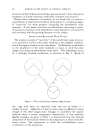
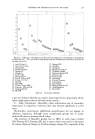
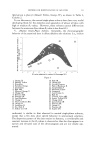
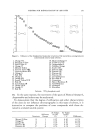
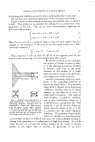
RECENT DEVELOPMENTS IN SURFACE PHYSICS 247 In the practical capillary system 0 is the so-called advancing contact angle. We can illustrate a practical application of this calculation as follows: Figure 1 shows a drop wicking out between two parallel rods on which it is held. The problem is to calculate the wicking force as a function of the separation of the rods. This can be done systematically, applying the following relationships: d__ (Area L,q) = ?1?1' q- BB' = 2A•/' (4) ds d-- (Area SL) = •/B q- •/'B' = 2•/B (5) ds Here the reservoir R is considered large so that we may neglect the area changes in the interfaces of the reservoir as the liquid moves out. Sub- stituting in equation 3: dF •-s = 2•/•:a. AA' -- 2•r•a cos O.,tB (6) Thus, equation 6 tells us that for dF/ds to be negative, and for the liquid to start advancing, •/•/' must be less than .4B.cosine 0. Fig. 1.--Parallel rods surrounded by a large liquid droplet. Top: Liquid front advancing distances between rods at separation r. Lower left: End-on view, rods far apart. Lower right: End-on view, rods close together. For simplicity it is assumed that the sides of the rods are flat and that the air surfaces of the advancing liquid column are flat. By similar methods we can calculate the motion of liquids in yarns or hair, or in the channels formed by wrinkles or furrows, and even in the small channels on the surface of a single fiber, provided we know the geometri- cal configuration of the channels. Another interesting aspect of capil- larity is the spreading behavior of liquids on single fibers. If a wettable single fiber is dipped into a liquid and withdrawn quickly, some of the liquid appears on the fiber as a series of small beads or droplets. The shape of these droplets, is called an unduloid, and is the equilibrium shape of a liquid drop on a cylindrical rod. The unduloid is one of the few shapes for which, like the sphere (1/R• -}- 1/Rs) is constant over the whole liquid-air interface. The problem of getting the liquid to spread out (spontaneously) over the fiber surface is a difficult one, since the even, unbulged coating re- suiting from spreading is a configuration of high free energy. It can be done, however, if we cause the surface tension of the liquid to become greater in one region than in another. In particular, if we lower

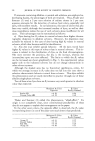
248 JOURNAL OF THE SOCIETY OF COSMETIC CHEMISTS the surface tension in the middle of the drop but not at the ends, the drop will spread. This might be done, for example, by heating the middle of the drop. A more practical way is to dilute the liquid with a miscible component of higher volatility and lower surface tension. As the more volatile component evaporates from the surface of the drop, it is more quickly replaced at the center of the drop, where the reservoir is deep, than at the ends near the three phase solid-liquid-air boundary lines. The net effect is that the surface tension becomes higher at the ends than in the middle, and the drop spreads. A practical example of this effect is the spreading of an oil mist on the nap of a fabric. Here the pure nonvolatile oily liquid remains in place indefinitely, but when diluted with butanol the droplets spread and enter into the dense system of the fabric within a few seconds (4). One of the most interesting phases of capillarity is the behavior of two- phase liquid systems such as emulsions or suspensions. When a simple two-phase system of this type is brought into contact with a solid, a contact angle characteristic of the three materials is formed at the liquid-liquid- solid boundary line. This contact angle is constant regardless of which liquid phase is exterior. Two important cases can be distinguished: one in which the contact angle is zero and the other in which it has a positive value. In the case where the contact angle has a positive value, the liquid which is in excess tends to become the external phase. The droplets of the inter- nal phase stick to the solid surface and resist being dislodged or distorted. In a wicking system of fibers this has the effect of narrowing the channels through which the mass of liquid flows. In this type of system the mixed liquid moves more slowly than either liquid alone would, even though the viscosity has not been increased. In the case where the contact angle is zero the droplets of the internal phase have no tendency to wet the solid surface. In a system of this type the liquid flow is unimpeded except when a droplet or mass of the internal phase is bigger than the channel. When this happens the external liquid is frequently able to distort the drop and force it through the channel. The resistance force of the inner phase (exerted at the liquid-liquid interface in the channel) is calculable. When it is less than the driving force at the liquid-air meniscus we have a situation where the external liquid can act as a carrier to force an otherwise nonwicking liquid into a capillary mass. We have used this effect to impregnate and penetrate fabrics with nonwetting liquids. Unlike the above discussion which relates primarily to wetting and spreading, the following discussion is applicable in problems of detergency and emulsification. The phenomenon of solubilization whereby an aqueous detergent solu-
Purchased for the exclusive use of nofirst nolast (unknown)
From: SCC Media Library & Resource Center (library.scconline.org)