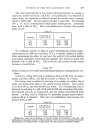
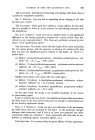
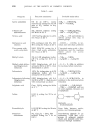
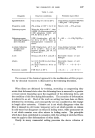
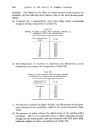
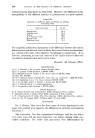
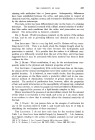
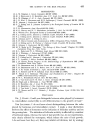
T•E CUEmSTR¾ OF HAm 427 Table I--cont. Reagents Epichlorhydrin Propylene oxide Dibromopropane Dibromopropane following thioglyco- late reduction Acrolein following thioglycolate reduction Acids Alkalis Potassium cyanide Reaction conditions Gas acting for 2 hr at 22 ø C acting at 100øC for 2 hr Water for 18 hr at 35 ø C then 0.002M 1,3-dibromopropane in 1.0M phosphate buffer, pH 8.0, for 20 hr at 35 ø C 0.2M thioglycolate, pH 4.5, for 18 hr at 35øC ß then di- bromopropane treatment as above 0.2M thioglycolate, pI-[ 7, for 24 hr at 22øC then in 3% aqueous acrolein, pH 10, for 18 hr at 50 ø C Strong acids at R.T. and pH 1 (a) 0.1N NaOH for short time at R.T. (b) 0.1N NaOH for 16 hr at R.T. 0.1M KCN at 65 ø C Probable main effect Cross-linking reactions between --NH• and --NH groups Reacts with --NH 2 groups 2 --SH -• --S--CH2CH•CH 2-- S-- Cross-linking between 2SH or between SH and NH• Reversible fission of salt linkages Reversible fission of salt linkages --S--S-- -- --C--S--C-- --S--S-- -• --C--S--C-- The success of the chemical approach to the modification of fibre proper- ties by che•nical treatment is illustrated by the following discussion. Setting When fibres are deformed by twisting, stretching or compressing they retain their deformed state when the deforming force is removed to a greater or lesser extent depending upon the magnitude of the deforming force, and the condition of the fibre during deformation. The retention of deformation is referred to as set. Most of the work on setting has been done on fibres deformed by stretching, and consequently set was considered as the change in length after extension. Cohesive set is set which disappears when the fibre is released in cold water, temporary set is set which persists on release in cold water but disappears on release in boiling water, while permanent set is set which remains even after release in boiling water. The principles which have been established in connexion with the setting of stretched fibres seem to apply to fibre deformations of other kinds. Clearly in many commercial setting processes the above criterion of

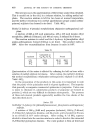
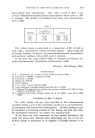
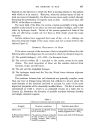
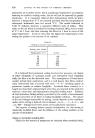
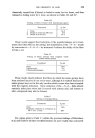
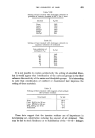
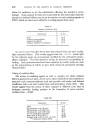
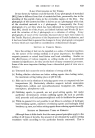
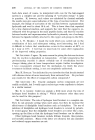
428 JOURNAL OF THE SOCIETY OF COSMETIC CHEMISTS permanent set is rather severe, but if a particular treatment is successful in inducing set stable to boiling water, the set will not be removed by gentler treatments. It is commonly believed that deformations which are intro- duced at a temperature T ø C are retained provided that the temperature of subsequent treatments does not exceed T ø C. The results indicated in Table II indicate, however, a somewhat different state of affairs. They relate to the set which is retained by heating stretched (40}/0) hair in water at T ø C for 1 hour, and then releasing the fibres for 1 hour in water at the same temperature. It can be seen that the higher the temperature of the setting the greater is the amount o[ set retained. Table II Setting of wool at various temperatures Setting and release Temperature (ø C) 70 8O 90 95 100 110 % Set 6.8 8.7 11.4 15.3 23-2 22-3 It is believed that permanent setting involves two processes, viz. fission of either disulphide or hydrogen bonds, and subsequent bond rebuilding while the fibre is in the deformed state. The consequences of bond fission usually include fibre contraction, and it is well known that fibres contract when unstretched hair is treated with such --S--S-- breaking agents as potassium cyanide or sodium bisulphite. Stretched fibres contract to a length less than their original length when they are steamed in the stretched state for a short time, and subsequently released in boiling water. Evidence of bond formation during setting is provided by the results of measurements of supercontraction of set fibres in boiling bisulphite solutions. The nature of the new linkages responsible for setting, clearly depends on the conditions under which setting is induced, but re-formed --S--S--, --C--S--C--, and --S--NH-- linkages have been shown to be particularly important. Two aspects of setting deserve special consideration, viz. the setting of chemically modified fibres, and the influence of the setting medium on the amount of set induced. Setting of chemically modified .fibres Values for the amount of permanent set obtained when stretched {40%)
Purchased for the exclusive use of nofirst nolast (unknown)
From: SCC Media Library & Resource Center (library.scconline.org)