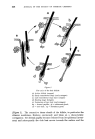
J. $oc. Cosmetic Chemists 15 447-457 (1964) ¸ 1964 :Society of Cos,,•tic Che,n•sts of Great Britain THE ACTIVITY OF THE HAIR FOLLICLE F. J. EBLING, M.Sc., Ph.D., M.I.Biol.* _Presented at the Symposium on "Hair", at Brighton, Sussex, on 16th April 11164. The activity oi the hair lollicle is cyclic, and the t¾1•e ot hair protluced 'may change during ageing or as a result ot hormonal stimulation. Cyclic activity is controlled l•artly by intrinsic and l•artly by systemic •actors such as hormones, and the l•roduction ot these can be influenced by environmental or l•sychological changes. The evidence •om animal experimenkq is reviewed and its relevance to hair growth in man is discussed. Hair loss in man is described in relation to l•hysiological and anatomical changes in the hair follicle. Hair is no more than an ephemeral glory dyed, waved and groomed, locus of the cosmetictans' art and cynosure of admiring eyes, it is soon shed or ,cut off, a disarranged, unwanted cylinder of dead keratin. No apology is made, therefore, for confining this contribution to the living root which, young and healthy so faithfully repairs the cosmetic mistake, ageing and infirm so stubbornly resists therapeutic attack. The follicle which produces the hair is a stocking-like inpushing of the surface epidermis, ensheathing at its base, like a press-stud, the dermal papilla. This papilla is surrounded by a matrix of actively dividing cells, and thus a tube-like mass of kerati- nizing cells is pushed outwards to form the hair. This crude description does not do justice to the fine intricacies of follicular architecture or hair structure, but I am not concerned with these I propose to describe the ,behaviour of the follicle, to discuss what controls its activity and to try to assess what may be learned from experimental research. THE HAIR MOULT CYCLE The activity of individual hair follicles does not continue throughout life. It is intermittent hairs reach a maximum length, fall out, and are replaced by new ones. At the end of the active phase (anagen) the middle region of the hair bulb starts to become restricted and above this restriction the base of the hair becomes expanded and keratinized to form a "club" .*Department of Zoology, The University, Sheffield 10, Yorks. 447

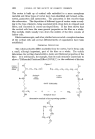
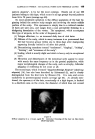
448 JOURNAL OF THE SOCIETY OF COSMETIC CHEMISTS e dp d b ':" $• Figure 1 The cycle of the hair follicle. (a) Active follicle (anagen) (b) Early transitional stage (early catagen) (c) Late transitional stage (late catagen) (d) Resting stage (telogen) (e) Formation of new hair (early anagen) dp= dermal papilla gl = sebaceous gland ch ---- club hair sg ---- secondary germ. {Figur• 1). The connective tissue sheath of the follicle, in particular the. vitreous membrane, thickens enormously and takes on a characteristic corrugation the dermal papilla becomes released from its epidermal invest- ment and subsequently the club hair moves towards the surface and the
Purchased for the exclusive use of nofirst nolast (unknown)
From: SCC Media Library & Resource Center (library.scconline.org)