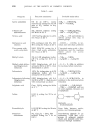
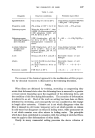
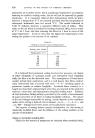
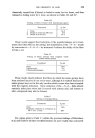
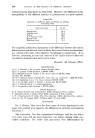
THE CHEMISTRY OF HAIR 435 staining with methylene blue or Janus green. Subsequently, differences have been established between the ortho- and para-cortex in respect of chemical reactivity, sulphur content, and resistance to fibrillation as revealed by the electron microscope. The meta-cortex has been differentiated only on the basis of a staining technique. The material is treated with a dilute, neutral solution of methy- lene blue under such conditions that the ortho- and para-cortex are not stained. The meta-cortex is, however, coloured. DR. J. BLAKE: Would you please comment on the nature of the surface of hair, and its role in governing diffusion and chemical attack on hair keratins ? THE LECTURER: This is a very big field, and Dr. Holmes will say some- thing about it (10). There is no doubt about the changes brought about by removing the surface of hair--the fibre becomes less hydrophobic and penetration is assisted. It is possible that the surface is of different com- position or is differently oriented from the rest of the fibre, and it has been suggested that it may be associated with fatty material but there is little evidence for this. DR. J. BLAK•: What contribution, if any, do the non-keratinous com- ponents make to the physical and chemical properties of hair ? THE LECTURER: Comparatively little work has been done on this topic, for almost all the serious investigations have been carried out on specially purified keratins. It is believed, in some textile circles, that the presence of oil and grease on the fibres exerts a protective effect and in one com- mercial method of chlorination, treatment of greasy material is recom- mended. The method of purification does, however, affect the properties of hair and useful information on the susceptibility of human hair, extracted by various solvents, to attack by papain has been provided by Holmes (11). He has suggested the presence of a lipid-keratin complex in hair. Mercer mentioned the presence of an intercellular cement but the amount of this which is not keratin is very small, and so far as I am aware, there is no evidence to show that it seriously affects the chemical reactivity of the hair. DR. J. BLAKE: DO yOU possess data on the energies of activation for any of the reactions listed in Table I, and would such data be of help in elucidating the mechanisms of these reactions ? THE LECTURER: I do not have such data for the reactions listed in Table I, as these have been studied largely by Lennox (2). I do, however, have figures relating to the action of complex aremines on hair and wool. (10) A. XV. Holmes J. Soc. Cosmetic Chemists 15 In the press (1964). (11) A. W. Holmes J. Textile Inst. 50 T422 (1959) Nature 189 923 (1961).

JOURNAL OF THE SOCIETY OF COSMETIC CHEMISTS Such data must, of course, be interpreted with care for the hair-reagent system is a complex one and the meaning of "activation energy" is open to question. If, however, such values are calculated by classical methods the results may give some indication of the type of reaction involved. For example, the energy of activation of the reaction between cuprammonium hydroxide and wool is about 18 k cal. This is lower than that expected for a true chemical reaction, and supports the view that the copper is co- ordinated with the groups in the main peptide chains, and that the reaction between keratin and cuprammonium hydroxide is primarily one of exchange between the ligands initially attached to the copper and groups in the fibre. DR. A. W. HOL•tES : I found the work which you carried out on the esterification of hair, and subsequent setting, most interesting, but I find it difficult to believe that esterification occurs in five minutes at 50øC, or in 1 hour at 10øC. I feel that we must look for some other explanation of the improved setting properties. THE LECTURER: I agree. My main reason for giving the data was to stress that the reaction is dependent on temperature. At high temperatures the predominating reaction is almost certainly one of esterification but the changes taking place at lower temperatures require further investigation. I have consequently stressed that the mechanism, by which the above treatments facilitate setting, is not yet completely understood. MRS. H. BUTLER: You indicated in your introduction that keratin treated with silicone retains oil more tenaciously than untreated hair. Do you have any results for the effect of comparable carbon compounds ? THE LECTURER: No. Exactly analogous carbon compounds are not readily available, but I would expect carbon-type water repellents to behave in a similar manner. MR. E. A. GOODE: Could you explain a little more about the role of hydrogen bond breakers in setting ? Which substances other than urea can be used for this purpose ? THE LECTURER: The role of hydrogen bond breakers is a complex one. They do not promote setting when used alone, but they do increase the effectiveness of disulphide bond breakers such as bisulphites. The use of mixtures of bisulphites and hydrogen bond breakers is covered by patents. It would appear that the disulphide bond breakers act rather like a key, opening up the fibre so that the hydrogen bond breakers can be effective. Other hydrogen bond breakers include lithium bromide, thiocyanates, and metallic ammines. Many of the latter are coloured, but zinc ammines and reduced copper ammines are not.
Purchased for the exclusive use of nofirst nolast (unknown)
From: SCC Media Library & Resource Center (library.scconline.org)