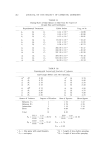
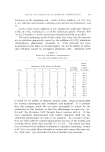
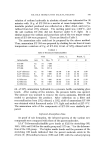
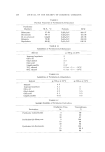
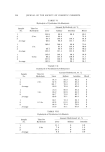
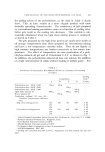
USE OF ANTI-IRRITANTS IN COSMETIC FORMULATING 325 it was an effective anti-irritant for this cologne formula, eliminating all corneal opacity and reducing total irritation scores to about one-third. An interesting insight into the mechanism by which this anti-irritant operates is provided by Formula "H" which contains Miranol 2MCA modified, the equi-molar reaction product of Miranol C2M with sul- fated lauryl alcohol, which quite obviously is not an anti-irritant. One is led to believe that the anti-irritant activity of Miranol C2M derives from its ability to combine chemically with an irritant and that combination with one irritant leaves no activity against others. Finally, thiodiglycolic acid was tried because of claims in a British patent (3) indicating that this material was valuable as an anti-irritant for certain scalp preparations. It was only partially successful against eye irritation in this aerosol cologne formula. In other tests it actually increased the eye irritation caused by an antiperspirant formula, but lowered the primary skin irritation produced by a topical proteolytic enzyme preparation (Table III). This pattern, of a material acting sometimes as an irritant and sometimes as an anti-irritant, will be observed again in the case of other additives. As a matter of interest, four of the above anti-irritants were also tested in a "Cologne Ice" type of preparation containing 2.5% perfume in a hydroalcoholic system gelled with an amine-neutralized "Car- bopol" polymer (B. F. Goodrich Chemical Co.). This preparation was judged "mildly irritating" after producing primary skin irritation TABLE III Patch Test of Proteolytic Enzyme Preparations Reactions to 24-Hr. Nonocclusive Patch 0 1+ 2+ Controls Oil gel placebo 10 0 0 Oil gel q- 2 % protease 10 0 0 O/W emulsion placebo 0 9 1 O/W emulsion q- 2% protease 0 9 1 Anti-irritant study-- O/W Emulsion q- 2% protease (a) Plus 6% Na lactate 1 3 6 (b) Plus 1% glycogen 2 3 5 (c) Plus 0.5% dithioglycolic acid 3 7 0 Note: Severity of reactions: Scoring was performed immediately after removal of patch, 24 hr after application of 0.05 g. of test material, as follows: O--no visible reaction 1 mild erythema, no edema and 2q---moderate erythema, moderate edema and induration.

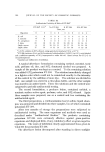
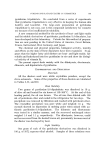
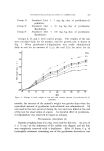
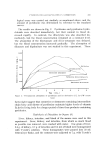
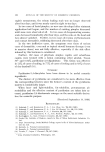
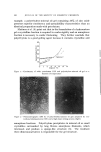
326 JOURNAL OF THE SOCIETY OF COSMETIC CHEMISTS indexes (12) varying from 0.5 to 2.0 when applied to rabbit skins. Each of the following agents, when added separately to the base formula in the quantities shown, reduced primary skin irritation to zero: 0.15% Miranol C2M (Miranol Chemical Co.) 2.00% Pluronic F68 (Wyandotte Chemical Corp.) 0.30% PVP-K30 (General Aniline Film Corp.) 0.50% Polypropylene Glycol P-2000 (Dow Chemical Co.) •lentholated Alcoholic Product An alcoholic facial preparation had been marketed for a number of years without causing skin or eye irritation complaints. Although its alcohol content was very high, the product did not sting, apparently because it contained over 10% of a bland, liquid fatty acid ester. When an effort was made to formulate a "mentholated" version of the same product, it was found necessary to add an unexpectedly large percentage of menthol (0.7ø•0) to achieve noticeable skin cooling in the presence of this fatty ester. As can be seen in Table II, the resulting product (Code B) was fairly irritating to the rabbit eye. Addition of PVP (K30) (Code C) reduced corneal opacity, but on the other hand its presence resulted in slightly increased conjunctival scores. In contrast, addition of Miranol C2M was dramatically successful, reducing the eye irritation to zero at all stages for all the rabbits tested. Topical ProteolyZic Enzyme Preparation As part of a study to determine the irritation potential of topical preparations containing proteolytic enzymes, several vehicles were evaluated, and the effect of various additives to these vehicles was then determined. After preliminary screening by repeated insult techniques on rabbits, nonocclusive "Band-Aid" patches were applied to ten human volunteers for twenty-four hours. The results are shown in Table III. The proteolytic enzyme was included at 2% concentration in two different bases, one a W/O gel, the other a typical nonionic O/W emulsion. Quite clearly, the oily gel proved to be the vehicle of choice from a safety standpoint. It produced no irritation at all, either as a placebo or when carrying the protease. In fact, its very inertness raised doubts regarding the potential efficacy of the product.
Purchased for the exclusive use of nofirst nolast (unknown)
From: SCC Media Library & Resource Center (library.scconline.org)