J. Soc. Cosmetic Chemists, 16, 309-315 (1965) The Action of Hair Sprays on Hair MARTIN G. BROOKINS, M.S.* Presented before the New England Chapter, April 23, 196•, Framingham, Mass. Synopsis--Observations are made concerning the mechanism of hair spray application and holding. Indirect evidence leads to the author's hypothesis that wetting by alcohol per se is not responsible for curl rclaxation. INTRODUCTION Since holding in a hair spray is due mainly to the mechanical rigidity of the resin deposit formed on hair fibers, its application becomes important. By studying how the resin deposit is formed on hair fibers, the degree of holding of different types of film formers and the effect of resin distribution throughout the entire mass of hairs can be assessed. The application also depends upon the wetting properties of the solvent vehicle on hair. In most commercial aerosol hair sprays today, the main solvent is alcohol, with halogenated hydrocarbons used as solvents and propellants. By the time the liquid hair spray droplet strikes the hair, most of the propellant has evaporated, leaving only a residual amount present in the droplet. The amount of "flow-out" of the droplet on the hair fiber depends upon the degree to which the droplet wets the hair fiber and also depends upon the mobility of the droplet after it strikes the hair fiber. It is known, for instance, that a hair spray container packed with 50% alcoholic concentrate and 50% propellant provides a much wetter spray than one packed with 70% propellant and 30% alcoholic concentrate. A wet spray, 50f50 type /assuming that the * John H. Breck, Inc., Springfield, Mass. 309

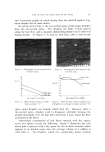
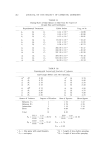
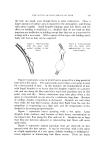
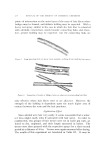
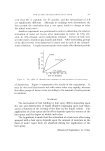
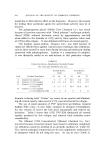
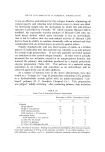
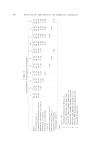
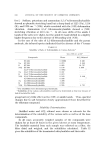
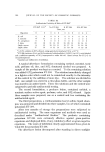
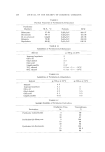
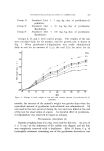
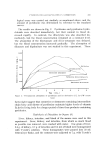
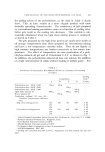
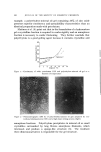
310 JOURNAL OF THE SOCIETY OF COSMETIC CHEMISTS same valve, pressure, and button system is used on both types of spray), will wet the hair much faster and more thoroughly than a 70/30 pack. RESULTS AND DISCUSSION The Holding Effect An attempt will be made to assay the dynamics of distribution, impingement, and holding by citing experimental results derived from the examination of a typical dry spray (i.e., 70/3() pack) versus a typical wet spray (50/50 pack). It may be stated at this point that there are other factors which influence the wetness of a hair spray. Valve orifices and internal container pressures are also important, but the TABLE I Experimental Design---Wet Versus Dry Spray Droplet Volume 1. Variables A. Product 1. A1 = Product :t (dry spray) (a) Alcoholic concentrate 30% (b) Freon 11/12 70% 2. A• = Product B (wet spray) (a) Alcoholic concentrate 50% (b) Freon 11/12 50% B. Spraying tiTne 1. Bi -- One-second burst 2. Bs = Two-second burst C. Drying time 1 C, = No drying titne 2. C,2 = One minute after spraying 3. C:• = Three minutes after spraying I I. Parameter Observed droplet volume as a function of all variables most important factor will be the amount of dilution of the concentrate with propellant. A series of experiments were conducted in accordance with the design outlined in Table I. In this experiment, cans repre- senting variable J were held in a fixed position and sprayed on hair shanks at a distance of 12 in. Time sequence photographs were taken so that measurements of approximate droplet diameters could be made with an optical comparator. Examples of time sequence photographs appear in Figs. 1 and 2. Droplet volume was calculated and recorded in cubic inches. Results were reported as mean droplet volume where .\• (number of droplets) varied from five to ten (Table II). Figures 3
Purchased for the exclusive use of nofirst nolast (unknown)
From: SCC Media Library & Resource Center (library.scconline.org)