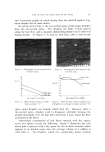
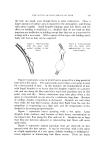
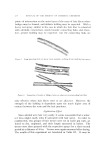
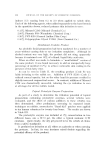
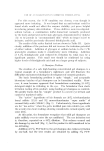
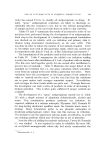
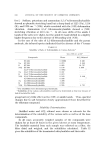
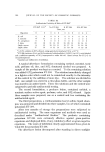
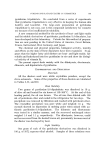
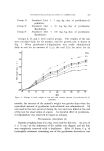
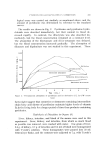
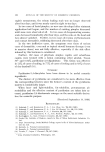
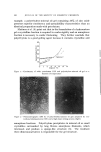
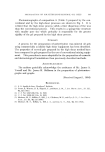
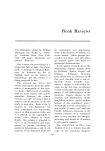
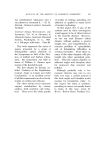
THE ACTION OF HAIR SPRAYS ON HAIR 313 the hair, are small, even though there is some coalescence. Thus, a larger amount of surface area is exposed to the atmosphere, and drying takes place rapidly. Small droplets impinge upon hair fibers, and the effect on holding is statistical, i.e., droplets that do not land on fiber junctions are ineffective in holding except that they act as a reservoir for setting with a wet comb. With a spray of this type, soft holding and a fairly soft feel on hair can be expected. Figure 5. Brief spraying with dry spray (note partial wetting of hair shaft) Figure q. Long spraying with dry spray (note agglomeration to form large droplets) Figure 6 represents a case in which hair is sprayed for a long period of time with a dry spray. The same results occur when a wet spray is used for a short period of time. In this instance, the bombardment of hair with liquid droplets is so heavy that the droplets coalesce at a greater rate and run along the fiber until they reach hair junctions and, at this point, stop and dry. Heavy coalescence may take place when a dry spray is concentrated on one area for a relatively long time. Because of cooling, droplet evaporation is decreased. Droplets are cool when they strike the hair fiber because, during their flight from the can, the propellant is evaporating at a high rate, and the temperature of the droplets is decreasing proportionately. Figure 7 represents heavy spraying with a wet spray. Large droplets form, coalesce, and, because of their heavy concentration at the impact site, flow along the fiber and wet it. Droplets are so large that flow-out between adjacent or intersecting hair fibers will occur quite easily. Figure 8 represents typical junctions that are observed on hair sprayed with dry hair sprays. It can be seen that, with a dry spray or a light application of a wet spray, definite bonding or bridging tween adjacent or intersecting hair fibers occurs. There are many

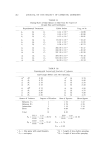
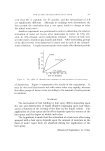
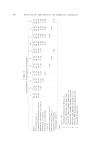
}14 JOURNAL OF TtlE SOCIETY OF COSMETIC CHEMISTS points of intersection on the outer layer of the mass of hair fibers where bridges may be formed, and definite holding may be expected. With a heavy wet spray, similar to the case in which the hair fiber is saturated with alcoholic concentrate, much broader connecting links and, there- fore, ,greater holding may be expected but the connecting links are Figure 7. Long spraying with wet spray (note complete wetting of hair shaft by hair spray) Figure 8. Formation of bonds or bridges between adjacent or intersecting hair fiber only effective where hair fibers cross or are adjacent. However, the strength of the holding is dependent upon the much higher area of contact between the resin and the hair junctions. A pp•ico, iion Effect, Since alcohol wets hair very easily, it seems reasonable that a water- set tress might easily relax if saturated with hair spray. In order to confirm this, two groups of hair tresses were set in water pin curls, al- lowed to dry, unpinned, and their length measured in inches. The tresses were then sprayed with the respective sprays for a three-second period at a distance of 10 in. Tresses were again measured after drying. The results of this experiment are tabulated in Table III. It may be
Purchased for the exclusive use of nofirst nolast (unknown)
From: SCC Media Library & Resource Center (library.scconline.org)