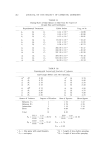
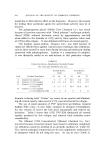
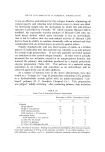
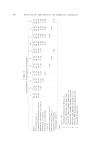
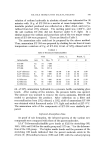
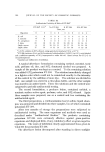
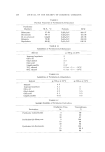
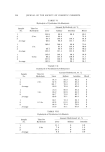
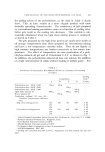
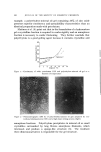
USE OF ANTI-IRRITANTS IN COSMETIC FORMULATING 329 tivity has caused F.D.A. to classify all antiperspirants as drugs. Fi- nally, "spray" antiperspirant containers are likely to discharge ac- cidentally into the consumer's eyes, due to the normal juxtaposition of armpit and face as the user looks down in order to aim correctly. Tables IV and V summarize the results of an extensive series of eye irritation tests performed during the development of an antiperspirant. Each step in the development of a finished antiperspirant formulation was checked on six rabbits, with eye irritation and primary skin ir- ritation being determined simultaneously on the same rabbit. This was done in order to reduce the number of test animals required. Even so, 84 rabbits were used in this particular study, which was carried out in cooperation with John D. Paul, Jr., of Bio-Toxicology Laboratories.* The formulations of the products used in this test series are detailed in Table IV. Table V summarizes the rabbit's eye irritation reading seventy-two hours after instillation of 0.1 ml. of product with no rinsing. (The lids were held together gently for one second after instillation to prevent loss of material.) Table V illustrates the major defect of the standard eye irritation test, i.e., the gross variations which sometimes occur from one animal to the next within a particular test series. These variations force the investigator to use large groups of test animals in order to "smooth out the curve," yet the very fact that the variations are so gross makes such averages somewhat suspect. Nevertheless, such averages do show trends which are quite real. Through their use, the investigator can rank a series of products in order of decreasing ir- ritation potential. This is often quite sufficient if proper controls are available. The development of a "spray" antiperspirant started (see A, Table IV) with a simple mixture of aluminum chlorhydroxide, alcohol and water. This combination produces moderate eye irritation. As expected, addition of a cationic antiseptic (Hyamine 1622, Formula B) for long-lasting deodorant qualities made the formula much more ir- ritating. Many formulators prefer to use phenolic antiseptics in deodorant-antiperspirants rather than risk this increase in irritation. The decision to use the quaternary salt was made, nevertheless, to avoid any staining problems which may develop due to use of phenolics. Next the effect of adding the nonionic surfactant, Tween 20 (Formula C), was studied. It was required in order to solubilize Myvacet 940, an acetylated monoglyceride whose oily feel nicely counteracted the * Merchantville, N.J.

33O JOURNAL OF THE SOCIETY OF COSMETIC CHEMISTS
Purchased for the exclusive use of nofirst nolast (unknown)
From: SCC Media Library & Resource Center (library.scconline.org)