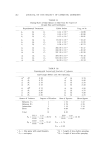
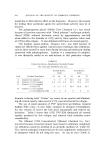
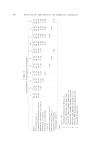
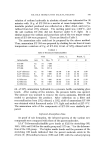
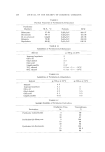
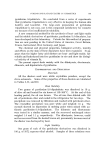
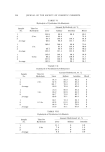
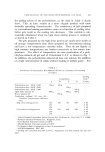
PYRiDOXINE-3,4-DIACYLATES IN COSMETICS 357 solution. One mi. of one of the pyridoxine-3,4-diacylates solutions was added, and the flasks were shaken for 0.5, 1 or 2 hours at 37øC to hydrolyze the ester. After shaking, 3 mi. of 10g aqueous trichloro- acetic acid solution was added, and the mixture was centrifugcd. Five mi. of the supernatant was neutralized with 1.5% NaOH solution. For 1 mi. of the solution thus obtained, concentration of pyridoxine was determined by using 2,6-dibromoquinone chloroimide at 650 mt•. The results are shown in Tables VI, VII, VIII, and IX. It can be seen that the dibutyrate was rapidly hydrolyzed in the blood and TABLE IX Hydrolysis of Pyridoxine-3,4-dipalmitate Amount Hydrolyzed, wt. % Sample Time for No. Hydrolysis Liver Kidney Intestine 1 0 0 0 2 2.3 0 0 3 2 hr. 1.3 0 0 4 0.4 0 0 Average 1.0 0 0 organ homogenates. The dioctanoate was not hydrolyzed in the blood but slightly in the organ homogenates. On the other hand, dilaurate and dipalmitate were not hydrolyzed even in the liver homogenate. Derreal Therapy During the clinical test, which was designed to demonstrate efficacy against several kinds of dermatitis, such as eczema and seborrhoea, hydrophilic ointments and lotions containing 0.2% and 0.02% pyr- idoxine-3,4-dipalmitate respectively were applied topically. The re- sults showed that pyridoxine-3,4-dipalmitate was an effective treatment for skin diseases without any harmful side effects. It is also noted that this substance showed marked antidandruff and anti-itching properties, as judged from the following studies. Fourteen dermal outpatients (7) suffering from eczemas and seborrhoea were treated with a hydrophilic ointment containing 0.2% pyridoxine-3,4- dipalmitate for seven to twenty days. This treatment was very effec- tive in six cases, satisfactory in six cases and ineffective in two cases. In three cases of seborrhoea and especially dermatitis of the face, patients felt a cooling sensation immediately after application sebum vanished day by day. In one case of rosacea (of the first degree), red- dening was reduced, oily luster vanished after ten days, and the disease was cured completely on the fourteenth day. In two cases of seborrhoea

358 JOURNAL OF THE SOCIETY OF COSMETIC CHEMISTS capiris neonatorum, the sebum leaking scab was no longer observed after four days, and it was nearly cured in eight to ten days. In two cases of facial pimples, no new ones developed after ointment application had begun, and the number of existing pimples decreased until none were observed at all. In two cases of desquamating eczema, scale decreased remarkably after four days, and the scale on the head and face almost vanished. Further, in two cases of eczema erythematosum and contact dermatitis, reddening decreased after three days. In the two ineffective cases, the symptoms were those of serious cases of dermatitis even oral or topical steroid hormone therapy (even in massive doses) was not fully effective, especially if the side effect induced by this hormone is considered. Further, 162 cases of pityriasis simplex capiris and seborrhoea capiris were treated with a lotion containing ethyl alcohol, Tween 80* and 0.02% pyridoxine-3,4-dipalmitate. This lotion was effective in 75% of cases of scaling, in 77% of cases of itching and in 85% of cases of dry dandruff (10). SUMMARY Pyridoxine-3,4-diacylates have been shown to be useful cosmetic ingredients. The diesters of pyridoxine are considered to be more effective than the corresponding triesters since the former's content of the pyridoxine moiety is considerably larger. When heat- and light-stability, fat-solubility, percutaneous ab- sorbability and the effective content of pyridoxine are taken into ac- count, pyridoxine-3,4-dioctanoate emerges as the most suitable deriva- tive for cosmetic purpose. (Received September 14, 1964) REFERENCES (1) Sakuragi, T., and Kummerow, F. A., J. Am. Chem. Soc., 78,839 (1956). (2) Sakuragi, T., and Kummerow, F. A., J. Am. Oil Chemists' Soc., 33, 116 (1956). (3) Sakuragi, T., and Kummerow, F. A., J. Nutrition, 58, 557 (1956). (4) Sakuragi, T., and Kummerow, F. A., Arch. Blochem. Biophys., 63, 32 (1956). (5) Rocheggiani, G., Soap, Perfumery Cosmetics, 34, 547 (1961). (6) Osaka City Institute of Hygiene, reports in files of Nihon Surfactants Industries Co. Ltd. (7) Dept. Dermatology, Osaka Medical College, report in file of Nihon Surfactants Indus- tries Co. Ltd. Kamada, A., Personal communication. Kamada, A., Personal communication. Yasuda, T., Japan. J. Dermatol., 73,487 (1963). * Atlas Chemical Industries, Wilmington, Del. (8) (9) (10)
Purchased for the exclusive use of nofirst nolast (unknown)
From: SCC Media Library & Resource Center (library.scconline.org)