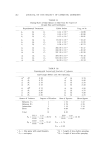
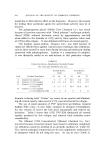
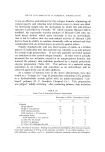
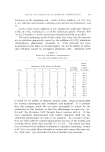
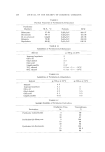
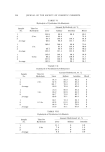
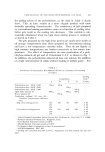
USE OF ANTI-IRRITANTS IN COSMETIC FORMULATING 331 harshness of the aluminum salt. Each of these additives (at 5%) was a very effective anti-irritant, reducing scores in half (see Formulas C and D). On the other hand, addition of the amphoteric surfactant Miranol C2M (at ().3%, Formula E), or of the surfactant polyol, Pluronic F68 (at 2%, Formula F), to the control base formula had little or no effect. The most surprising result of this whole test series was the increase in eye irritation apparently caused by the addition of 0.25% aluminum chlorhydroxy allantoinate (Formula G). This material has been mentioned several times by dermatologists (14) for its ability to reduce skin irritation caused by astringent aluminum salts. Allantoin itself TABLE V Draize Eye Test Scores--Antiperspirants (No wash after instillation into eye) Individual 72 Hr. Scores for Rabbit Code 1 2 ,3 4 5 6 _ CulylU- lative Average, 7 Days (• 72 Hr. (Average) A 6 6 2 4 6 4 4.6 27.0 B 8 12 4 8 6 4 7.0 36.6 C 8 2 0 2 4 0 2.7 20.3 D 4 4 6 2 2 2 3.3 21.6 E ll) 6 6 2 10 8 7.0 36.7 F 0 12 12 4 2 4 5.7 36.2 G 13 41 18 6 10 32 20.0 108.2 H 2 2 4 0 0 0 1.3 21.3 I 2 0 0 6 2 6 2.7 16.6 J 2 4 4 10 8 8 6.0 32.3 K 6 4 2 2 4 12 5.0 32.0 is noted for its ability to disperse keratin scales, being recommended for various pathological skin conditions and dandruff. It is possible that this property made the eye more susceptible to attack by the quaternary in this formula, or that the allantoinate in some way "ac- tivated" the Hyamine 1622 through direct reaction with it. It has been repeatedly demonstrated that neither allantoin itself nor the aluminum allantoinates are skin or eye irritants. As a matter ef fact, they are often added to topical preparations because of the healing and soothing effects which they provide (15, 16, 22). The author has long been convinced that addition of allantoin to lipsticks containing "bromo acid" dyes can make them tolerable to women who cannot otherwise use the "high stain" type of product for fear of cheiliris type reactions.

332 JOURNAL OF THE SOCIETY OF COSMETIC CHEMISTS The most significant anti-irritant effect was noted when both Tween 20 and Myvacet 940 were present in the antiperspirant spray (Formula H). The seventy-two-hour eye irritation scores for this formula averaged only one-fifth those of the control, Formula B. Additions of Pluronic F68 (Formula J) or aluminum chlorhydroxy allantoinate (For- mula K), seemed to nullify some of the anti-irritant effects produced by the Tween-Myvacet combination. The primary skin irritation test results for this series were not interesting at all. Draize (12) defines topical preparations as "mildly irritating" if they show a primary irritation (PI) index no higher than 2.0. The control product for primary skin irritation Formula A, was applied to each rabbit simultaneously with the various test products. It gave PI indices which varied from 0 to 0.25 the test formulation PI indices varied from 0 to 0.44. In order to try to visualize primary irritations more clearly, Trypan Blue injections were attempted. Since none of the formulations was a primary irritant (when applied according to the techniques of Draize), all of these attempts to deter- mine possible topical anti-irritant effects were useless. CONCLUSIONS Some will question the validity of the test results reported in this paper, saying that the irritation tests themselves are not valid because of inability to reproduce them exactly. The eye is too sensitive and too variable an organ to react consistently when subjected to the type of insult called "the eye irritation test" (see Table V). In contrast, the skin's role of acting as a protective layer for the body means that it is inherently resistant to insults by various foreign matehals. As a result, irritation test results sometimes vary wildly and at other times show almost nothing at all. This is unfortunate, but nevertheless the fact remains that some products are irritating to the body, and some are not. Crude as they are, no one should doubt that animal irritation tests of this sort are worth carrying out. Even "average" results are better than no indica- tion at all, and such averages in fact are sufficiently reliable to rank a series of products to determine their order of irritation potential to humans. We will not know the exact extent of the irritancy or anti-irritant usefulness of various matedhals until we have developed more refined irritation testing procedures. In the meantime, we must work with what is available to us. The available evidence points very strongly to
Purchased for the exclusive use of nofirst nolast (unknown)
From: SCC Media Library & Resource Center (library.scconline.org)