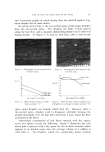
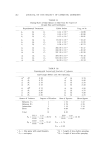
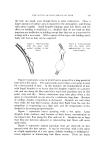
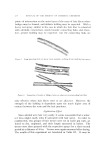
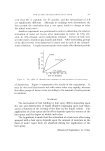
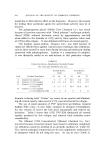
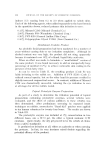
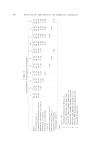
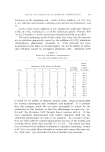
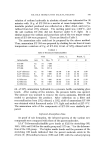
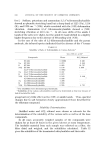
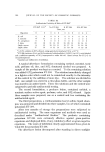
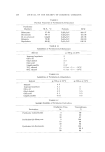
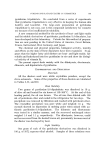
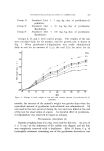
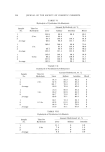
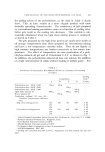
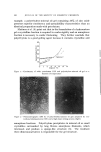
PREPARATION OF POLVETHYLENE-MINERAL OIL GELS 361 the gelling action of the polyethylene, as the data in Table I clearly show. This, in turn, results in a more elegant product with more desirable spreading characteristics. The consistency of gels prepared by conventional mixing procedures varies as a function of cooling rates. Softer gels result as the cooling rate decreases. This variable is sub- stantially eliminated when the high shear mixing process is employed, as shown in Table I. The gels prepared by the high shear process are much more stable at all storage temperatures than those prepared by conventional mixing and have a low temperature viscosity index. They do not liquefy at high summer temperatures nor harden excessively at low winter tem- peratures. The effect of temperature on cone penetration of a poly- ethylene-mineral oil gel and of Petrolatum U.S.P. is shown in Fig. 1. In addition, the polyethylene-mineral oil base can tolerate the addition of a high concentration of solids without making it unduly pasty. For TABLE I Consistency of Polyethylene Wax-Mineral Oil Gels as a Function of Processing Procedure Cooling Composition Rate? A B C D øC/min. Polyethylene wax M.W. 1500 • Polyethylene wax--M.W. 2000 • Polyethylene wax--M.W. 7000 •' Light white mineral oil c Heavy mineral oil d Penetration readingsZ (0.1 min. div., "Precision" penetrometer with brass COliC) High shear mixing process Conventional nfixing process 120 g. 120 g ....... ...... 120 g .... ......... 120 g. 880 g .... 880 g. 880 g. ... 880 g ....... ß . 215 212 210 370 270 190 195 191 300 • 0.35 ......... O. 50 ......... 3.00 370 620 34() • O. 35 ......... 0.50 ......... 3.00 • Allied Chemical Corporation, Solvay Process Div,, 40 Rector St., New York, N.Y. 10006. • Eastman Chcmical Products, Inc., Kingsport, Tenn. c 65/75 Saybolt Universal seconds at 100øF. d 300/360 Saybolt Universal seconds at 100øF. • Gel displays slight oil separation at time of measure•nent. / ASTM Designation: D217-60T. a Cooling rate controlled from 90 ø to 45øC. Preparation •vas then poured into jars and tubes.

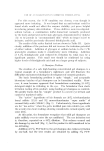
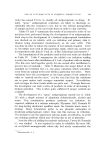
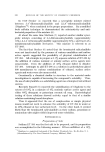
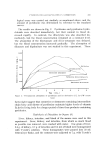
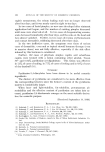
362 JOURNAL OF THE SOCIETV OF COSMETIC CHEMISTS example, a polyethylene-mineral oil gel containing 30% of zinc oxide possesses superior consistency and spreadability characteristics than an identical preparation made with petrolatum. Mutimer et al. (6) point out that in the formulation of a hydrocarbon gel a crystalline fraction is required to confer rigidity and an amorphous fraction is necessary to confer thickening. They further conclude that polyethylene is a good gelling agent because it contains crystalline and 6OO 500 o_q400 . .[ 300 "=" 200 .... ....................... •.. -I0 0 I0 20 30 40 Tempe•olu•e (=C) Figure /.--Consistency of white petrolatum USP and polyethylene-mineral oil gel as a function of temperature ::•:"' ::• "' ..i'• •-•:' ........ ' ........... •':•: ..•.... :-:• :• ... '•.• ß •' -.:- ... • .... •. '•.• ].•"., -. .• •a ..%.•- ?..?• - :.,. •. •'} . : .•-[ ..'..: ..• . . '½"•:•¾%::'• ..• ........... • ......... Figure •.•Photomicrographs (•60 X) of polyethylene-mineral oil gels prepared by con- ventional mixing process (left) and a high-sh•r mixing process (right) amorphous fractions. Polyethylene precipitates in mineral oil as small crystallites surrounded by long fibrous amorphous filaments, which intermesh and produce a sponge-like structure (6). The resultant three-dimensional lattice is responsible for the gel structure.
Purchased for the exclusive use of nofirst nolast (unknown)
From: SCC Media Library & Resource Center (library.scconline.org)