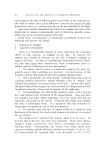
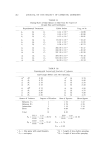
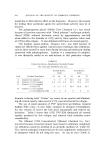
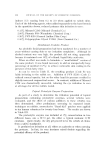
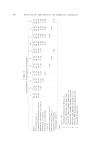
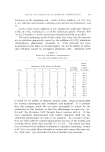
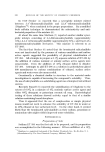
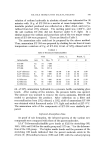
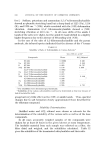
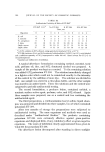
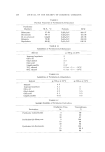
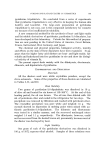
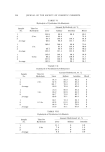
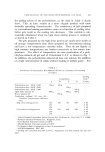
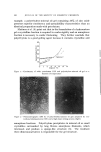
310 JOURNAL OF THE SOCIETY OF COSMETIC CHEMISTS same valve, pressure, and button system is used on both types of spray), will wet the hair much faster and more thoroughly than a 70/30 pack. RESULTS AND DISCUSSION The Holding Effect An attempt will be made to assay the dynamics of distribution, impingement, and holding by citing experimental results derived from the examination of a typical dry spray (i.e., 70/3() pack) versus a typical wet spray (50/50 pack). It may be stated at this point that there are other factors which influence the wetness of a hair spray. Valve orifices and internal container pressures are also important, but the TABLE I Experimental Design---Wet Versus Dry Spray Droplet Volume 1. Variables A. Product 1. A1 = Product :t (dry spray) (a) Alcoholic concentrate 30% (b) Freon 11/12 70% 2. A• = Product B (wet spray) (a) Alcoholic concentrate 50% (b) Freon 11/12 50% B. Spraying tiTne 1. Bi -- One-second burst 2. Bs = Two-second burst C. Drying time 1 C, = No drying titne 2. C,2 = One minute after spraying 3. C:• = Three minutes after spraying I I. Parameter Observed droplet volume as a function of all variables most important factor will be the amount of dilution of the concentrate with propellant. A series of experiments were conducted in accordance with the design outlined in Table I. In this experiment, cans repre- senting variable J were held in a fixed position and sprayed on hair shanks at a distance of 12 in. Time sequence photographs were taken so that measurements of approximate droplet diameters could be made with an optical comparator. Examples of time sequence photographs appear in Figs. 1 and 2. Droplet volume was calculated and recorded in cubic inches. Results were reported as mean droplet volume where .\• (number of droplets) varied from five to ten (Table II). Figures 3

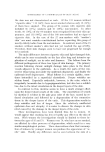
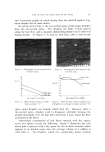
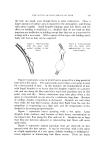
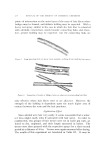
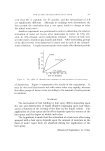
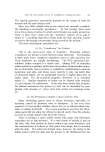
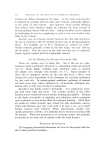
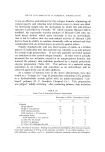
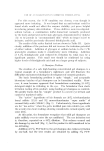
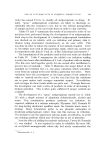
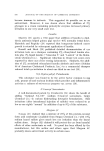
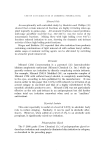
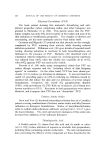
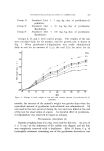
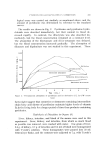
THE ACTION OF HAIR SI'R_\\'S ON HAIR 311 and 4 represent graphs in which drying time was plotted against Log,. mean droplet size in cubic inches. As can be seen in Fig. 3, the two-second spray yields larger droplets than the one-second spray. The droplets are fairly evenly spaetd along the hair fiber, and a regularly diminishing droplet size is observed during drying. In Figure 4, it may be seen that, after a one-second Figure 1 Photograph of hair sprayed with dry hair spray ß ..•....i .. :•2! '•'" .• ...... 5.- . ß • .•'.7,. ß ß :'.":': "• ..... ":•' : Figure 2. Photograph of hair sprayed with wet hair spray -10. -II LOGe IN5 -12 -13 -14 •, 47 ' 2 second SI•Qy - •8 i [ -•-41 seco_nd sEr_ay o I 2 3 TIME IN MI•TES •TER SPRAYIN• LOG e •r,• - 12 -14 -15 -16 _ o I SECOND SPRAY 0 2 SECONSPRA 0 I I I i 2 3 TIME IN MINUTES AFTER SPRAY1NG Figure 3. Mean droplet volume in cubic Figure 4. Mean droplet volume in cubic inches inches: product "A" drying time as a change in w)lume: product "B" spray, giant droplets are formed, which then dry. However, after a two-second spray, droplets tend to disappear, probably because the alcohol thoroughly wets the hair fiber and forms a layer about the fiber and between the fibers. Microscopic examination of hair fibers sprayed with dry sprays versus wet sprays reveals the following: Figure 5 illustrates the case where hair is sprayed with a dry spray for two to three seconds, which appears to be normal usage since the average volume of a coiffure is 1000-3000 ec. The droplets, which dry considerably before striking
Purchased for the exclusive use of nofirst nolast (unknown)
From: SCC Media Library & Resource Center (library.scconline.org)