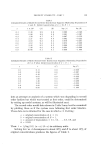
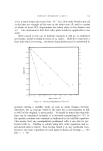
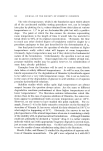
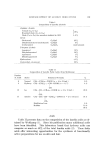
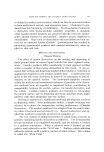
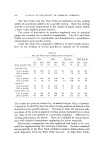
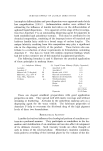
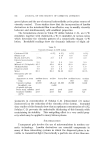
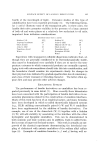
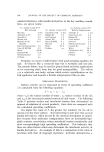
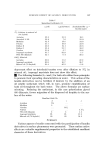
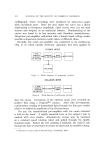
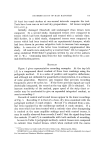
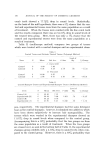
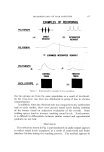
146 JOURNAL OF THE SOCIETY OF COSMETIC CHEMISTS that this simplifies both the statistical analysis and the task of judging the degree of conformity of the results to the Arrhenius equation. Table III shows four series of suggested storage temperatures which fit Toot- ill's design. Times and temperature set chosen would be determined depending on the degradation rate, to get the length of the experiment to a manageable or convenient length. Kennon (11) illustrated the utility of mathematical models in deter- mining chemlcal,stabfi•ty. The construction of the reference reaction paths he used was based on considerations involving heats of activation and shelf-life goals. From these paths a logical assay schedule arose. The schedule is actually based on the temperatures chosen for sample storage and would change if another set of storage conditions were used. An example of a set of suggested storage conditions and an assay schedule are shown in Table IV. Lordi and Scott (12) reported on their development of nomographic stability charts which were designed to facilitate the analysis and en- hance the utility of data obtained from stability tests. In connection with these efforts, they also suggested a stability program design based on probable heats of activation and t90's. They suggest the times and temperatures shown in Table V. Normally only one of the sets (either the 41.5-60 øC or the 46-70 øC) would be used. Two additional--and untraditional--types of stability testing proce- dures are also worthy of note. These methods of "placement" are quite different from those discussed so far. Eriksen, Pauls, and Swintosky (13) investigated the accuracy of heating-time measurements as they are affected by time lags during the heating and cooling of samples during a stability study. They developed an equation relating sample heating or cooling rate, storage time and temperature, and the heat of activation. This provided the ETTE or "equilibrium temperature time equivalent," and this information en- abled one to get better data for kinetic calculations. These techniques may not appear to be especially useful for our purposes, but they are most valuable when one works with high temperatures for short times, or with very large bulks, or when heat conductivity factors are not ideal. In a subsequent paper these authors (14) presented some additional infor- mation concerning applications of this technique in a tablet stability study. Some years later Eriksen and Stelmach (15) devised and illustrated with appropriate data a "one step" method of implementing a kinetic study. The technique uses a "reciprocal heating machine" to make a

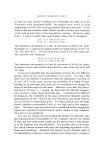
PRODUCT STABILITY--PART I 147 single nonisothermal run which is considered to be equal to a complete stability study. Essentially, the sample is subjected to a programmed change of temperature-time conditions. Some function, then, which represents both temperature and concentration, is obtained from samples removed and analyzed during the run. Plotting of the function rs. time produces a straight line from which both the heat of activation and the specific reaction rate constant may be calculated. Rogers (16) also presented a similar accelerated storage testing technique in which both the heat of activation and the room temperature reaction rate constant could be obtained from analyses made on samples withdrawn while the temperature of the system was raised in accordance with a certain pro- gram. (Received October 27, 1965) REFERENCES (1) Farrer, K. T. H., Blochem. J., 39, 128 (1945). (2) Farrer, K. T. H., Ibid., 39,261 (194,5). (3) Farrer, K. T. H., Ibid., 41, 162 (1947). (4) Farrer, K. T. H., 41, 167 (1947). (5) Maeek, T. J., Feller, B. A., and Hanus, E. J., J. Am. Pharm. Assoc., Sci. Ed., 39,365 (1950). (6) Watanabe, A., J. Pharm. Soc. Japan, 59 (3), 52,218 (1939). (7) Watanabe, A., Ibid., 59 (7), 133,500 (1939). (8) Heirnlich, K. R., and Martin, A. N., J. Am. ]harm. Assoc., 3ci. Ed., 49,592 (1960). (9) Ooteghem, M. V., and Stcigcr, K., through M. Gulllot, Am. J. Hosp. JVharm., 17• 540 (1960). 10) Tootill, J.P. R., J. Pharm. Pharmacol., 13• 75T (1961). 11) Kennon, L., J. Pharm. Sci., 53• 815 (1964). 12) Lordi, N. G., and Scott, M. W., Ibid., 54,531 (1965). 13) Eriksen, S. P., Pauls, J. F., and Swintosky, J. V., J. Am. ]harm. Assoc., Sci. Ed., 47,697 (1958). 14) Eriksen, S. P., Irwin, G. M., and Swintosky, J. V., Ibid., 49,632 (1960). 15) Eriksen, S. P., and Stelmaeh, H., J. ]harm. Sci., 54, 1029 (1965). 16) Rogers, A. R., J. ]harm. Pharmacol., 15, 101T (1963).
Purchased for the exclusive use of nofirst nolast (unknown)
From: SCC Media Library & Resource Center (library.scconline.org)