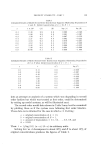
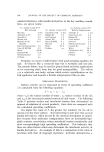
] 44 JOURNAL OF THE SOCIETY OF COSMETIC CHEMISTS mechanism appears to take place at temperatures at and below 100øC as compared to studies done between 100 and 150 øC. Similarly, Oote- ghem and Steiger (9) showed that the hydrolyric process in degrading aqueous procaine hydrochloride solutions is not the same at 20øC and above 80 øC, so that, e.g., a study done at 100 øC will not permit calcula- tion of the degradation rate at 20 øC. Finally, although the kinetic basis upon which stability studies rest is not absolutely unequivocal, we may still conclude that chemical ki- netics gives us a potentially useful tool. PLACEMENT The preceding section covered the basic structure of methods which use chemical kinetics to predict product stability. Central to predictive techniques is, of course, the necessity of placing samples at various ele- vated temperatures---or stressing them in some way such as exposing them to freeze-thaw cycles. Normally, storage temperatures have been chosen more or less arbitrarily, although the evolution of the choices has resulted in a very reasonable, useful, and workable system for most formulators. The purpose of this section is simply to call attention to the fact that there exist certain theoretical--and practical--reasons which have been used by some workers to develop particular systems of storage tempera- tures and assay schedules for stability studies. Examples which illus- trate this will now be cited. Tootill (10) based his suggestions of storage temperatures on a slope ratio experimental design. This is a statistical term for a certain experi- mental design which facilitates the application of statistical methods to the analysis of the results. This system is valuable when, of necessity, imprecise assay methods must be used. Here the aim is loose in the sense that the exact path of degradation is not determined, but rather statistics are used to estimate expiration dates. The design corrects the situation in which one obtains equivocal k values and Arrhenius plots due to a large number of unreplicated sampling times with a minimum num- ber of storage temperatures. Tootill's method requires six time-tem- perature combinations in addition to the initial assay. The tempera- tures of storage are chosen so that the reciprocal absolute temperature values are in arithmetical progression. This will cause, if the Arrhenius relationship holds, the slopes of the individual degradation lines to be in geometric progression this fact is expressed as the slope ratio. Fur-

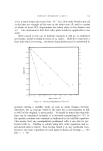
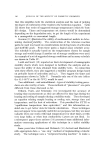
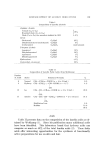
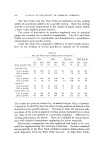
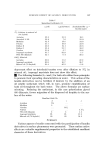
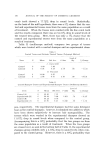
PRODUCT STABILITY--PART I Table Suggested Stability Storage Temperatures (Tootill) Series 145 1 2 3 4 øC øF øC øF øC øF øC øF 39 102 42 108 52 126 60 140 63 145 63 145 64.5 148 69 156 91 196 87 189 78 172 78.5 173 Table iV Suggested Stability Test Design (Kennon) Tc•nperature Assay or Sampling Times (Months) o C øF 1st 2nd 3rd 4th 60 146 1 3 4 .. 45 113 3 4 6 8 37 99 6 8 12 .. RT RT 8 12 18 24 Table V Suggested Stability Test Design (Lordi and Scott) Temperature Assay or Sampling Times (Months) ø C øF 1st 2nd 3rd 41.5 107 0.84 2 5 60 140 0.35 0.84 2 46 115 0.43 1.3 4 70 158 0.14 0.43 1.3 thermore, the time scales to get the same amount of breakdown at each temperature will also be in geometric progression in the opposite direc- tion from the temperatures (as the higher temperatures require less time). The times are set on the basis of an estimate of the slope ratio. Thus, one needs an estimate of the slope ratio to start the experiment. This may be obtained from literature data or from a preliminary study. The experimental design will then result in approximately the same amount of degradation at the times samples are withdrawn and assayed regard- less of temperature. The design calls for samples to be withdrawn at two times for each of three temperatures, with the second time being set for 50% decomposition. Tootill has shown that, following this arrangement, each individual degradation curve is estimated with approximately equal precision and
Purchased for the exclusive use of nofirst nolast (unknown)
From: SCC Media Library & Resource Center (library.scconline.org)