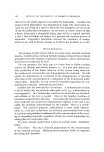
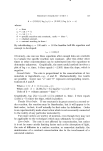
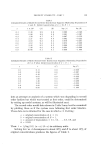
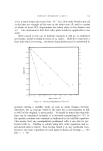
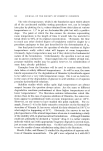
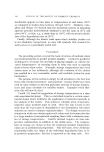
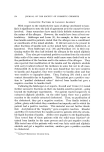
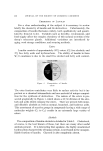
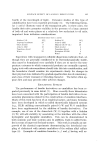
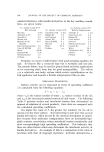
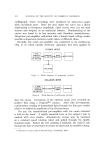
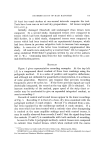
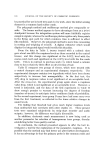
158 JOURNAL OF THE SOCIETY OF COSMETIC CHEMISTS CHEMISTRY OF LANOLIN For a clear understanding of the subject it is necessary to review briefly the chemistry of lanolin and its derivatives. Unfortunately, the composition of lanolin fluctuates widely, both qualitatively and quanti- tatively, from lot to lot. Variables such as heredity, environment, and food supply affect the complex chemistry of this natural secretion of the sheep's sebaceous glands. Additional variations are introduced by aging, wool storage conditions, and scouring methods. Esters Lanolin consists of approximately 95% esters, 4% free alcohols, and free fatty acids and hydrocarbons. The ability of lanolin to form W/O emulsions is due to the small free alcohol and fatty acid content. Figure 1. Composition of lanolin esters The ester fraction contributes very little to surface activity but is im- portant as a chemical intermediate and raw material of unique composi- tion for the synthesis of derivatives. The nature of the esters is pre- sented graphically in Figure 1, which shows a 50/50 division of the alco- hols and acids which compose the esters. There are present both mono- and dihydric alcohols as well as normal, branched, and hydroxy acids. This assortment of reactive groups in compounds having a wide range of molecular weights (Co to C3,) results in an extremely large variety of esters. Alcohols The composition of lanolin alcohols is detailed in Table I. Cholesterol, of course, is the best known of these, but there are many other useful alcohols present. It is interesting that squalene, the highly unsaturated hydrocarbon characteristic of human sebum, is not found in the unsapon- ifiable fraction of lanolin. Glycerol is also completely absent.

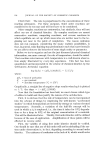
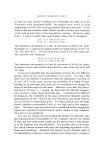
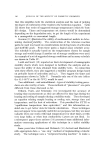
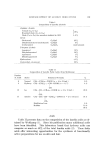
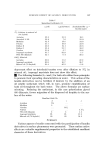
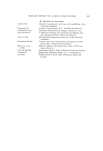
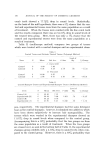
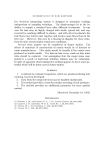
SURFACE EFFECT OF LANOLIN DERIVATIVES Table I Composition of Lanolin Alcohols 159 A liphatic AIcohols Normal (C•s to C.,•) Branched chain (C17 to C.,•) Diols (C1• to C.,4) five members isolated in 1951 Sterols Cholesterol C.,7H460 Dihydrocholesterol (cholestanol) C.,,H4sO Cerebrosterol C27H4702 Triterpene Alcohols Lanosterol C.•0H500 Dihydrolanosterol Ca0H520 Agnosterol C30H4sO Dihydroagnosterol Ca0H•00 Hydrocarbons -Unclassified--at present 18% 4-5% 25% 5% s•nall amount •o% lo% 1% 4% •% 20% Table II Composition of Lanolin Fatty Acids (from Weitkamp) Number of Acids Series Structural Formula 9 Normal 2 Hydroxy 10 Iso 11 Anteiso CH•--(CH,,),•n--COOH (n -- 4 to 12 incl.) 9.5 CH•--(CH2)•n-•--CH--COOH (n = 6, 7) 4.2 OH CH•--CH--(CH,•),•,•COOH (n = 3 to 11 incl.) 29.3 I CH3 CHa--CH2--CH--(CH,,)2n--COOH (n = 2 to 13 incl.) 37.3 I CH3 Distillation Loss 6.0 Residue 13.0 99.3 Acids Table II presents data on the composition of the lanolin acids as ob- tained by Weitkamp (1). Since his publication many additional acids have been identified. This laboratory found that hydroxy acids can comprise as much as 40% of the total lanolin acids (2). These fatty acids offer interesting opportunities for the synthesis of functionally active preparations for use on skin and hair.
Purchased for the exclusive use of nofirst nolast (unknown)
From: SCC Media Library & Resource Center (library.scconline.org)