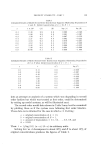
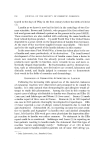
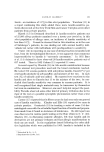
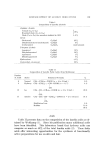
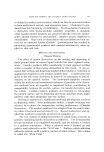
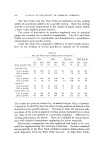
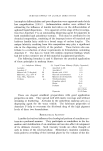
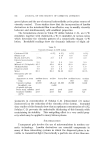
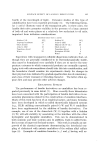
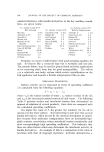
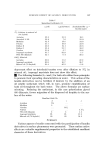
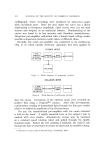
166 JOURNAL OF THE SOCIETY OF COSMETIC CHEMISTS sociated interfaces, with lanolin derivatives as the key auxiliary emulsi- tiers, are given below: (e) Anionic Lotion O/W (g) Nonionic Lotion O/W Hair Dressing (f) Cationic Lotion O/W Roll-On Antiperspirant Waxolan 5.0% Amerchol L-101 5.0% Amerlate P 1. $% Amerchol L-101 4.0 Solulan 98 2.0 Amerehol L-101 3.5 Amerlate P 3.0 Cetyl alcohol 1.0 Solulan 98 2.0 Stearic acid 2.0 Arlacel 165 4.0 Cetyl alcohol 2.0 Mineral oil (70 10.0 Emcol E-607S 0.1 Glycerol 2.0 Saybolt) Glycerol 2.0 Polyoxyl 40 stearate 4.0 Glyceryl monostearate 1.0 Water 85.9 Veegum HV 1.0 Ucon 50 HB 660 5.0 Perfume q.s. Water 38.0 Water 68.86 Chlorhydrol, 50% 36.0 Carbopol 941 0.15 Alcohol 10.0 Triethanolamine 1.0 Perfume q.s Perfume q.s. Formula e is a heavy bodied lotion with good grooming qualities for hair. It behaves like a cream-oil type but is washable and non-oily. The cationic lotion f may be used for general hand and body applications or for removing static from hair for good manageability. The roll-on g is a relatively non-tacky system which resists crystallization on the ball applicator and deposits a flexible antiperspirant film on skin. SPREADING PROPERTIES Surface activity can be expressed in terms of spreading coefficient (S) calculated from the following equation: S = ?B- 3•A- 3'A• where •B is the surface tension of water •A surface tension of the oil and %• is the interfacial tension between oil and water. The following Table V presents surface and interfacial tension data determined on mineral oil solutions of several products these data are compared with the calculated spreading coefficients. The higher the value of S, the greater the tendency for the oil to spread over the water surface. It is interesting to note here that several lanolin derivatives, which do not fit the classical description of emulsi- fiers because their molecular configurations show no hydrophilic-lipo- philic contrast, nevertheless reduce interfacial tension considerably and show correspondingly high spreading coefficients. This indicates that there are other factors which may determine the interfacial activity of lanolin derivatives. An example of this is a comparison of the value of Acetulan with that of isopropyl myristate: Acetulan demonstrates a

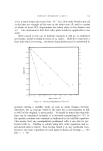
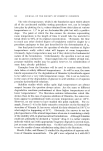
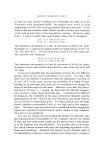
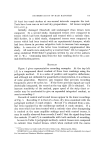
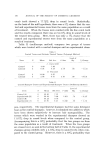
SURFACE EFFECT OF LANOLIN DERIVATIVES 167 Table V Spreading Coefficients (S) 7A(oil) -•AB(oil/water) S(calculated for 7B = 72.3 for water) 5% Solutions in mineral oil (70 Saybolt) Acetulan 32.0 21.2 19.1 Amerchol L-101 32.8 7.6 31.9 Modulan 32.5 15.0 24.8 Polylan 31.7 16.8 23.8 Ricilan B 32.6 19.1 20.6 Ricilan C 32.4 21.7 18.2 Viscolan 31.8 5.7 34.8 Isopropyl myristate 31.7 32.9 7.7 PEG 400 dilaurate 32.7 0.4 39.2 100% Materials Acetulan 32.9 17.2 22.2 Isopropyl myristate 30.9 16.7 24.7 Mineral oil (70 Saybolt) 32.4 45.3 -- 5.6 depressant effect on interfacial tension even after dilution to 5% in mineral oil isopropyl myristate does not show this effect. [•[ The following formulas (h, i and 1') for bath oils utilize these principles to promote their spreading characteristics on water. This action of the lanolin derivatives can be fortified, if desired, by the addition of an oil soluble surfactant which will, in turn, promote emulsification of bath oil throughout the bath water. The above formulas are surface orienting. Reducing the surfactant, in this case polyethylene glycol 400 dilaurate, favors migration of the dispersed oil droplets to the sur- face of the water. Emoilient Bath Oils h i j Acetulan 5% ...... Modulan 5 ...... Viscolan ... 10% ... Polylan ...... 3.5% PEG 400 dilaurate 5 5 4.5 Isopropyl myristate 25 25 37.5 Mineral oil (70 Saybolt) 60 60 54.5 SUMMARY Various aspects of studies concerned with the participation of lanolin derivatives in surface phenomena were presented. These surface active effects are valuable supplemental properties to the established emollient character of these derivatives.
Purchased for the exclusive use of nofirst nolast (unknown)
From: SCC Media Library & Resource Center (library.scconline.org)