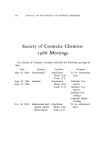
170 JOURNAL OF THE SOCIETY OF COSMETIC CHEMISTS Society of Cosmetic Chemists 966 Meetings The Society of Cosmetic Chemists will hold the following meetings in 1966: Date Meeting Location Program May 10, 1966 Semiannual Americana To be announced Hotel, New later York, N.Y. Sept. 20, 1966 Seminar Americana Pediatric Cos- Sept. 21, 1966 Hotel, New metics York, N.Y. Geriatric Cos- metics Perfume Psy- chology Cosmetic Safety Testing To be announced later Nov. 30, 1966 Semiannual and medal award dinner-dance Americana Hotel, New York, N.Y.

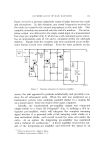
J. •o½. Cosmetic Chemists, 17, 171-179 (1966) Instrumental Method for the Determination of Hair Raspiness WILLIAM C. WAGGONER, Ph.D., and GEORGE V. SCOTT, Ph.D.* Presented December 1, 1965, New York City Synopsis--As comb teeth arrange hair fibers in a parallel manner and rub along hair scales, vibrational frequencies are emitted and play a role in the "feel" of hair. The audible fre- quencies, which denote raspincss, may be cosmetically undesirable. In an attempt to record and evaluate hair raspiness, an electronic comb, specifically designed to pick up frequencies by contact, was constructed. Several groups of hair tresses, which were treated with cos- metic chemicals, rinsed and dried, were combed with the instrument. Computer analysis of the data showed the expected differences between tresses and some differences reflected excellent probabilities of test reproducibility. The method lends itself to rapid laboratory screening of agents designed to reduce friction during combing. Hair raspiness, which is the property of a substance producing grating, harsh sounds and feel, is probably most noticeable during the combing process. As the comb moves through the hair and arranges it in a parallel manner, friction at the tooth-hair interface generates fre- quencies and conveys to the individual an impression of general hair condi- tion. It has been shown (1) that subjective judgments of handle and combing ease correlate very well with frictional measurements. A litera- ture survey (2) has revealed the existence of many fiber frictional meas- urement methods, some of which may be applied to human hair studies. Others (3, 4) have measured the spectral distribution of sound produced by fibers in friction. In an attempt to investigate characteristics of hair sound and feel as experienced by an individual during the combing process, an electronic * Colgate-Palmolive Co., Research and Development Dept., Piscataway, N. J. 08854. 171
Purchased for the exclusive use of nofirst nolast (unknown)
From: SCC Media Library & Resource Center (library.scconline.org)