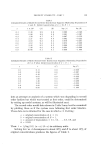
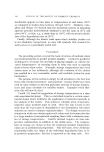
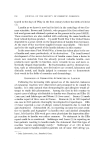
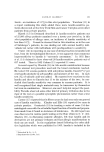
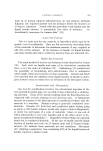
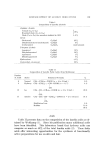
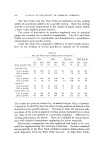
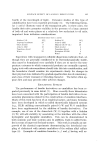
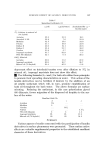
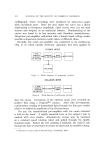
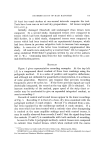
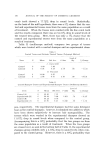
176 JOURNAL OF THE SOCIETY OF COSMETIC CHEMISTS comb teeth showed a 77.72% drop in sound levels. Statistically, on the basis of the null hypothesis, there was a 5% chance that the con- trol and experimental tresses were from the same population as a result of treatment. When the tresses were combed with the fine comb teeth and the results compared, there was an 84.31% drop in sound levds of the treated tress group. Here, there was only a 1% chance that the control and experimental tresses were from the same population as a result of treatment. Table I1 (oscilloscope method) compares two groups of tresses which were treated with a control shampoo and an experimental sham- Table I Control Tresses and Cationic-Treated Tresses (Polygraph Method) Level of Tress N Mean Std. der. t Value Sig. • Change A. Coarse teeth Control 3 4.09 1.98 ......... Cationic 3 0.91 0.24 3.70 .95 -77.72 B. Fine teeth Control 3 14.98 3.55 ......... Cationic 3 2.84 0.47 5.87 .99 --84.31 Table II Control Shampoo Tresses and Experimental Shampoo Tresses (Oscilloscope Method) Level of Tress N Mean Std. Der. t Value Sig. % Change Control (A) 6 40.81 7.21 ......... Experimental (B) 6 36.02 5.88 1.261 .70 --11.87 Control (B) 5 54.23 9.78 ......... Experimental (A) 6 51.67 4.27 0.545 .40 -- 4.73 poo, respectively. The experimental shampoo had the same detergent base as the control shampoo however, it contained two additives which have been shown subjectively to increase hair manageability. The tresses which were washed in the experimental shampoo showed an 11.87% drop in sound levels when compared to the control group. Accompanying this is a 30% probability that the two groups are from the same population as a result of treatment. When the tress groups are crossed over, as seen in the bottom half of Table II, the experimental shampoo group exhibits only a 4.73% drop in sound levels when com- pared to the control group. However, there is a 60% probability that

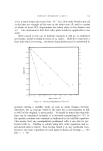
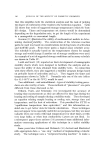
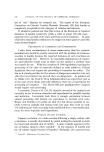
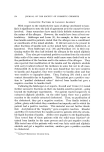
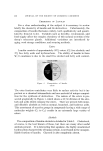
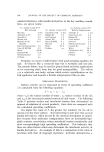
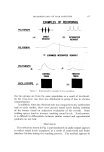
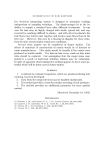
POLYGRAPH POLYGRAPH DETERMINATION OF HAIR RASPINESS EXAMPLES OF RECORDINGS (A) DIRECT (B) INTEGRATED REAOOUT REAOOUT 177 POLYGRAPH (C) EXPANOED INTEGRATED REAOOUT CONTROL TREATED TRESS TRESS OSCILLOSCOPE (F) (O) Figure ,5. Representative examples of tress recordings the two groups are from the same population as a result of treatment. In the cross-over, one tress was eliminated in group B due to obvious contamination. In addition, when dry bleached hair was compared to dry unbleached hair in early studies, there were greater sound levels during combing of the former based on subjective evaluation of the records. Some holding sprays tend to increase combing sound levels. Furthermore, it is difficult to differentiate between similar control and experimental products on wet hair. DISCUSSION The method as shown in Fig. 5 and monitored on audio output appears to reflect sound levels (raspiness) as a result of comb-tooth and frame interface friction during the combing process. The method appears to
Purchased for the exclusive use of nofirst nolast (unknown)
From: SCC Media Library & Resource Center (library.scconline.org)