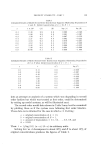
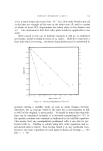
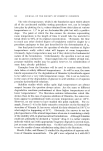
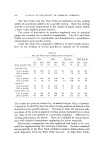
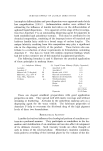
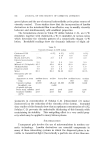
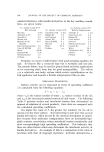
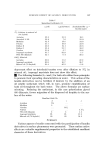
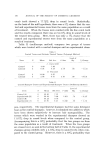
178 JOURNAL OF THE SOCIETY OF COSMETIC CHEMISTS be practical for use in both tress and in vivo work, since the initial sensing element is a common hard rubber comb. The polygraph method and oscilloscope method give comparable re- sults. The former method appears to have advantages from an a priori standpoint because the integration system will more faithfully register complete signals whereas the oscilloscope photos register only those points in the flying spot path for which residence time is sufficient to affect film emulsion. However, the polygraph method is more time consuming in cutting and weighing of records. A digital voltmeter which would display the integrated signal would rectify this situation. From the data in Table I, tresses treated with a cationic rinse gave about one-fifth the raspiness levels as those recorded in the control tresses and this change was significant at the 0.050/0 level with the coarse comb teeth and significant at the 0.01% level with the fine comb teeth. This is in contrast to previous work (1), which found a cationic rinse to have relatively little effect on dry friction of hair. Table II compares two groups of tresses, which were treated with a control shampoo and an experimental shampoo, respectively. The experimental shampoo contains two ingredients which have been shown subjectively to increase hair manageability. In the first test, the 12% drop in raspiness values is not significant at an acceptable level. After the cross-over, the experimental group again shows a raspiness value drop, which is not significant at an acceptable level. However, a trend is noticeable, and the data of the first experiment in Table II show enough promise to warrant increasing the degrees of freedom (numbers of tresses) to anticipate better confidence limits of probability. In the second experiment, tress group B may have had some carry-over from the first treatment, as reflected in the lower relative changes in sound levels. The finding that bleached hair gives much higher raspiness levels than unbleached hair correlates with other studies (1). These present tests were examined subjectively by strip-chart recorder and audio outputs however, the difference was highly discernible. In addition, electronic comb measurement is now being used as another parameter for selection of homogeneous tress groups, thereby establishing better tress quality control. In conclusion, the method presented appears to offer the hair in- vestigator a tool for the exploration of the parameter, raspiness. It is possible that the method may find better use after further development. It has an advantage in that the primary probe is the common comb and

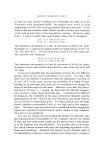
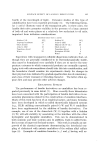
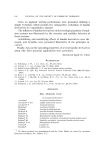
DETERMINATION OF HAIR RASPINESS 179 the electrical integrating system is designed to normalize readings independent of sampling technique. The disadvantages lie in the in- ability to sample a standard tress after different treatments. In one case the hair may be highly charged with static, spread out, and rep- resentative combings difficult to obtain and with other treatments the hair fibers may tend to mat together and involve more fibers than in the first case. However, this may be a blessing in disguise for these situa- tions do more closely depict actual user conditions. Several other aspects can be considered in future studies. The effects of materials of construction of combs would be of interest to comb manufacturers. This study would be feasible if the combs were produced in similar molds. The hair-on-hair versus comb-on-hair noise ratio should be explored. Our assumption that the major noise com- ponent is a result of tooth-hair interface friction may be vulnerable. In spite of apparent shortcomings the method appears to have some po- tential which will be borne out by future studies. SUMMARY 1. A method to evaluate frequencies, which are produced during hair combing, has been developed. 2. Data from the output devices may be handled statistically. 3. The method provides a basis for routine screening of hair products. 4. The method provides an additional parameter for tress quality control. (Received December 10, 1965) REFERENCES (1) Schwartz, A.M., and Knowles, D.C., J. Soc. Cosmetic Chemists, 14,455 (1963). (2) Langston, J. H., and Rainey, W. R. Jr., Textile Res. J., 24,643 (1954). (3) Thorsen, W. J., and Veneklasen, P., Ibid., 31,804 (1961). (4) Thorsen, W. J., Ibid., 32,670 (1962).
Purchased for the exclusive use of nofirst nolast (unknown)
From: SCC Media Library & Resource Center (library.scconline.org)