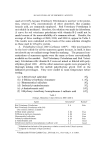
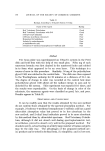
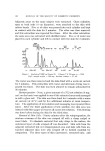
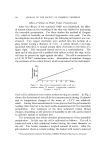
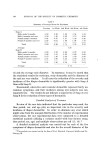
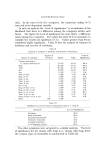
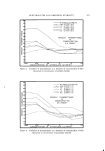
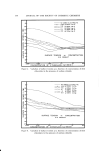
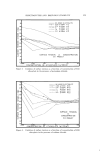
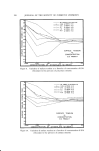
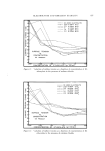
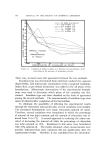
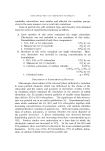
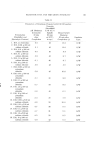
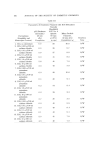
ELECTROLYTES AN[) EMULSION STABILITY 179 emulsifier interactions were similar and affected the emulsion param- eters in the same manner over several ratio variations. Data on particle size, pH, emulsion type, and viscosity were obtained from two series o[ experimental emulsions as follows: A. Each member of this series contained the single ethoxylate. Electrolyte was not included in any emulsions of this series. Formtllations consisted of only three components: 1. El5, El0, or E5 ethoxylate ..................... 10% by wt. 2. Mineral oil (65/75 Saybolt) ..................... 5% by wt. 3. Deionized water ............................... 85% by wt. B. Members of this series contained one single ethoxylate. How- ever, electrolyte was included in varying concentration in all formulations: 1. El5, El0, or E5 ethoxylate .................. 10% by wt. 2. Mineral oil (65/75 Saybolt) .................. 5% by wt. 3. Calcium, potassium, or sodium chloride ........ 0.001%, 0.01%, or 10.0% by wt. 4. Deionized water .............................. q.s 100% DISCUSSION O•' EXPERIMENTAL RESULTS Microscopic observations of the internal phase indicated a variation in mean particle diameter which was influenced by the choice of the ethoxylate and the nature and quantity of electrolyte (Tables I-liD. In emulsions which contained the ethoxylate in the absence of added electrolyte, the E5 product formed particles of smaller mean diameter than did the El5 or El0 ethoxylates. The significance of this observa- tion was pointed out in an earlier publication (6). Experimental emul- sions which contained the ES, El0, and El5 ethoxylates together with increasing concentrations of potassium, sodium, and calcium chlorides exhibited distinct variations in particle size. With increasing concentra- tions of sodium, potassium, or calcium chlorides the mean diameter of the particle decreased. A direct relationship was observed between diminishing particle size and increasing electrolyte concentration up to 10%. Further studies were undertaken at a later date in which the electrolyte content was increased to 29%. In the case of the El0 and El5 products, there was further reduction in the mean emulsion particle diameters. In the case of the E5 formulations, 2I)% of sodium, potas- sium, or calcium chloride increased the particle size.

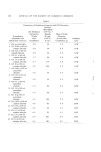
180 JOURNAL OF THE SOCIETY OF COSMETIC CHEMISTS Table I Formulation (Emulsifier and Electrolyte Content) Parameters o[ Emulsions Prepared with E5 Ethoxylate Viscosity (Brookfield pH (Beckman LVF No. 4 Zeromatic) Spindle Mean Particle 30 min 60 rpm Diameter, after at 25øC 30 min after Completion in cps) Completion (u) E•nulsion Type 1. E5, no electrolyte 5.8 50 4.3 O/W 2. E5, 0.001 g/100 ml sodium chloride 5.8 50 4.3 O./W 3. E5, 0.01 g/100 ml sodiur• chloride 5.8 55 4.2 O/W 4. E5, 0.1 g/100 ml sodium chloride 5.7 60 3.8 O/W 5. E5, 1.0 g/100 ml sodium chloride 5.7 170 2.9 O/W 6. E5, 10 g/100 ml sodium chloride 5.6 300 2.0 O/W 7. E5, 0.001 g/100 ml potassium chloride 5.9 50 4.0 O/W 8. E'5, 0.01 g/100 ml potassium chloride 5.6 45 3.5 O/W 9. E5, 0.1 g/100 ml potassium chloride 5.5 60 3.3 O/W 10. ES, 1.0 g/100 ml potassium chloride 5.4 55 2.7 O/W 11. ES, 10 g/100 ml potassium chloride 5.3 100 2.0 O/W 12. ES, 0.001 g/100 ml calcium chloride 4.4 50 4.5 O/W 13. E5, 0.01 g/100 ml calcium chloride 4.4 ,55 4.4 O/W 14. E5, 0.1 g/100 ml calcium chloride 4.3 70 4.1 O/W 1,5. ES, 1.0 g/100 ml calcium chloride 3.8 100 3.9 O/W 16. E5, 10 g/100 ml calcium chloride 3.5 150 3.0 O/W
Purchased for the exclusive use of nofirst nolast (unknown)
From: SCC Media Library & Resource Center (library.scconline.org)